Demographics of Mcculloch County
Affluence Level in Mcculloch County
A below-average socioeconomic profile. Incomes, home values, and educational attainment trail the U.S., with higher poverty and unemployment.
People of Mcculloch County
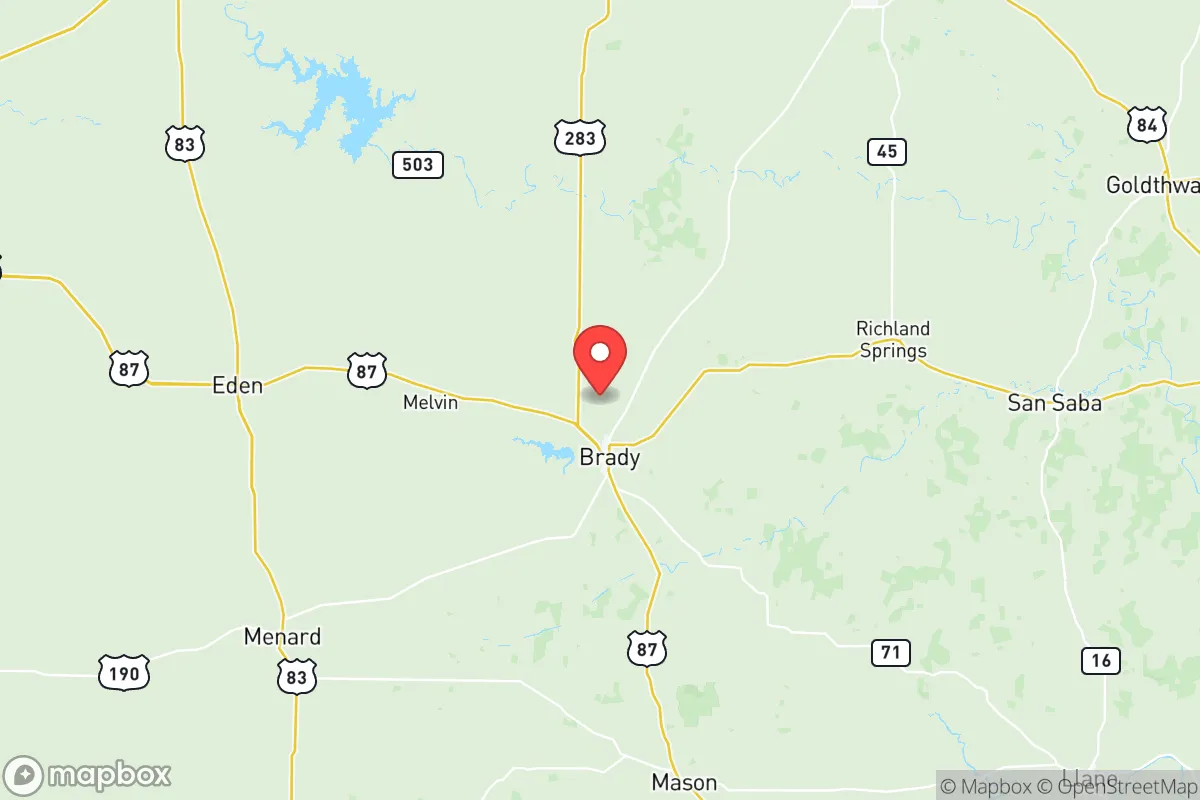
Today, McCulloch County, Texas, is home to 7,565 residents, a population that reflects its deep rural West Texas roots. The county is predominantly White (63.6%) with a substantial Hispanic community (30.7%), creating a cultural blend shaped by generations of ranching, farming, and small-town life. Its population is older and less diverse than the state average, with only 4.4% foreign-born and a low 19.6% college attainment rate, giving the county a distinctly traditional, working-class character centered on the county seat of Brady and smaller communities like Melvin, Rochelle, and Lohn.
Settlement & growth (pre-1960)
Before Anglo-American settlement, the area now known as McCulloch County was part of the traditional territory of the Lipan Apache and, later, the Comanche, who dominated the region through the 18th and early 19th centuries. Spanish expeditions passed through but established no permanent settlements; the land remained a sparsely populated frontier buffer zone between Spanish Texas and the Comanchería. No French or Mexican colonization occurred within the county's boundaries.
Anglo-American settlement began in earnest after Texas statehood in 1845 and the subsequent defeat of the Comanche in the 1870s. The first permanent settlers were primarily Anglo-American cattle ranchers from the southern United States—Tennessee, Alabama, and Mississippi—who arrived in the 1850s and 1860s, drawn by the open grasslands and the promise of cheap land for cattle grazing. The town of Brady, founded in 1876 as the county seat, became the commercial hub for these ranching families. A smaller wave of German and Czech immigrants trickled in during the 1880s and 1890s, settling near Melvin and Rochelle, where they established farms and small businesses, though they never formed the dense ethnic enclaves seen in the Texas Hill Country to the east.
The arrival of the Santa Fe Railroad in Brady in 1890 accelerated growth, bringing merchants, tradesmen, and a few African American families who worked as laborers and domestic servants. By 1900, the county's population had reached roughly 4,000, overwhelmingly Anglo-American with a small Black minority. The early 20th century saw the rise of cotton farming, which attracted Mexican migrant laborers during the 1910s and 1920s, many of whom settled permanently in Brady's west side, forming the foundation of today's Hispanic community. The Dust Bowl of the 1930s hit the county hard, driving out some Anglo farmers but also bringing a small number of Okies from the Texas Panhandle and Oklahoma. The post-World War II era saw modest growth as returning veterans took up ranching and farming, but the county never experienced a boom; its population peaked at around 8,000 in the 1950s and has since declined slowly.
Modern era (post-1965)
The 1965 Hart-Cellar Act had a minimal direct impact on McCulloch County, as the region did not attract significant new international immigration. The foreign-born population today stands at just 4.4%, almost entirely composed of Mexican-born residents who arrived in the 1970s and 1980s to work in ranching, construction, and the local pecan industry. These families settled primarily in Brady, with smaller concentrations in Lohn and Voca, and have steadily increased the Hispanic share of the population from roughly 15% in 1970 to 30.7% today. No significant East/Southeast Asian, Indian, or Arab communities formed; the county's Asian population is 0.2% and Indian population 0.3%, likely individuals employed in healthcare or education.
Domestic migration has been the dominant demographic force since 1965, but it has been a net outflow rather than an inflow. Young adults have left for college and jobs in larger Texas cities—San Angelo, Austin, and Dallas-Fort Worth—while retirees have largely stayed put or moved to Brady for its low cost of living. The county's Black population has dwindled from a peak of around 5% in 1920 to just 0.8% today, as younger African Americans left for urban opportunities. Suburbanization has not occurred; the county remains rural, with no new subdivisions or master-planned communities. The population has declined from 8,205 in 2000 to 7,565 in 2024, a loss of roughly 8%.
The future
McCulloch County is likely to continue its slow population decline over the next 10–20 years, with the Hispanic share gradually increasing as Anglo residents age and younger Anglo families leave. The county's low college attainment rate (19.6%) and limited job base—primarily ranching, farming, and a small healthcare sector centered on Brady's Heart of Texas Healthcare System—will continue to push educated young adults outward. The Hispanic population, which is younger on average, will become a larger share of the remaining residents, potentially reaching 35–40% by 2040. No new immigrant groups are expected to arrive in significant numbers, as the county lacks the industrial or service-sector jobs that attract foreign-born populations. The small communities of Pear Valley and Salt Gap may see further depopulation, while Brady will remain the county's anchor, albeit with a grayer and more Hispanic character.
For someone moving in now, McCulloch County offers a quiet, affordable, and deeply traditional rural lifestyle, but it is a place where population decline and an aging demographic are the defining trends. The county is becoming more Hispanic but not more diverse in a broader sense, and its cultural identity remains rooted in ranching, hunting, and conservative values. New residents should expect a close-knit community where change comes slowly and where the future is likely to look much like the present, only smaller.

* Values derived from national, state, county, city and local statistics and may differ in a specific area. Last updated: 2026-07-27T22:12:38.000Z
Narrative content on this page is AI-generated and may contain mistakes. Verify any details that matter before acting on them.
ReloMaps may earn a commission from affiliate links at no extra cost to you.

