Personal Sovereignty in Mcculloch County
Strong independent fundamentals that actively favor personal liberty and low regulation.
What does Personal Sovereignty tell us?
Personal Sovereignty measures your capacity for self-reliance and independence with minimal government friction. Higher scores mean fewer barriers between you and the way you want to live... but it assumes you have the space you need and good neighbors.
What does this tell us?
Personal Sovereignty measures your capacity for self-reliance and independence with minimal government friction. Higher scores mean fewer barriers between you and the way you want to live... but it assumes you have the space you need and good neighbors.
State Policy
Energy independence: Net exporter (220% of energy produced in-state)
Personal Liberty
Homesteading

Personal Liberty Analysis
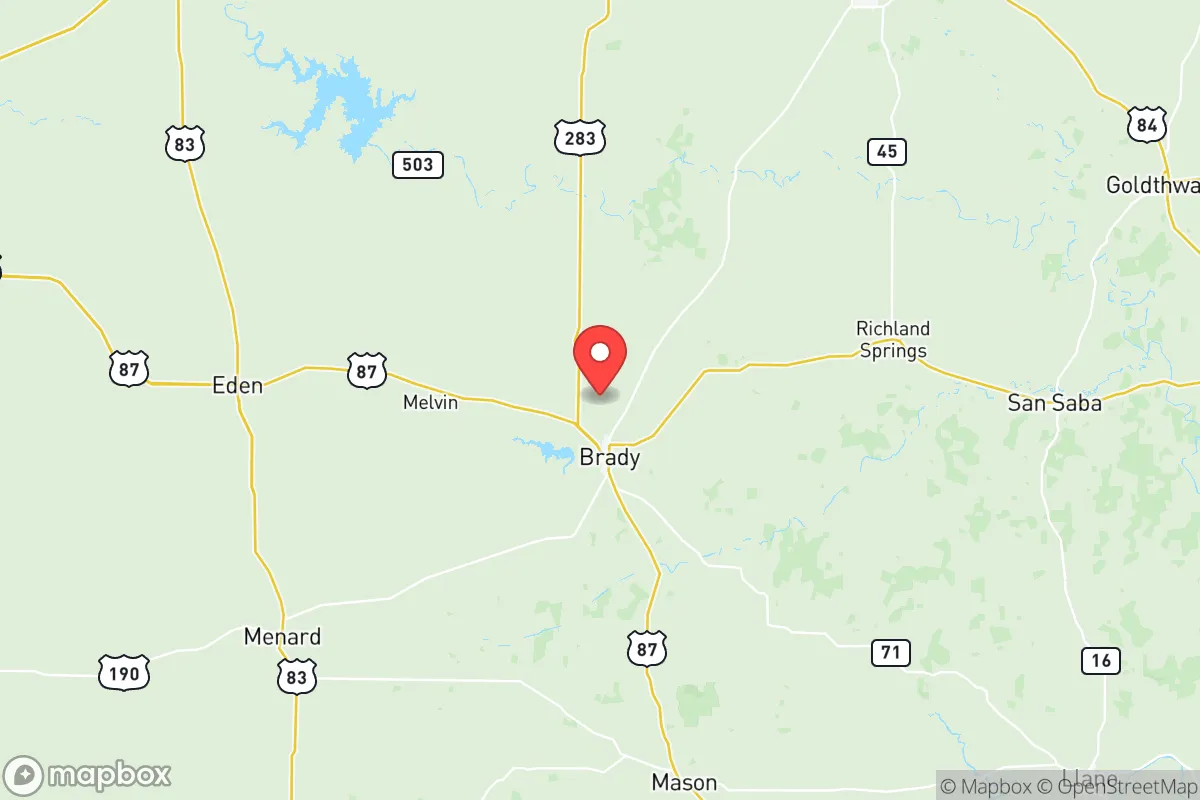
McCulloch County, anchored by the seat of Brady and stretching across the rolling plains of Central Texas, offers a personal sovereignty environment that is markedly more permissive than what residents would find in the state's major metropolitan hubs. The county's political and cultural fabric is woven from a deep-seated preference for minimal government interference, a stance reflected in local governance, law enforcement priorities, and land-use policies. For individuals and families prioritizing autonomy, the area presents a landscape where self-reliance is not just tolerated but expected, with the regulatory touch being notably light compared to jurisdictions like Travis or Bexar counties.
Tax burden and regulatory posture in Brady and surrounding communities
The overall tax burden in McCulloch County is a significant draw for those seeking to maximize personal financial sovereignty. The county's property tax rate is set by local taxing entities, including the county itself, the Brady Independent School District, and the city of Brady, but it remains substantially lower than rates found in the urban cores of Texas. There is no county-level income tax, aligning with the state's constitutional prohibition. The regulatory posture of the county government is characterized by a hands-off approach; there are no county-wide zoning ordinances that dictate land use outside of municipal limits, which is a critical distinction for property owners. In the unincorporated areas surrounding towns like Melvin and Rochelle, residents face far fewer bureaucratic hurdles for building, fencing, or operating a small business from their property than they would in a city with a robust planning department. The city of Brady does maintain some municipal codes, but they are generally focused on basic safety and sanitation rather than aesthetic or lifestyle mandates, preserving a high degree of personal discretion for property owners.
Self-defense and gun law specifics in McCulloch County
For the sovereignty-minded individual, McCulloch County's alignment with Texas's expansive firearm laws is a cornerstone of personal security. The county is situated in a region where the Second Amendment is treated as a fundamental, non-negotiable right. Local law enforcement in Brady and the sheriff's office for the county are known for a permissive interpretation of state statutes regarding open carry and licensed concealed carry. The county is a "Second Amendment Sanctuary" in practice, if not always by formal resolution, meaning local officials are not inclined to enforce any future state or federal restrictions they deem unconstitutional. Gun ownership is the norm rather than the exception, and the culture around firearms is one of practical utility for hunting, ranching, and self-defense. For residents in more remote areas like Lohn or Placid, discharging a firearm on private property is a routine and accepted activity, provided it is done safely and within state law. The absence of local ordinances that restrict magazine capacity or specific firearm types means that state law is the ceiling, not the floor, for gun rights in the county.
Self-reliance and homesteading viability across the county
McCulloch County's land-use policies create a highly favorable environment for homesteading and off-grid living, particularly when compared to the restrictive covenants found in suburban subdivisions. In the unincorporated areas, there are no county-level building codes that mandate specific construction methods, allowing for the use of alternative building materials like earthbags, straw bale, or shipping containers. Lot sizes vary widely, but agricultural and rural residential parcels of 5 to 50 acres are common and affordable, especially near Milburn and Pear Valley. Off-grid utilities are entirely feasible; rainwater catchment systems are a standard water source for many rural properties, and solar panel installations face no permitting hurdles from the county. The county's zoning is virtually non-existent outside of Brady's city limits, meaning residents can keep livestock, including chickens, goats, and cattle, without special permits. The local extension office through Texas A&M AgriLife provides support for soil testing and agricultural practices, but the decision to pursue a self-sufficient lifestyle is left entirely to the landowner. This regulatory vacuum is a deliberate feature of the local governance philosophy, which views property rights as paramount.
Personal liberties in daily life: parental rights, medical autonomy, and property
Personal liberties in McCulloch County extend beyond firearms and taxes into the realms of family and healthcare decisions. The local culture strongly supports parental rights in education and medical choices, with the school district in Brady generally deferring to parents on matters of curriculum and student welfare. There is a palpable resistance to state or federal overreach into local schools, a sentiment shared by many families in the county. Regarding medical autonomy, the area's distance from large hospital systems in San Angelo or Austin means that individuals often take a more active role in their own health management, and there is a community acceptance of alternative or holistic health practices. Property rights are fiercely protected; the county's appraisal district is known for being accessible to landowners who wish to protest their valuations, and the legal climate favors the property owner in disputes over easements or boundary lines. The freedom to speak one's mind on political or social issues is exercised openly in public forums and local gatherings, with little fear of social or professional reprisal, reinforcing a community standard of robust, unfiltered discourse.
In the broader context of Texas and the nation, McCulloch County represents a stronghold of personal sovereignty. While it lacks the economic opportunities and amenities of a major city, it compensates with a level of personal freedom that is increasingly rare. For the individual or family whose primary priority is living life on their own terms—with minimal taxation, maximal gun rights, the ability to build and live as they see fit, and a community that values personal responsibility—the county offers a compelling and authentic option. Compared to the heavily regulated environments of the Texas Hill Country's tourist towns or the suburban sprawl of the Dallas-Fort Worth metroplex, McCulloch County provides a tangible, lived experience of autonomy that is both its greatest asset and its defining characteristic.

* Values derived from national, state, county, city and local statistics and may differ in a specific area. Last updated: 2026-07-27T22:12:38.000Z
Narrative content on this page is AI-generated and may contain mistakes. Verify any details that matter before acting on them.
ReloMaps may earn a commission from affiliate links at no extra cost to you.

