
Photo by Zoshua Colah on Unsplash
Political ClimatePolitical Climate in Ridgewood, NY
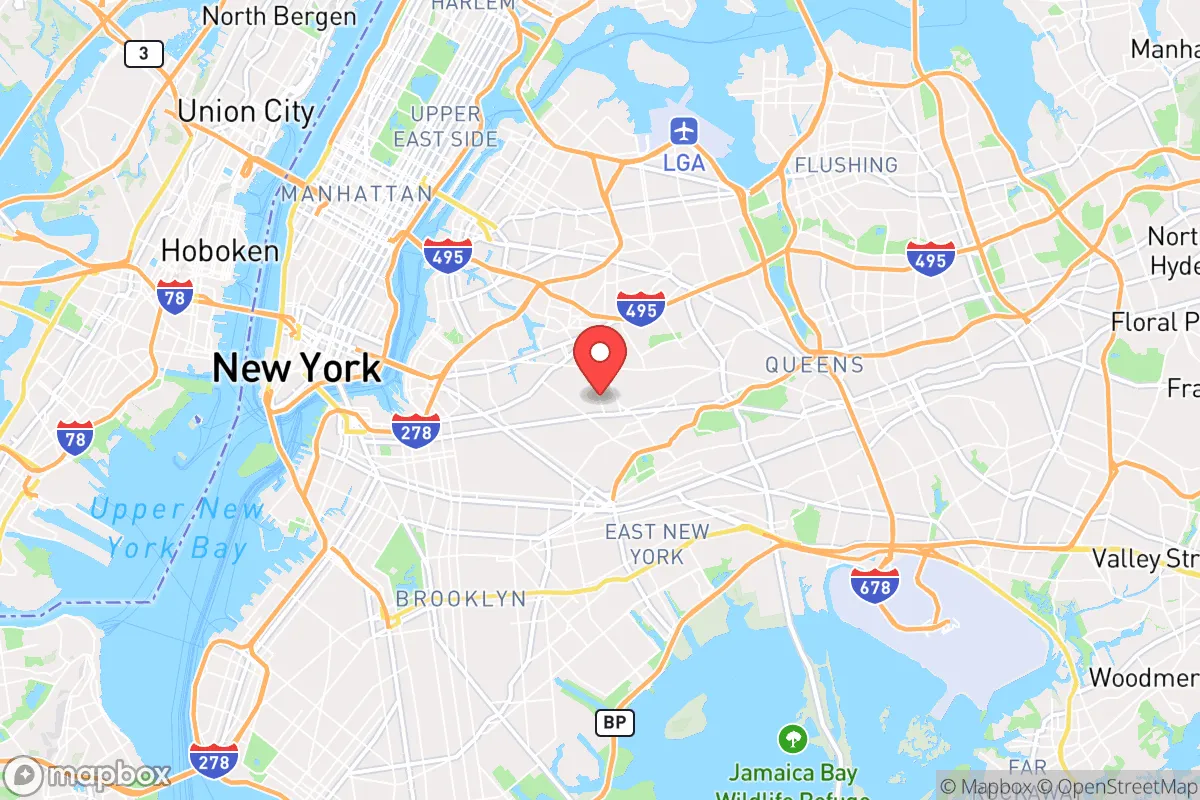
District shown is the primary district for this city’s centroid. Cities may span multiple districts.
Local Political AnalysisPolitical Analysis of Ridgewood, NY
Ridgewood, New York, is a solidly Democratic stronghold, with a Cook Partisan Voting Index (PVI) of D+25, making it one of the most reliably blue neighborhoods in an already blue city. This isn't a recent shift—the area has been a working-class, immigrant-heavy enclave for decades, and its politics have long reflected the priorities of its diverse, union-friendly, and socially liberal base. The trajectory here is one of deepening Democratic alignment, driven by an influx of younger, more progressive residents and a growing Asian and Latinx population that tends to vote heavily Democratic. You won't find much political swing in Ridgewood; it's a place where local elections are often decided in the primary, not the general.
How it compares
Compared to New York City as a whole, Ridgewood is actually more Democratic than the city average. While NYC's overall PVI is around D+25 to D+30, Ridgewood's D+25 puts it in the same ballpark as deep-blue neighborhoods like Jackson Heights or parts of Park Slope. The real contrast is with nearby areas just outside the city. Head a few miles west into Glendale or Middle Village, and you'll find neighborhoods that are still Democratic but with a much stronger conservative, law-and-order streak—places where voters are more likely to cross over for Republican candidates in local races. Even closer, Bushwick to the north is similarly liberal but has a younger, more activist edge, while Maspeth to the east leans more moderate and union-focused. Ridgewood sits in a kind of political sweet spot: it's not as aggressively progressive as Williamsburg, but it's far from the swing-voter territory of Staten Island or parts of Queens' eastern end.
What this means for residents
For liberal residents, Ridgewood is a comfortable place where your views on social issues, public transit, and housing policy are the local norm. You'll find strong support for rent stabilization, public schools, and immigrant rights baked into the local political conversation. For conservative residents, life here means being a clear minority—your vote in a local election won't change the outcome, but you're not isolated. You'll find like-minded neighbors in the older Polish and Italian communities, and the local civic associations often take a more pragmatic, less ideological stance on issues like zoning and public safety. Practically, this means property taxes are high but services are robust, and the local political machine—still influenced by the Queens Democratic Party—tends to reward loyalty and community involvement over ideological purity. If you're a Republican, you're not going to change the neighborhood's politics, but you can still have a real voice in block-level issues like street cleaning or park maintenance.
Culturally, Ridgewood's political climate translates into a few distinct policy distinctions. The neighborhood has been a battleground over upzoning and affordable housing, with progressive groups pushing for more density and older residents wary of change. You'll also see a strong emphasis on local small business protections—the area fought hard to keep chain stores out of the main commercial strips. The police presence is a point of tension: calls for defunding are louder in Ridgewood than in nearby Maspeth, but the local precinct still gets solid support from many longtime homeowners. In the long term, expect Ridgewood to stay deeply blue, but with an increasingly vocal progressive wing that will keep pushing on housing, transit, and climate policy. The old-school machine politics aren't dead yet, but they're on notice.

State Political ClimatePolitical Climate in New York
State Political AnalysisPolitical Environment in the State
New York State is a solidly Democratic stronghold, but its reputation as a monolithic blue bastion hides one of the most dramatic urban-rural political chasms in the country. Over the last 20 years, the state has shifted leftward at the state level, driven by the massive population and electoral weight of New York City and its inner suburbs, while vast swaths of Upstate New York have swung hard in the opposite direction. In 2024, Kamala Harris carried the state by roughly 12 points, down from Joe Biden’s 23-point margin in 2020, reflecting a national trend of Democratic erosion in working-class areas, but the state legislature remains overwhelmingly Democratic and has enacted some of the nation’s most progressive policies.
Urban vs. rural divide
The political map of New York is a tale of two states. New York City’s five boroughs — Manhattan, Brooklyn, Queens, The Bronx, and Staten Island — deliver roughly 40% of the state’s total vote, and they vote overwhelmingly Democratic. Manhattan and Brooklyn routinely give Democrats 80-85% of the vote. The inner-ring suburbs of Nassau County and Westchester County are also reliably blue, though with more moderate margins. The real action is Upstate. Erie County (Buffalo) and Monroe County (Rochester) are Democratic-leaning due to their urban cores, but the surrounding rural counties — Allegany, Steuben, Chenango, Lewis — have become deeply Republican, often voting 65-70% for Trump. The Capital Region around Albany is a purple battleground, with the city itself blue and the surrounding suburbs and exurbs trending red. Suffolk County on Long Island has been a bellwether: it voted for Obama twice, then flipped to Trump in 2016 and 2020, and backed Harris by only a few points in 2024. The Hudson Valley counties north of Westchester — Dutchess, Ulster, Orange — are a mix, with Ulster solidly blue and Orange trending red as New York City transplants move in. The North Country (Plattsburgh, Watertown) and the Southern Tier (Binghamton, Elmira) are now reliably Republican outside of a few college towns.
Policy environment
New York’s policy environment is among the most progressive in the nation, and it directly affects daily life. The state has a progressive income tax with rates from 4% to 10.9% on income over $25 million, and a state sales tax of 4% (localities add their own, often totaling 8-9%). Property taxes are among the highest in the country, especially in Upstate and suburban school districts. The state has a universal background check law for gun purchases, a red flag law, and a ban on assault weapons and high-capacity magazines. In 2022, the state passed the Concealed Carry Improvement Act (CCIA), which made it a felony to carry a firearm in “sensitive locations” like Times Square, subways, and parks — a law that has been partially blocked by federal courts but remains largely in effect. Education is highly decentralized, with strong local control over curriculum, but the state mandates universal pre-K and has a free school lunch program for all students. Healthcare is regulated tightly: the state has a public option for health insurance and a single-payer bill (the New York Health Act) that has passed the Assembly multiple times but stalled in the Senate. Election laws are among the most accessible: no-excuse absentee voting, early voting (10 days), and automatic voter registration at the DMV. The state also has a sanctuary city policy that limits cooperation between local law enforcement and federal immigration authorities.
Recent policy direction
The last five years have seen a sharp leftward turn on several fronts. In 2019, the state passed the Reproductive Health Act, codifying Roe v. Wade protections into state law and allowing nurse practitioners to perform abortions. In 2021, it legalized recreational marijuana for adults 21 and over, with a heavy emphasis on social equity licenses. The Clean Slate Act (2023) automatically seals most criminal records after a set period. On the property rights front, the state’s rent stabilization laws were tightened in 2019, limiting how much landlords can raise rent and making it harder to evict tenants — a boon for renters but a burden for small landlords. The Housing Compact proposed in 2023 would have forced suburbs to allow more density near transit, but it failed in the legislature due to suburban opposition. On parental rights, the state has moved in the opposite direction of many red states: it passed a law in 2022 prohibiting school districts from banning books, and it has a Gender Expression Non-Discrimination Act (GENDA) that protects transgender students. The state also passed a digital fairness law in 2024 that restricts how platforms can collect and use personal data. On gun rights, the CCIA has been a flashpoint, with lawsuits ongoing and a Supreme Court case (Antonyuk v. Chiumento) that could reshape the law. The state also passed a ban on ghost guns and raised the minimum age to buy a semi-automatic rifle to 21.
Civil unrest & political movements
New York has a long history of political activism, and recent years have been no exception. The Black Lives Matter protests in summer 2020 were massive, especially in New York City, where tens of thousands marched daily for weeks. The state responded with the Eric Garner Anti-Chokehold Act (2020), which made it a felony for police to use chokeholds, and the Police Reform and Reinvention Collaborative, which required every local police department to develop a reform plan. On the right, the Second Amendment movement is strong in Upstate counties, with groups like New York State Rifle & Pistol Association organizing rallies and lawsuits. The anti-vaccine mandate protests of 2021-2022 were concentrated in places like Albany and Buffalo, where healthcare workers and state employees rallied against the state’s vaccine requirement. Immigration politics are a constant flashpoint: New York City’s sanctuary city status has been tested by the arrival of over 100,000 asylum seekers since 2022, straining shelters and schools. Mayor Eric Adams has clashed with the state over funding and policy. There have been secession movements in parts of Upstate — the most notable being the New York State of Mind proposal to split the state into two, but it has never gained serious legislative traction. Election integrity has been a minor issue: the state’s universal mail-in voting expansion in 2020 was challenged in court but upheld, and there have been isolated cases of fraud, but nothing systemic.
Projection
Over the next 5-10 years, New York’s political trajectory is likely to be one of continued polarization. The Democratic majority in the legislature will likely hold, but the margin may shrink as Upstate continues to bleed population and the suburbs drift rightward. The state’s high cost of living and tax burden are driving out-migration, especially among families with children and retirees, who tend to vote more conservatively. The in-migration is largely from international immigrants and young professionals moving to New York City, who lean heavily Democratic. This demographic churn means the state will remain blue, but the geographic divide will deepen: expect rural counties to become even more Republican and the five boroughs to become even more Democratic. The Housing Compact or something like it will likely pass eventually, forcing suburban towns to build more apartments near train stations, which could shift the political balance in those areas. On gun rights, the CCIA will probably be narrowed by the courts, but the state will continue to push for stricter laws. The sanctuary policy will remain a flashpoint, especially if the federal government under a future administration tries to cut funding. The climate law (the Climate Leadership and Community Protection Act) will drive a rapid transition to renewable energy, which will create economic winners and losers — expect fights over wind and solar farms in rural areas.
For a new resident, the bottom line is this: if you lean conservative, you will find plenty of like-minded neighbors in Upstate counties, but you will be voting in a state where your vote for president and Senate is effectively meaningless. Your state taxes will be high, your gun rights will be restricted, and your local school board may be at odds with state mandates. If you lean liberal, you will find a state that largely aligns with your values on social issues, healthcare, and the environment, but you will pay for it in taxes and cost of living. Either way, New York is a state of stark contrasts — you can live in a deep-red rural town and drive an hour to a deep-blue city. The key is picking the right county for your priorities.
* Values derived from national, state, county, city and local statistics and may differ in a specific area. Last updated: 2026-10-01T11:40:57.000Z
Narrative content on this page is AI-generated and may contain mistakes. Verify any details that matter before acting on them.
ReloMaps may earn a commission from affiliate links at no extra cost to you.

