
Photo by Zoshua Colah on Unsplash
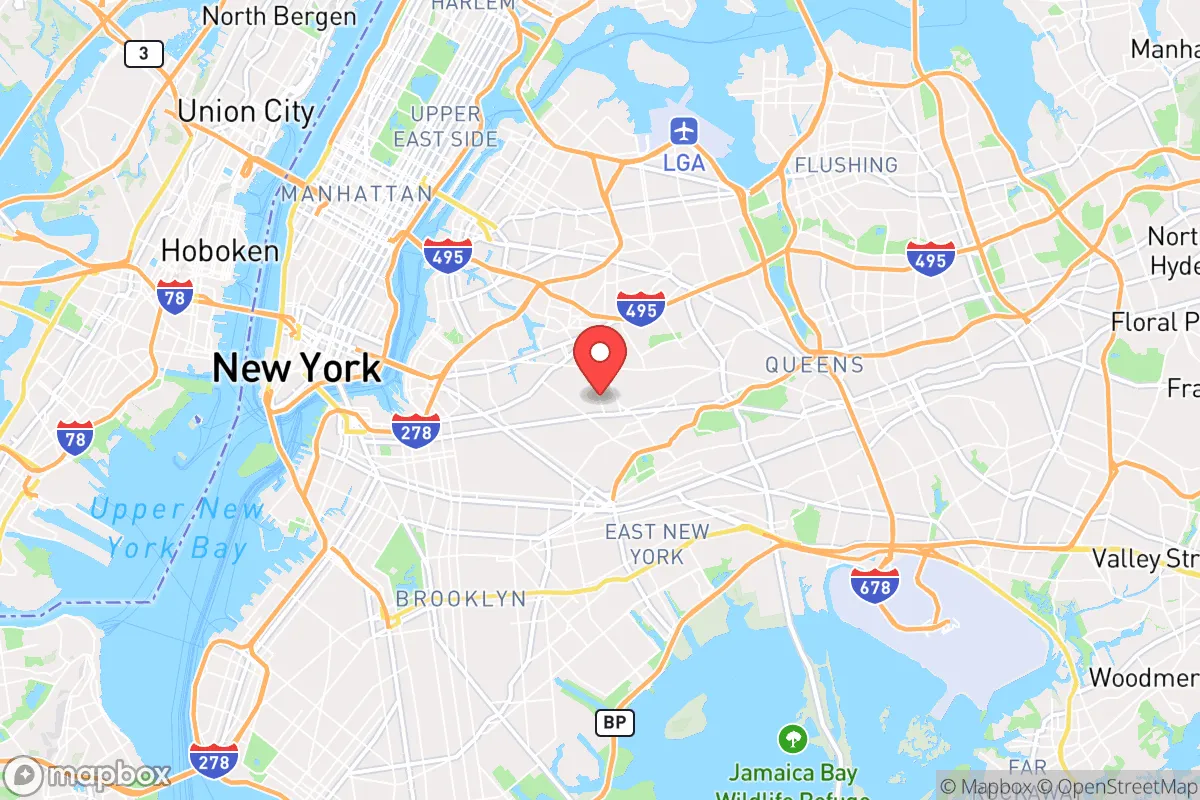
Personal Sovereignty in Ridgewood, NY
Moderate friction. Expect trade-offs in some aspect of personal liberty and independence.
What does Personal Sovereignty tell us?
Personal Sovereignty measures your capacity for self-reliance and independence with minimal government friction. Higher scores mean fewer barriers between you and the way you want to live... but it assumes you have the space you need and good neighbors.
What does this tell us?
Personal Sovereignty measures your capacity for self-reliance and independence with minimal government friction. Higher scores mean fewer barriers between you and the way you want to live... but it assumes you have the space you need and good neighbors.
State Policy
Energy independence: Importer (12% of energy produced in-state)
Personal Liberty
Homesteading

Personal Liberty Analysis
Ridgewood, New York, presents a complex and often restrictive environment for personal sovereignty, where the dense urban fabric of Queens is layered with New York State’s heavy regulatory and tax apparatus. For a reader prioritizing autonomy, the area offers strong property rights and a vibrant community of self-reliant small business owners, but these are counterbalanced by some of the nation’s highest taxes, stringent gun laws, and limited space for homesteading. The overall autonomy environment is best described as one of constrained independence—where personal freedom is exercised through community networks and legal savvy rather than through physical self-sufficiency or low government overhead.
Tax burden and regulatory posture: what you pay and what you can do
New York State imposes one of the heaviest tax burdens in the country, and Ridgewood residents feel this acutely. The combined state and local income tax rate can reach nearly 12% for top earners, while property taxes in Queens are among the highest in the nation, averaging roughly $5,000 to $7,000 annually for a typical two-family home. The regulatory posture is similarly heavy-handed: New York City’s zoning code is notoriously complex, and the city’s Department of Buildings requires permits for nearly any structural change, from a new fence to a basement renovation. Small business owners in Ridgewood face a thicket of licensing requirements, from the city’s strict food vendor permits to the state’s Scaffold Law, which imposes absolute liability on property owners for construction injuries. This regulatory density means that starting a home-based business or making even modest property improvements requires significant paperwork and often legal counsel. For a reader accustomed to lighter-touch environments, the message is clear: you can operate, but you must navigate a bureaucratic maze.
Self-defense and gun law specifics: what you can and cannot carry
New York State’s gun laws are among the most restrictive in the nation, and Ridgewood residents must comply with both state and city regulations. The New York SAFE Act requires a license for all handgun possession, and the process to obtain one in Queens is lengthy, often taking six months or more, and requires a "proper cause" showing that goes beyond general self-defense. The state’s 2022 Concealed Carry Improvement Act further restricted where licensed carriers can bring firearms, banning them from "sensitive locations" including parks, public transit, and most businesses unless the owner explicitly posts a sign allowing them. In practice, this means carrying a firearm for self-defense in Ridgewood is legally difficult and practically limited. Long guns are less restricted, but New York City requires a separate permit for rifles and shotguns, and the city bans certain features like adjustable stocks and flash suppressors. For a reader who prioritizes the right to self-defense, Ridgewood represents a highly constrained environment where legal compliance is expensive and time-consuming, and where the ability to carry a firearm in daily life is sharply curtailed.
Self-reliance and homesteading viability: lot sizes, zoning, and off-grid feasibility
Ridgewood’s dense urban character makes traditional homesteading nearly impossible. The typical lot size is 20 feet by 100 feet, with many homes built as attached row houses or two-family dwellings. Zoning is predominantly R6 and R7, which allows for multi-family buildings but prohibits agricultural uses, livestock, or any significant outdoor food production beyond a small vegetable garden. Off-grid living is not feasible: the area is fully connected to city water, sewer, and electrical grids, and New York City building codes require connection to these systems. Rainwater harvesting is technically allowed but heavily regulated, and composting toilets are not permitted for primary residences. However, self-reliance in Ridgewood takes a different form: the neighborhood is known for its strong community networks, with many residents running home-based businesses, bartering services, and participating in local food co-ops. The Ridgewood Bushwick Senior Citizens Council and other local organizations support mutual aid efforts, and the area’s many small hardware stores and bodegas mean that basic supplies are always within walking distance. For a reader seeking physical self-sufficiency, Ridgewood is a poor fit; for someone who values community-based resilience and urban independence, it offers a viable alternative.
Personal liberties: parental rights, medical autonomy, speech, and property
New York State generally protects personal liberties in some areas while restricting them in others. Parental rights are relatively strong: New York law allows parents to make educational choices, including homeschooling, with minimal oversight beyond annual assessments. The state also permits religious exemptions from vaccination for school attendance, though this has been challenged in recent years. Medical autonomy is more constrained: New York has strict vaccine mandates for healthcare workers and schoolchildren, and during public health emergencies, the state has shown a willingness to impose broad mandates. Free speech is robustly protected under the state constitution, and Ridgewood’s diverse population ensures a wide range of political and cultural expression. Property rights are a mixed bag: while the city’s rent stabilization laws heavily restrict landlords’ ability to set market rates—covering roughly half of all rental units in Queens—homeowners generally have strong protections against eminent domain and can use their property as they wish within zoning limits. The New York City Loft Law also provides protections for artists and small manufacturers in converted industrial spaces, which is relevant to Ridgewood’s many former factory buildings now used as live-work spaces. For a reader who values the ability to control their own medical decisions and educate their children freely, New York’s environment is moderately restrictive; for those who prioritize property rights and free expression, it is generally favorable.
Overall, personal sovereignty in Ridgewood is a trade-off: you gain the benefits of a dense, walkable community with strong property protections and a vibrant small-business culture, but you pay for it with high taxes, heavy regulation, and limited space for self-sufficient living. Compared to areas in the South or Midwest, where lower taxes, looser gun laws, and larger lots are the norm, Ridgewood feels distinctly constrained. However, compared to other parts of New York City or the Northeast, it offers a relatively high degree of autonomy for those willing to work within the system. For a reader who values community-based independence and is comfortable navigating bureaucracy, Ridgewood can be a viable home; for those seeking maximum personal sovereignty with minimal government interference, it is likely not the right fit.

* Values derived from national, state, county, city and local statistics and may differ in a specific area. Last updated: 2026-10-01T11:40:57.000Z
Narrative content on this page is AI-generated and may contain mistakes. Verify any details that matter before acting on them.
ReloMaps may earn a commission from affiliate links at no extra cost to you.

