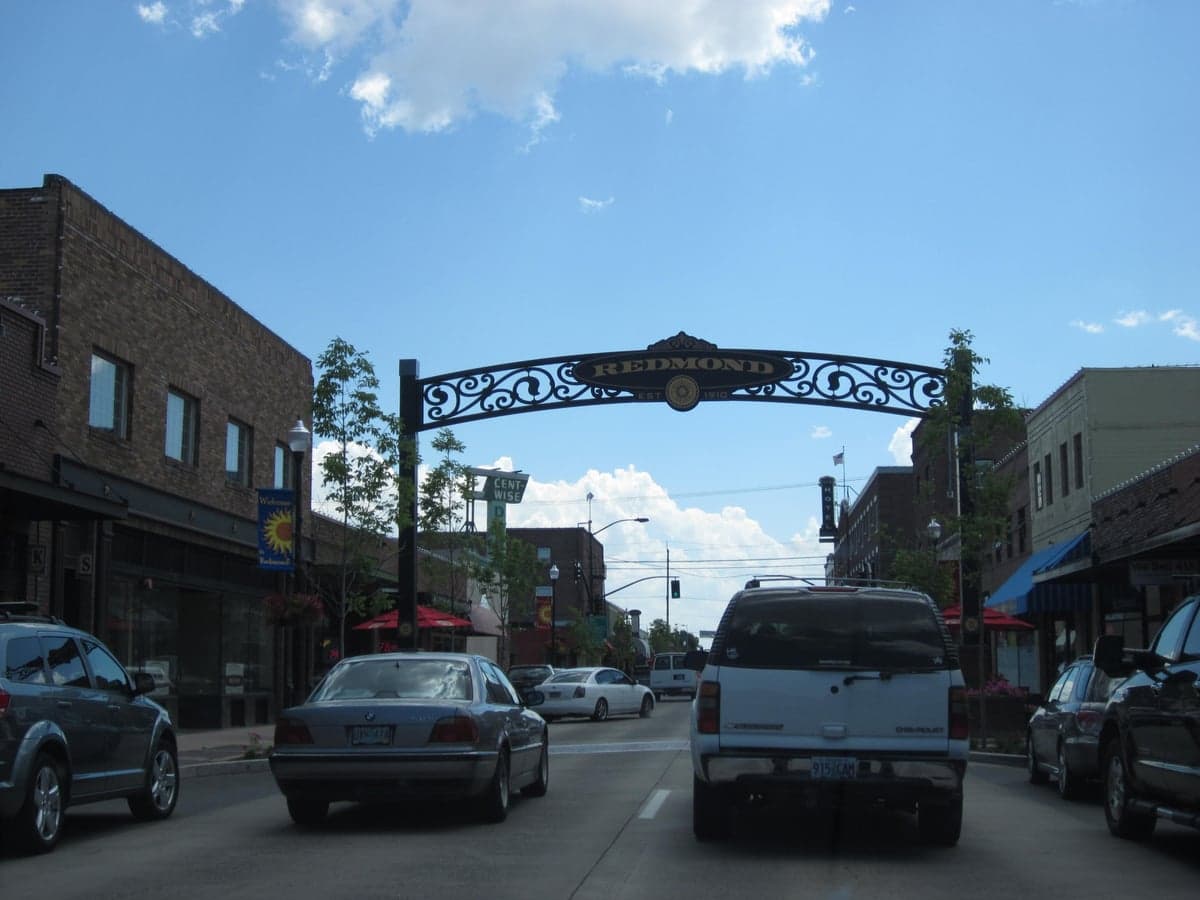
Photo: Wikipedia
Political ClimatePolitical Climate in Redmond, OR
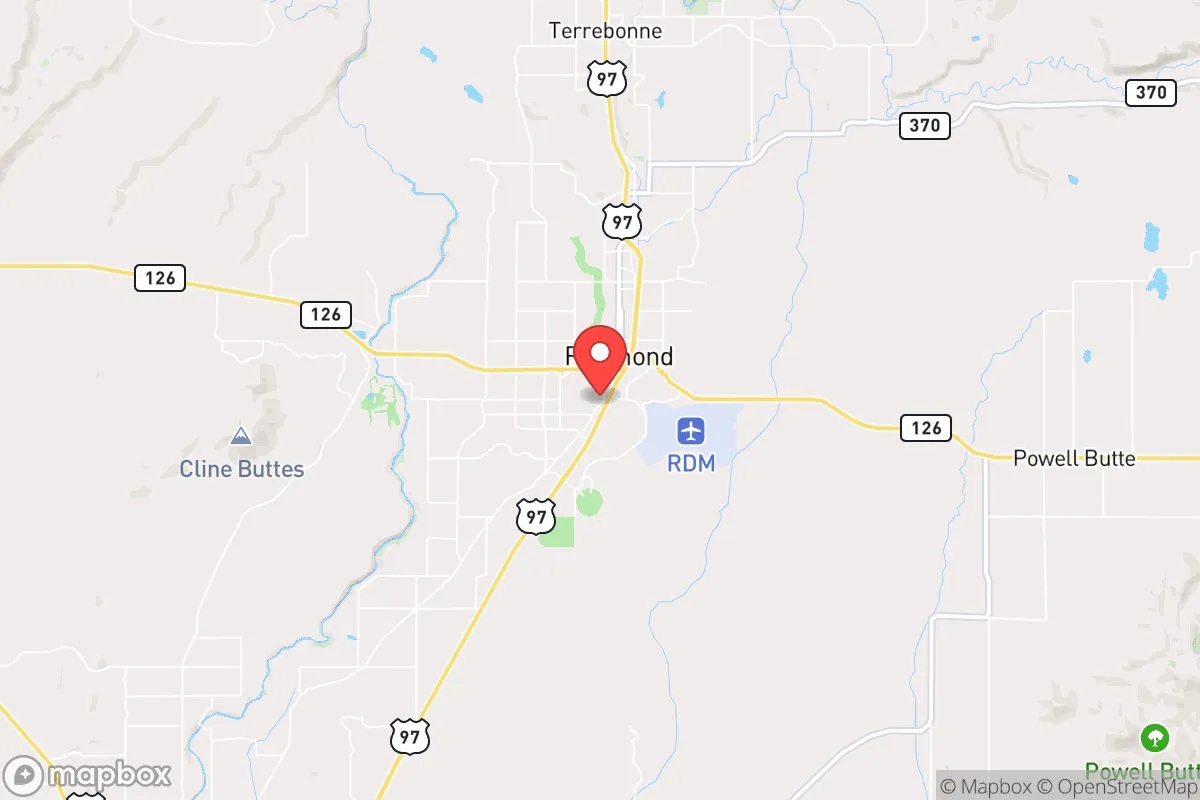
District shown is the primary district for this city’s centroid. Cities may span multiple districts.
Local Political AnalysisPolitical Analysis of Redmond, OR
Redmond sits in a political sweet spot that feels a bit different from the rest of Oregon. While the state as a whole leans solidly Democratic with a Cook PVI of D+8, Redmond’s Deschutes County clocks in at D+4, making it one of the more competitive areas in the state. That gap isn’t just a number on a map—it reflects a real, ongoing shift. Deschutes County has been trending bluer over the past decade, driven by an influx of new residents from California and the Portland metro area, but Redmond itself still holds a noticeably more conservative bent than neighboring Bend. If you’re looking at a political map, Redmond is the place where the bright blue of Bend starts to fade into the deep red of rural Central Oregon.
How it compares
Redmond’s political lean is best understood by looking around. Just 15 miles south, Bend is a D+12 or stronger island of progressive politics, with bike lanes, craft breweries, and a city council that often pushes ambitious climate and housing policies. Drive 30 minutes north to Madras, and you’re in Jefferson County, which reliably votes Republican by 20 points or more. Redmond sits right in the middle of that spectrum—more purple than either of its neighbors. The city itself votes slightly more Democratic than the surrounding unincorporated areas, but the county’s D+4 rating means local elections are often decided by just a few hundred votes. In 2024, Deschutes County’s presidential vote was within 2 points of the national popular vote, underscoring how much of a bellwether this area has become.
What this means for residents
For conservatives, Redmond offers a place where you’re not outnumbered. You’ll find plenty of neighbors who share your views at the local coffee shop or hardware store, and the county commission has leaned center-right in recent years. For liberals, the trajectory is encouraging—each election cycle brings more registered Democrats and independents, and local progressive groups are active on issues like affordable housing and wildfire preparedness. The practical reality is that both sides have to engage in genuine coalition-building here; no single party can simply run the table. This means school board meetings, planning commission hearings, and city council races are where the real action is, not just the national headlines.
Key cultural and policy distinctions
One way this political mix shows up is in local policy. Redmond has been quicker than Bend to approve new housing developments, including single-family subdivisions, reflecting a more growth-friendly attitude among officials. At the same time, the city has invested in parks and a downtown revitalization that appeals to younger, more liberal newcomers. The culture itself is pragmatic—people here are less likely to fly political flags than Bend residents, and more likely to talk about the high cost of living or the fire season than any national culture war. For a newcomer, Redmond offers a genuine middle ground where you can live comfortably regardless of your party, as long as you’re willing to show up and get involved at the local level.

State Political ClimatePolitical Climate in Oregon
State Political AnalysisPolitical Environment in the State
Oregon carries a Cook Partisan Voting Index of D+8, making it one of the more reliably Democratic states in the union, but that number tells a story of deep fracture rather than monolithic blue dominance. The state’s political identity has shifted significantly over the past 20 years: as recently as 2000, Oregon was a genuine battleground, with George W. Bush losing by just 0.4% of the vote, but by 2024 the Democratic lean had solidified, driven largely by explosive growth in the Portland metro area and the continued migration of out-of-state liberals into the Willamette Valley. At the same time, a majority of Oregon’s landmass — all of eastern and southern Oregon — has grown more intensely Republican, producing a state where statewide elections are effectively decided by the suburban crescent stretching from Portland through Salem to Eugene, while large swaths of the state feel increasingly alienated from the government in Salem.
Urban vs. rural divide
The political map of Oregon can be drawn with a single line following the Cascade Range: west of the Cascades, you find the state’s population centers, all of which vote Democratic; east of the Cascades, the landscape opens into high desert and conservative counties that vote Republican by margins of 50 points or more. Multnomah County (Portland) alone cast roughly 20% of the state’s votes in 2024 and went D+45, while neighboring Washington County (suburban Hillsboro and Beaverton) and Clackamas County (Oregon City, Lake Oswego) both delivered double-digit Democratic wins. The state’s second and third cities tell the same story: Eugene (Lane County, home to the University of Oregon) votes solidly blue, while Salem (Marion County) is a more moderate blue due to a significant rural farming population. Conversely, places like Klamath Falls, Burns (Harney County), and Ontario (Malheur County) routinely vote 70-80% Republican, with some eastern Oregon counties like Grant and Lake approaching 90% GOP. A notable microcosm is Bend in Deschutes County, which has flipped from red to purple and is now trending blue as Californians and out-of-state remote workers pour into the high desert, making it a bellwether for demographic-driven political change.
Policy environment
Oregon’s state-level policy environment is decidedly progressive on most fronts, but with some unique wrinkles that matter to relocators. Oregon has no state sales tax, instead relying on a relatively high personal income tax (top rate of 9.9%) and a corporate activity tax, which makes the tax burden heavier on high earners and businesses but lighter on consumption. The state has a unique "kicker" law that refunds surplus tax revenue to taxpayers when collections exceed forecasts by more than 2%, a populist measure that occasionally delivers unexpected rebate checks. Property taxes are constrained by Measure 50 (1997), which limits annual increases to 3%, but can spike upon sale, meaning long-time homeowners pay far less than recent buyers. Gun policy is among the strictest in the West — Measure 114, passed in 2022 and tied up in legal challenges, would require a permit-to-purchase and ban magazines over 10 rounds, though its implementation remains uncertain. Oregon has a "sanctuary" law (ORS 181A.820) that explicitly prohibits state and local law enforcement from using resources to enforce federal immigration law, a policy that has made Portland, Woodburn, and Hillsboro de facto safe havens. Election laws are essentially all mail-in voting — Oregon was the first state to adopt this system in 1998 — meaning every registered voter receives a ballot by mail and must return it by Election Day. Ballot drop boxes are common, and there is no in-person voting on machines, which conservative critics have argued reduces election security and transparency.
Recent policy direction
The last few legislative sessions in Salem have pushed Oregon decisively leftward on a range of liberty-related issues, with consequences for relocators of all political persuasions. On housing, the 2023 session passed HB 2001, which effectively eliminated single-family zoning statewide, allowing duplexes, triplexes, and fourplexes in all residential neighborhoods, a move aimed at increasing density but one that also reduces local control and can alter established neighborhoods. On education, Oregon has one of the strongest sanctuary policies for LGBTQ+ students in the nation, with state law (HB 2023, though the actual student privacy law dates to 2021) prohibiting schools from notifying parents when a student changes their gender identity or expression at school — a policy that has become a flashpoint for conservative families and has driven some to homeschool or enroll in private religious schools. On health and bodily autonomy, Oregon has some of the most permissive laws in the country for abortion and gender-affirming care, with no gestational limits on abortion and a shield law protecting providers from out-of-state prosecution. On property rights, Measure 37 (2004) and Measure 49 (2007) created a contentious regulatory landscape: property owners can seek compensation or waivers for land-use regulations that reduce property value, but the process is complex and often litigated. On self-defense, Oregon is a shall-issue state for concealed carry permits, but permits are issued by county sheriffs, and some counties (particularly Multnomah and Washington) are known for slow processing or stricter interpretation. There is no state preemption on firearms, so Portland has enacted its own local ordinances banning guns from public parks and buildings. On voting, there is no voter ID law — voters are verified by signature match on their mail-in ballot envelope — which critics argue is insecure but proponents defend as increasing turnout. On drug policy, Oregon notably decriminalized possession of all drugs via Measure 110 (2020), but amid a fentanyl crisis and public outcry, the legislature re-criminalized possession (HB 4002) in 2024, signaling a pivot back from one of the nation’s most liberal drug regimes.
Civil unrest & political movements
Oregon has a long history of political activism on both extremes, and a new resident will encounter visible signs of that legacy. Portland experienced extended protests in the summer of 2020 following George Floyd’s murder, with some protests turning into nightly confrontations between demonstrators and federal law enforcement (DHS and Border Patrol agents) deployed by the Trump administration, an event that became a national flashpoint and is still referenced in local politics. Groups on both sides — including the leftist Rose City Antifa and various Proud Boys chapters — have a presence in the Portland metro, though street-level organizing has diminished since 2021. In eastern Oregon, there have been periodic secessionist rumblings under the "Greater Idaho" movement, which proposes that several eastern Oregon counties join Idaho, citing cultural and political alienation from the Portland-controlled state government. As of 2025, 11 of Oregon’s 36 counties had passed resolutions in favor of moving the state line, though the movement remains symbolic — it would require approval from both state legislatures and Congress, a near-impossible hurdle. On immigration, the sanctuary law is broadly supported in the Willamette Valley but intensely unpopular in Woodburn (a city with a large Latino farmworker population) and southern Oregon towns like Grants Pass and Medford, where the debate has become a proxy for larger questions about law enforcement and community safety. There is no organized antifragility or election-denial movement with major political influence at the state level, but individual county clerks (notably in Linn and Douglas counties) have been sued over mismanagement and procedural issues. New residents will not encounter persistent, visible unrest in daily life outside Portland, but political polarization is palpable in social media, local news, and even in the way people talk about which part of the state they live in.
Projection
Looking ahead five to ten years, Oregon’s political trajectory is likely to remain a tug-of-war between demographic change and rural resistance, with the state’s overall lean staying blue but the internal fractures deepening. The Portland metro area continues to grow faster than the rest of the state, and in-migration is overwhelmingly from California, Washington, and other blue states, which will reinforce Democratic dominance in the legislature and the governor’s mansion. However, the "Greater Idaho" movement is unlikely to succeed in full, but it could gain traction as a symbolic pressure valve, possibly leading to some form of regional autonomy for eastern counties — think of a "menu" of local control over land use, forestry, and education funding, rather than a full border change. Republican strength will likely continue to concentrate in rural and suburbanizing areas like Deschutes County (Bend) and Jackson County (Medford), where growth from out-of-state conservatives is partially offset by liberal newcomers. The state’s fiscal health is a wildcard — Oregon’s economy is heavily dependent on the tech sector (Intel, Nike, and a growing semiconductor cluster) and property taxes, both of which are sensitive to economic cycles. A recession could trigger a budget crisis that forces the state to moderate its spending ambitions. For a conservative relocator, the practical expectation is this: statewide elections for governor, attorney general, and secretary of state will remain Democratic-won, but with margins closer to 5-10 points, not the 15-20 of deep-blue strongholds like California or New York. Republican control of local offices — county commissions, sheriffs, school boards — will expand in the rurban fringe, while cities like Portland and Eugene will continue to advance progressive policies on housing, drug policy, and education that may clash with state-level pendulum swings on criminal justice.
For a conservative individual or family moving to Oregon, the bottom-line reality is that the state government will remain hostile to many of your core priorities on guns, taxes, and education, but local options and county-level autonomy provide meaningful escape hatches. If you move to Klamath Falls or Ontario, you can live in a community where your neighbors share your values and your county commissioners push back on Salem — you just have to accept that state laws are largely out of your hands. If you choose to live in the Portland suburbs (like Happy Valley or West Linn), you will be in blue territory but with excellent schools and job opportunities, and you can find like-minded communities through churches, private schools, and conservative political networks. The key insight for a conservative relocator is that Oregon is not a state you move to expecting to change the government’s direction; instead, you choose a specific city or county as a refuge, and you accept the state-level tradeoffs like a higher income tax and permitting burdens. It’s a place where you can find your tribe if you pick your location carefully, but you won’t avoid the broader policy environment — you’ll just find ways to navigate it.
* Values derived from national, state, county, city and local statistics and may differ in a specific area. Last updated: 2026-06-25T20:59:50.000Z
Narrative content on this page is AI-generated and may contain mistakes. Verify any details that matter before acting on them.
ReloMaps may earn a commission from affiliate links at no extra cost to you.

