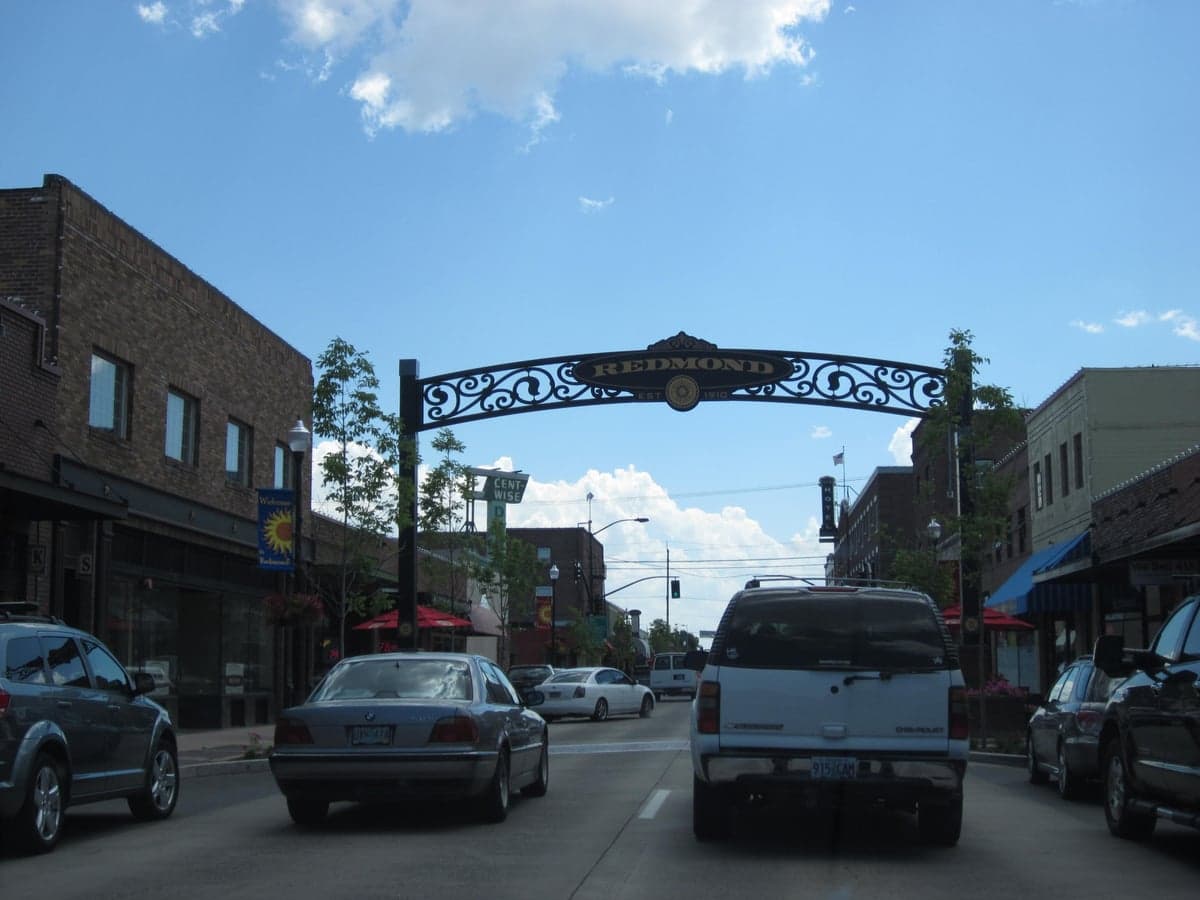
Photo: Wikipedia
Personal Sovereignty in Redmond, OR
Viable for self-reliance. Generally workable, though some barriers may limit total independence.
What does Personal Sovereignty tell us?
Personal Sovereignty measures your capacity for self-reliance and independence with minimal government friction. Higher scores mean fewer barriers between you and the way you want to live... but it assumes you have the space you need and good neighbors.
What does this tell us?
Personal Sovereignty measures your capacity for self-reliance and independence with minimal government friction. Higher scores mean fewer barriers between you and the way you want to live... but it assumes you have the space you need and good neighbors.
State Policy
Energy independence: Importer (35% of energy produced in-state)
Personal Liberty
Homesteading

Personal Liberty Analysis
Redmond, Oregon, offers a notably high degree of personal sovereignty for a city of its size, combining Oregon’s famously permissive land-use and self-defense laws with a central Oregon culture that prizes self-reliance and non-interference. The regulatory environment is light-touch relative to West Coast urban centers, and the tax structure is among the most favorable in the state for individuals and families seeking to keep more of their income and property. While not a libertarian enclave, Redmond provides a practical balance of legal autonomy and community expectation that appeals strongly to conservative-leaning relocators.
Tax burden and regulatory posture for families and individuals
Oregon’s lack of a state sales tax is a significant advantage for residents, particularly those making large purchases or running home-based businesses. Local property taxes in Deschutes County are moderate, with an effective rate around 0.86% of assessed value, well below the national average. The statewide property tax system under Measure 50 caps annual assessed value growth at 3%, which provides long-term stability and predictability—a key benefit for families buying into the area. Oregon does impose a progressive state income tax, with rates from 4.75% to 8.75% (as of 2025), and Redmond residents in higher brackets will see a noticeable cut. However, the overall burden remains lower than comparable states with sales tax, and there is no inheritance or estate tax. The regulatory posture at the city and county level is business-friendly for light industrial and trade work, with straightforward permitting for single-family homes and home occupations. Zoning is less restrictive than in Portland or Bend; for instance, the city allows accessory dwelling units (ADUs) by right on most single-family lots, and agricultural exemptions for small-scale livestock are common on parcels of one acre or more within the urban growth boundary.
Self-defense and gun law specifics for Redmond residents
Oregon is a “shall-issue” state for concealed handgun licenses (CHLs), and Deschutes County processes applications efficiently—typically within 30–45 days. Redmond residents enjoy strong self-defense protections: the state does not require a permit to open carry (though a CHL is necessary to carry concealed). The preemption law prevents local governments from passing stricter ordinances than state law, meaning Redmond’s city council has no authority to ban firearms on most public land. Notably, Oregon enacted Measure 114 in 2022, which originally required a permit to purchase any firearm (including long guns) and banned magazines over ten rounds. As of early 2026, the permit-to-purchase portion remains blocked by court order, but the magazine limit is in effect—though compliance and enforcement vary. For a relocator, the practical reality is that Redmond remains a strong gun-rights community: gun stores are plentiful, shooting ranges like the Redmond Rod & Gun Club are active, and local law enforcement is generally supportive of lawful carry. The CHL process includes a background check and fingerprinting, but no firearms training is required beyond a basic safety course (usually one hour online). Home defense statutes in Oregon align with the Castle Doctrine, with no duty to retreat in one’s dwelling.
Self-reliance and homesteading viability: lot sizes, zoning, off-grid feasibility
Redmond’s zoning code is more permissive for homesteading than most Oregon cities of its size. Standard residential lots in newer subdivisions are often 6,000–8,000 square feet, but many established neighborhoods and unincorporated areas near the city limits offer lots of 1–5 acres where chickens, goats, and small-scale orchard production are allowed without special permits. The city explicitly permits up to four chickens per standard residential lot, with no roosters. For larger livestock, zoning in the “Rural Residential” (RR) and “Farm Forest” (FF) zones—common just outside the city—allows horses, cattle, and sheep on parcels as small as one acre. Off-grid feasibility is limited by Oregon’s building codes: habitable dwellings must be connected to a septic system (approved by Deschutes County) and either municipal water or a permitted well. Solar panels are widely used and permitted by right, but net metering is capped at 25kW for residential systems. Rainwater collection is legal for non-potable uses without a permit. The city does allow composting toilets and graywater systems as alternatives to sewer connections in rural zones, though the permitting process adds cost and time. For the serious homesteader, the 20-acre parcels in the “Exclusive Farm Use” (EFU) zone (common south and east of Redmond) allow the most autonomy—including dwellings without a building permit if classified as “farmworker housing.” However, the high desert climate (average 9 inches of precipitation annually) imposes a practical limit: irrigation rights are required for most crops, and these water rights are tied to the land parcel and cannot be easily transferred.
Personal liberties: parental rights, medical autonomy, speech, and property
Parental rights in Oregon are broadly protected under state law, including a parent’s right to direct their child’s education, medical care, and religious upbringing. Oregon is a parental-notification state for minors seeking abortion, requiring written consent from a parent or guardian—a factor that resonates with conservative families. The state also has a robust “opt-out” system for sex education and immunization, though school masking mandates during public health emergencies remain a point of contention. Medical autonomy in Redmond is mixed: the state allows medical aid-in-dying (Death with Dignity Act), which some residents view as a personal liberty issue, and there are no bans on specific alternative or complementary therapies. However, Oregon mandates that all children have health insurance and that certain vaccines be administered before school entry (with medical and religious exemptions available). Real property rights are strong: Oregon’s strict land-use system (primarily governed by Goal 14 and urban growth boundaries) limits where and how property can be developed, but once a parcel is zoned, the owner has significant latitude. There is no rent control in Redmond, and short-term rentals (like Airbnb) are allowed with a simple registration. Freedom of speech and assembly are constitutionally protected, and Redmond’s city council does not impose special event fees for religious or political gatherings on public property. The overall atmosphere is one of live-and-let-live, with a notable absence of the neighborhood association conflicts common in Portland suburbs.
Compared to other high-freedom destinations in the West, Redmond navigates a middle path. It offers lower taxes than Washington state (no capital gains tax on home sales, for instance) and more relaxed firearm laws than California or Colorado, while maintaining Oregon’s robust personal autonomy in areas like homesteading and property rights. For the relocator seeking a community where government interference is minimal, self-reliance is respected, and daily life does not require constant navigation of regulatory red tape, Redmond represents one of the stronger values in the Pacific Northwest.

* Values derived from national, state, county, city and local statistics and may differ in a specific area. Last updated: 2026-06-25T20:59:50.000Z
Narrative content on this page is AI-generated and may contain mistakes. Verify any details that matter before acting on them.
ReloMaps may earn a commission from affiliate links at no extra cost to you.

