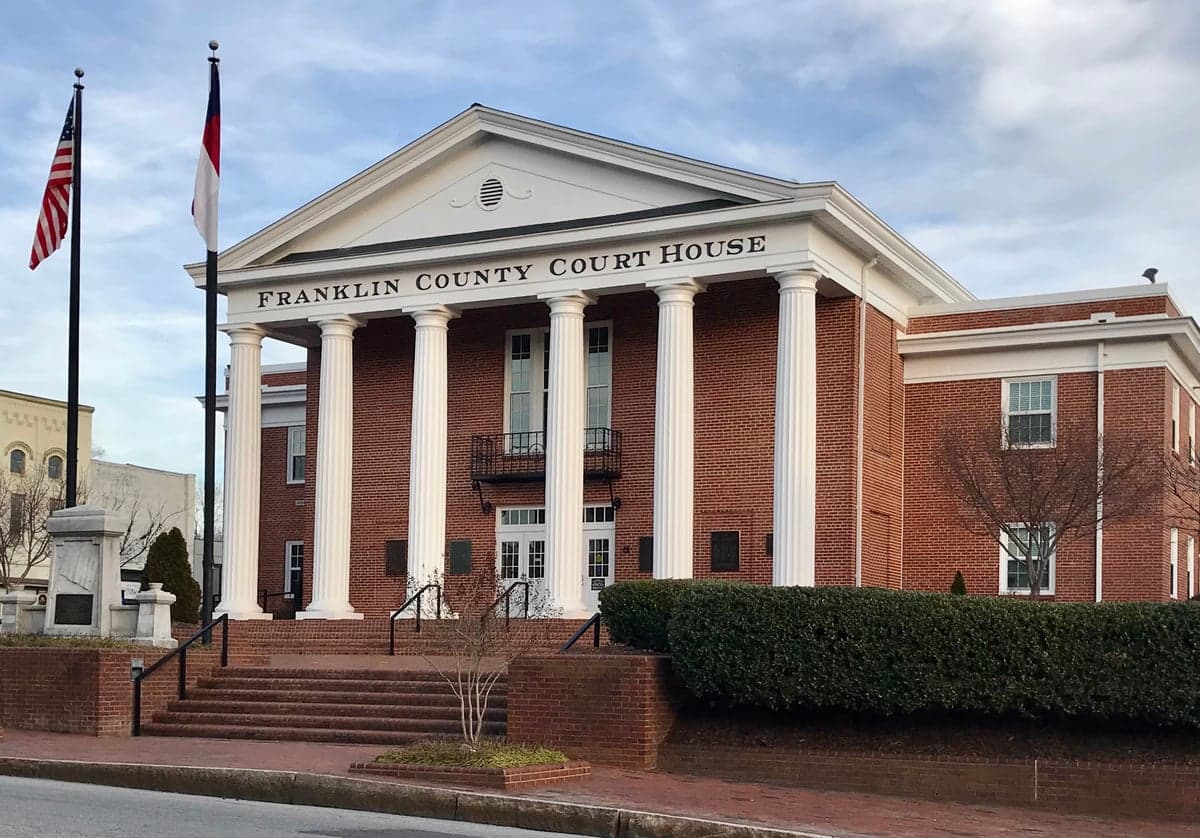
Photo: Wikipedia
Political ClimatePolitical Climate in Franklin County
Showing county-level results — no local-only data available.
Lean and PVI are calculated from this county’s 2020 and 2024 presidential results, Cook-style.
Political rankings in North Carolina
- Most Conservative Cities in North Carolina
- Most Liberal Cities in North Carolina
- Best Liberal-Leaning Towns in the South
- Best Liberal-Leaning Towns in Appalachia
- Safest Liberal-Leaning Towns in the South
- Safest Conservative-Leaning Towns in the South
- Safest Conservative-Leaning Towns on the East Coast
- Affordable Small Towns for Conservatives
- Most Conservative Counties in North Carolina
- Most Liberal Counties in North Carolina
Local Political AnalysisPolitical Analysis of Franklin County
Franklin County, North Carolina, has a solidly Republican lean, with a Cook Partisan Voting Index (PVI) of R+8, meaning it votes about eight points more Republican than the national average. This is a significant shift from just a decade ago, when the county was more of a swing area, and it now stands in contrast to the state of North Carolina as a whole, which is a competitive R+1. The county’s trajectory has been steadily redder, driven by population growth from the Raleigh-Durham exurbs and a rural base that has become more reliably conservative.
How it compares to North Carolina
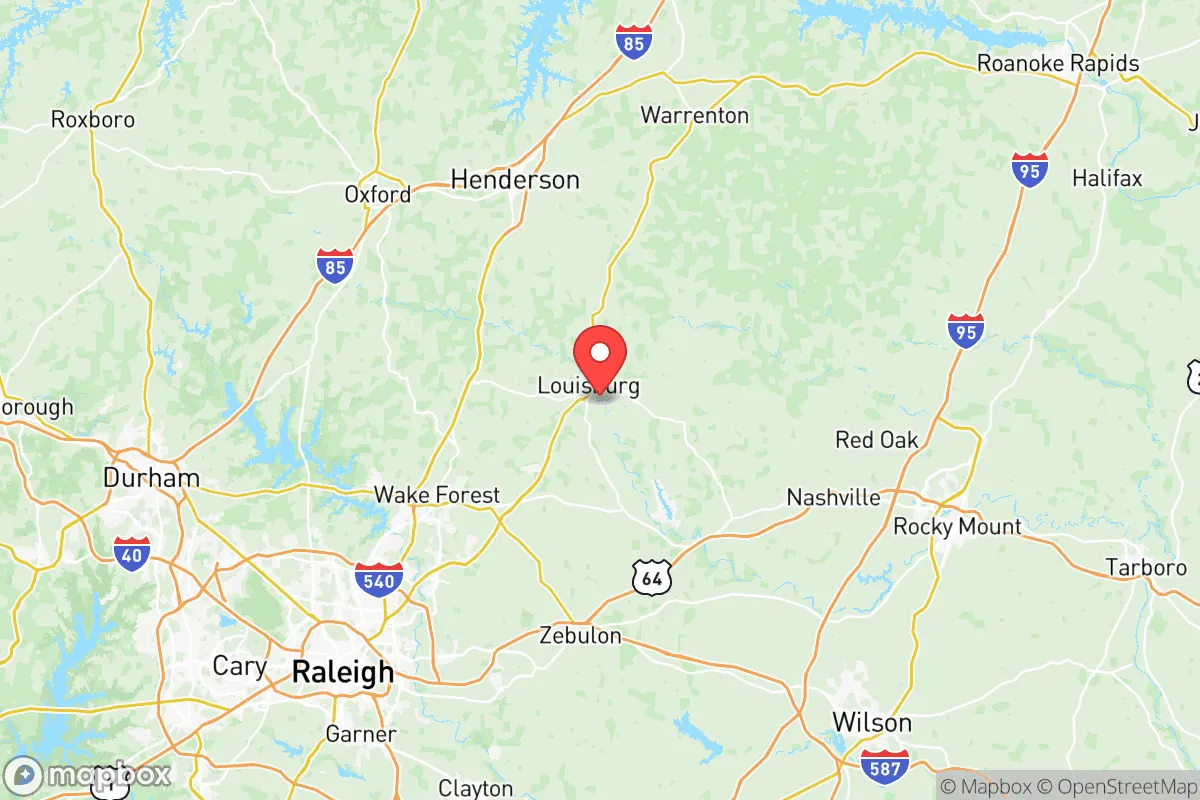
While North Carolina is a classic battleground state—flipping between parties in presidential elections and hosting tight races for governor and legislature—Franklin County is a safe bet for Republicans. In 2024, the county voted for Donald Trump by a margin of roughly 20 points, while the state overall was decided by less than 2 points. This gap has widened over the past two cycles. The county’s R+8 PVI is more in line with neighboring rural counties like Vance and Warren, not the purple suburbs of Wake County to the south. However, there’s real variation inside Franklin County. The town of Louisburg, the county seat and home to Louisburg College, leans more moderate to blue, with Democratic candidates often winning precincts around the downtown and campus. In contrast, Youngsville and Franklinton are reliably red, with Trump winning those precincts by 30 points or more. The swing precincts are in the fast-growing southern part of the county, near the Wake County line—areas like Bunn and Zebulon (which straddles the border) where new residents from Raleigh bring a mix of suburban conservatism and some liberal-leaning professionals.
What this means for residents
For conservative residents, the county’s lean means their values are reflected in local governance—the county commission is Republican-majority, and school board races often focus on traditional values and fiscal conservatism. You’ll see “Trump 2024” signs on lawns year-round, and local GOP events are well-attended. For liberal residents, the political reality can feel isolating, especially in the rural northern parts. But in Louisburg, there’s a small but active Democratic presence, and the town’s college gives it a more progressive vibe. The practical impact is that policy debates—like zoning for new subdivisions, school funding, or broadband expansion—tend to favor limited government and low taxes, which keeps property taxes relatively low compared to Wake County. However, this also means fewer public services and slower infrastructure upgrades, which can frustrate newcomers used to Raleigh’s amenities.
Culturally, Franklin County remains a place where church and community are central, and the political divide often mirrors the rural-suburban split. The county’s agricultural roots—tobacco, soybeans, and now hemp—still shape its identity, but the influx of exurbanites is slowly shifting the conversation. You won’t find the same partisan intensity as in the Triangle, but the trajectory is clear: Franklin County is getting redder and more suburban, while North Carolina as a whole stays purple. For anyone moving here, the key is knowing that your experience will depend heavily on whether you settle in Louisburg’s historic district or a new subdivision near Youngsville.

State Political ClimatePolitical Climate in North Carolina
State Political AnalysisPolitical Environment in the State
North Carolina is a classic swing state that has been trending rightward over the past decade, with a Cook PVI of R+1 that masks a deeply competitive and polarized political landscape. The state’s overall lean is a narrow Republican advantage in statewide elections, driven by a coalition of rural and exurban conservatives, but Democrats remain highly competitive thanks to strongholds in the Research Triangle, Charlotte, and the Piedmont Triad. Over the last 20 years, the state has shifted from a reliably red southern state (voting Republican in every presidential election from 1980 to 2008 except for 1976) to a true battleground, with Barack Obama narrowly winning it in 2008, then flipping back to Trump in 2016 and 2020 by margins of 3.6% and 1.3% respectively. The 2024 election saw Trump carry the state again by roughly 3 points, cementing its status as a lean-Republican state that still hosts competitive Senate and gubernatorial races.
Urban vs. rural divide
The political map of North Carolina is a textbook study in the urban-rural split. The state’s three major metro areas—Charlotte (Mecklenburg County), Raleigh-Durham-Chapel Hill (Wake, Durham, Orange counties), and Greensboro-Winston-Salem (Guilford, Forsyth counties)—are solidly Democratic, with Mecklenburg and Wake counties alone delivering over 600,000 votes for Biden in 2020. These metros are powered by a mix of tech, finance, and university populations, with Durham and Orange County being among the most liberal areas in the South. In contrast, the vast rural and exurban counties—like Gaston (west of Charlotte), Johnston (southeast of Raleigh), and Union (south of Charlotte)—have swung hard to the right, often voting 65-70% Republican. The state’s coastal and mountain regions are also conservative strongholds, with Wilmington (New Hanover County) being a notable exception as a purple-to-blue city in a red county. The suburban counties around Charlotte and Raleigh—like Cabarrus and Harnett—are trending redder as new arrivals from blue states settle in exurban developments, while inner-ring suburbs like Cary and Morrisville have become reliably Democratic.
Policy environment
North Carolina’s policy environment reflects its divided government: a Republican-controlled General Assembly (with supermajorities in both chambers since 2023) and a Democratic governor (Roy Cooper until 2025, now Josh Stein). The state has a flat income tax rate of 4.5% (scheduled to drop to 3.99% by 2027), a 6.75% corporate income tax (phasing down to 2.5% by 2030), and a state sales tax of 4.75% (local add-ons push it to 7-7.5% in most areas). Property taxes are low by national standards, with average effective rates around 0.8%. Education policy is a major battleground: the state has a robust charter school system and a private school voucher program (the Opportunity Scholarship Program) that was expanded in 2023 to cover all families regardless of income. Healthcare is mixed—the state expanded Medicaid in 2023 under a bipartisan deal, covering roughly 600,000 low-income adults, but abortion access was restricted to 12 weeks in 2023 (with exceptions for rape, incest, and fetal anomalies). Election laws have been tightened: voter ID is now required (implemented in 2023), early voting was reduced from 17 to 10 days in 2018 but later restored to 17 days, and same-day registration is not allowed. The state also has a right-to-work law and is a “shall-issue” state for concealed carry permits.
Recent policy direction
Over the past five years, North Carolina has moved decisively to the right on several fronts. In 2023, the Republican supermajority overrode Governor Cooper’s vetoes to pass a 12-week abortion ban (SB 20), a permitless concealed carry law (HB 189, allowing carry without a permit), and a ban on gender-affirming care for minors (HB 808, which also restricts transgender athletes’ participation in school sports). The state also passed a Parents’ Bill of Rights (HB 755) in 2023, requiring schools to notify parents about instructional materials involving sexuality and to obtain parental consent for changes to a student’s name or pronouns. On gun rights, the state is now among the most permissive in the South: no permit needed for concealed carry (as of 2023), no waiting period for long guns, and a “stand your ground” law (enacted in 2011). Property rights were strengthened with a 2023 law limiting local governments’ ability to regulate short-term rentals (like Airbnb) and a 2024 law restricting municipal annexation without property owner consent. On voting, the 2023 law (SB 747) made it harder to mail in ballots by requiring a witness signature or notarization, and it banned private funding of election administration. The state has no statewide privacy law comparable to California’s, but a 2023 law (HB 347) restricted the use of facial recognition by law enforcement. Medical freedom is limited: the state has no vaccine mandate ban for private employers, but a 2023 law prohibits COVID-19 vaccine mandates for state employees and contractors.
Civil unrest & political movements
North Carolina has a history of visible political activism on both sides. The 2020 protests over George Floyd’s death in Charlotte and Raleigh saw significant property damage and clashes with police, leading to a state of emergency in Charlotte. The “Moral Monday” movement, led by the NAACP and progressive clergy, has staged regular protests at the General Assembly since 2013 against voter ID laws, abortion restrictions, and education cuts. On the right, the “We the People” movement and local Tea Party groups remain active, particularly in rural counties like Gaston and Union. Immigration politics are relatively muted compared to border states, but Durham and Orange County have declared themselves “sanctuary counties” (limiting cooperation with ICE), while the state legislature passed a 2015 law (HB 318) requiring sheriffs to honor ICE detainer requests. Election integrity controversies have been a flashpoint: the 2020 election saw Trump’s campaign challenge the state’s mail-in ballot procedures, and the 2024 election cycle featured a high-profile dispute over the State Board of Elections’ makeup (Republicans sued to remove Democratic appointees). Secession or nullification rhetoric is rare, but a 2023 bill (HB 40) proposed a “constitutional convention” to discuss state sovereignty—it died in committee. A new resident would notice the ubiquity of political yard signs and bumper stickers, especially in exurban subdivisions, and the occasional protest at the state capitol in Raleigh.
Projection
Over the next 5-10 years, North Carolina is likely to remain a lean-Republican state at the presidential level, but the margin could narrow as in-migration from blue states (especially New York, New Jersey, and California) continues to fuel growth in the Research Triangle and Charlotte. The state’s population grew by 9.5% from 2010 to 2020, and the trend is accelerating—Wake County alone added 100,000 residents between 2020 and 2024. These newcomers tend to be younger, more educated, and more Democratic-leaning, which could flip the state to a toss-up by 2030. However, the Republican General Assembly is likely to maintain its supermajority through aggressive gerrymandering (the 2023 congressional map gave Republicans 10 of 14 seats despite a 50-50 statewide vote split) and continued rural turnout. The key battleground will be the exurban counties around Charlotte and Raleigh—places like Johnston and Cabarrus—where new subdivisions are filling with families who vote Republican on taxes and crime but may shift on social issues. A new resident moving in now should expect a state that remains politically divided, with a Republican tilt in statewide races but a Democratic governor (Josh Stein, elected in 2024) who will continue to veto conservative bills. The policy environment will likely see further tax cuts, continued school choice expansion, and ongoing battles over abortion and transgender rights.
For a new resident, the bottom line is that North Carolina offers a mix of low taxes, strong gun rights, and a business-friendly climate, but with a Democratic governor who can block the most aggressive conservative legislation. Conservatives will find a welcoming environment in the suburbs and rural areas, with a state government that generally aligns with their priorities on taxes, education, and Second Amendment rights. Liberals will find vibrant communities in the cities and college towns, but will face a state legislature that consistently overrides their governor’s vetoes on social issues. The state’s political trajectory is toward a more competitive future, but for now, it’s a place where your experience depends heavily on which county you call home.
* Values derived from national, state, county, city and local statistics and may differ in a specific area. Last updated: 2026-11-15T23:20:12.000Z
Narrative content on this page is AI-generated and may contain mistakes. Verify any details that matter before acting on them.
ReloMaps may earn a commission from affiliate links at no extra cost to you.

