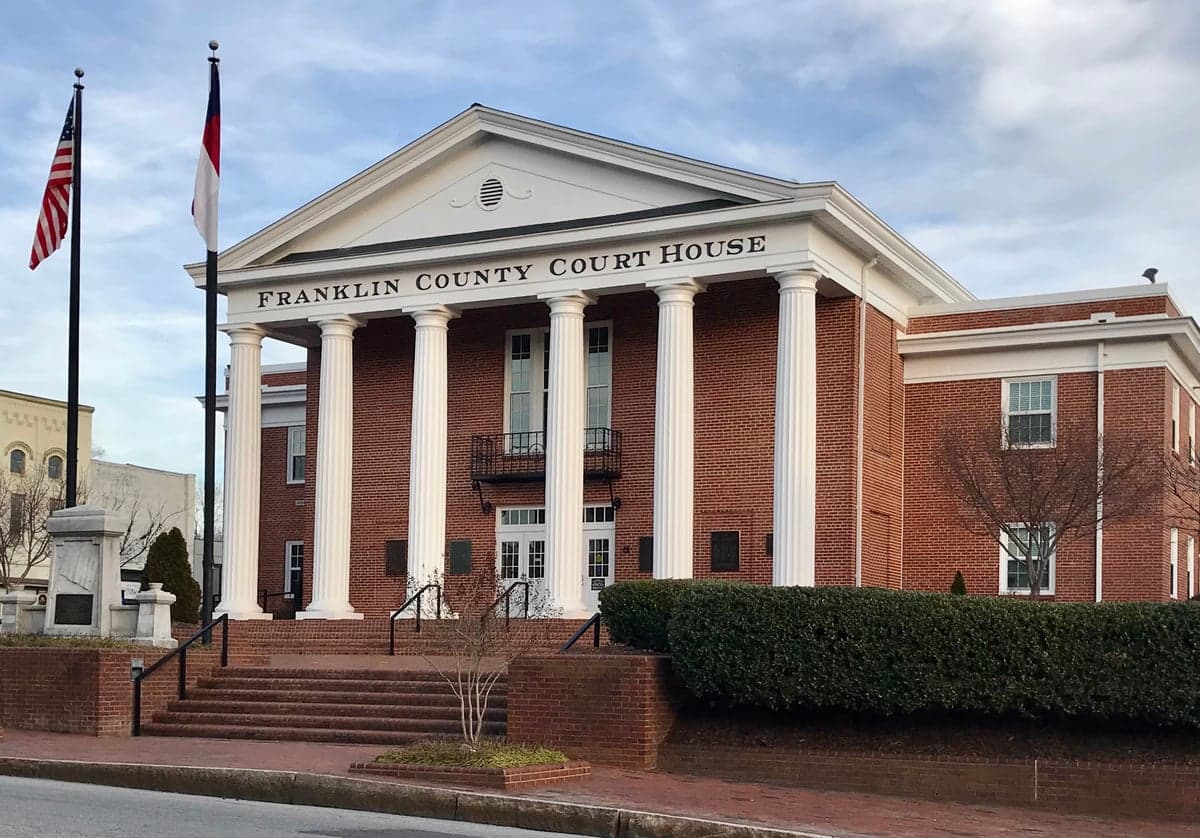
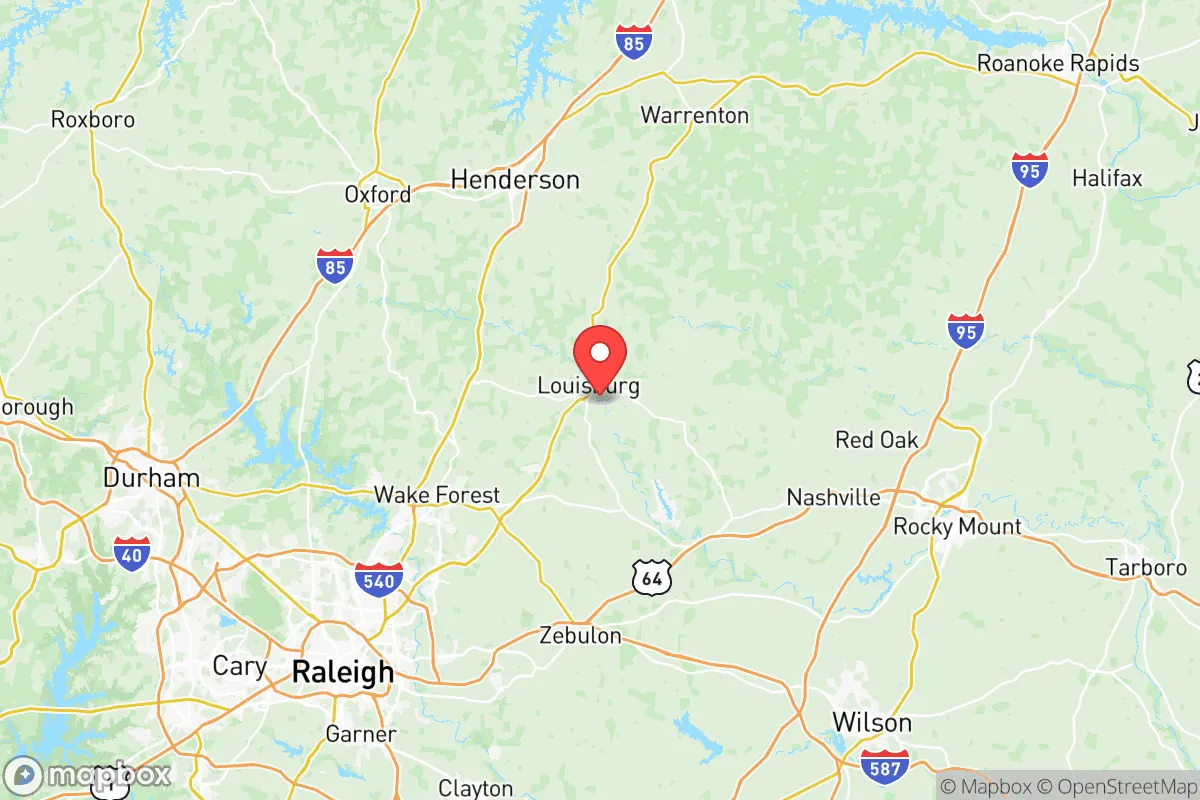
Photo: Wikipedia
Demographics of Franklin County
Affluence Level in Franklin County
A below-average socioeconomic profile. Incomes, home values, and educational attainment trail the U.S., with higher poverty and unemployment.
People of Franklin County
Franklin County, North Carolina, is a community of roughly 72,000 residents whose character is shaped by a deep agricultural heritage and a steadily diversifying population. Today, the county is predominantly White (61.1%) with a significant Black population (22.9%) and a growing Hispanic community (10.6%), creating a demographic profile that is more diverse than many of its rural neighbors. The county’s identity is rooted in its small towns—Louisburg, Franklinton, Youngsville, and Bunn—where a blend of historic families, long-time Black landowners, and newer arrivals from the Raleigh-Durham metro area are redefining what it means to live in this part of the Piedmont.
Settlement & growth (pre-1960)
Long before European settlers arrived, the land that is now Franklin County was part of the hunting and trading grounds of the Tuscarora and Occaneechi peoples. The Tuscarora, an Iroquoian-speaking nation, had villages along the Tar River and its tributaries, including areas near present-day Louisburg and Franklinton. By the early 1700s, the Tuscarora War (1711–1715) and subsequent colonial expansion had largely displaced these Native communities, opening the region to European settlement.
The first wave of European settlers arrived in the mid-1700s, primarily English and Scots-Irish farmers moving south from Virginia along the fall line. These families were drawn by the promise of fertile, rolling land suitable for tobacco cultivation. They established small farms and plantations, and by 1779, the North Carolina General Assembly created Franklin County from a portion of Bute County, naming it after Benjamin Franklin. The county seat was established at Louisburg in 1781, named after King Louis XVI of France in recognition of French support during the American Revolution. Early settlers concentrated in the area around Louisburg and Franklinton, the latter becoming a key stop on the Raleigh-to-Petersburg stagecoach route.
Throughout the 19th century, the county’s economy was built on tobacco and cotton, worked by a large enslaved Black population. By 1860, enslaved people made up roughly 45% of Franklin County’s population, a figure that shaped the region’s social and economic structure for generations. After the Civil War and Emancipation, many freedmen and their families remained in the county, establishing independent farming communities and churches. Towns like Bunn and Youngsville became centers for Black landownership and community life, with families like the Bunns and the Alstons leaving lasting legacies.
The late 1800s and early 1900s saw little new immigration to Franklin County. Unlike industrializing areas of the North, the county remained overwhelmingly rural and agricultural. A small number of German and Italian families arrived as merchants and craftsmen in Louisburg and Franklinton, but they did not form distinct ethnic enclaves. The Great Migration (1910–1970) saw many Black residents leave Franklin County for Northern industrial cities like Philadelphia and New York, reducing the Black population share from its post-Reconstruction peak. Meanwhile, the county’s White population remained stable, anchored by families who had been there for generations.
The post-World War II period brought the first significant changes. The expansion of state highways, particularly US-1 and NC-56, began connecting Franklin County more closely to Raleigh, 30 miles to the south. Small manufacturing plants opened in Franklinton and Louisburg, offering non-farm employment. However, the county remained largely rural and slow-growing through 1960, with a population of just over 28,000.
Modern era (post-1965)
The 1965 Hart-Cellar Act had a limited direct impact on Franklin County, as the area did not attract large numbers of post-1965 immigrants. The foreign-born population today stands at just 3.5%, well below the national average. However, the act’s long-term effects are visible in the county’s growing Hispanic community, which now makes up 10.6% of the population. This growth began in the 1990s and accelerated in the 2000s, driven by demand for labor in agriculture (tobacco, sweet potatoes, and Christmas trees) and in construction and food processing. Hispanic families have concentrated in and around Louisburg and Franklinton, where they have established small businesses, churches, and community organizations. The town of Youngsville has also seen a notable Hispanic presence, particularly among families working in the poultry processing industry.
The most transformative demographic force in modern Franklin County has been domestic migration from the Raleigh-Durham metro area. Beginning in the 1990s and accelerating sharply after 2010, families and individuals seeking more affordable housing and a slower pace of life have moved north from Wake County. This wave has been predominantly White and college-educated, drawn by new subdivisions in Youngsville, Franklinton, and the unincorporated areas along the US-1 corridor. The county’s population grew by over 20% between 2010 and 2020, and the share of college-educated residents has risen to 24.4%, though this remains below the state average. This influx has shifted the county’s political and cultural character, introducing more suburban sensibilities to a historically rural, conservative area.
The Black population, now 22.9%, has remained relatively stable in share but has seen internal shifts. Long-established Black communities in Bunn and rural areas have seen some out-migration of younger residents to Raleigh and other cities, while new Black families have moved in from Wake County, attracted by lower housing costs. The East/Southeast Asian population (0.4%) and Indian subcontinent population (0.4%) are very small, concentrated among professionals working in the Raleigh-Durham tech sector who have chosen Franklin County for its lower cost of living.
The future
Franklin County is on a trajectory toward becoming a more diverse, more suburban extension of the Raleigh-Durham metro area. The Hispanic population is projected to continue growing, potentially reaching 15-18% by 2040, driven by both natural increase and continued migration for agricultural and service-sector jobs. This growth is likely to be concentrated in Louisburg and Franklinton, where existing community infrastructure can support new arrivals. The White population share will continue to decline as the county diversifies, though it will remain the majority for the foreseeable future.
The Black population is expected to remain stable or grow slightly, as the county becomes an increasingly attractive option for Black families priced out of Wake County. The small Asian and Indian populations may grow modestly as the tech and healthcare sectors expand in the Triangle region, but Franklin County is unlikely to become a major destination for these groups compared to Cary or Morrisville. The county’s cultural identity is evolving from a quiet, agricultural community to a more dynamic, commuter-oriented suburb, with tensions between long-time residents and newcomers over development, schools, and land use.
For someone moving in now, Franklin County offers a middle ground: a place with a strong sense of local history and community, but one that is clearly being reshaped by its proximity to a booming metro area. The next 10-20 years will likely see continued growth in Youngsville and Franklinton, more subdivisions on former farmland, and a slow but steady increase in diversity. The county’s character will be defined by how well it balances this growth with the preservation of its rural heritage and the needs of its long-standing Black and newer Hispanic communities.

* Values derived from national, state, county, city and local statistics and may differ in a specific area. Last updated: 2026-11-15T23:20:12.000Z
Narrative content on this page is AI-generated and may contain mistakes. Verify any details that matter before acting on them.
ReloMaps may earn a commission from affiliate links at no extra cost to you.

