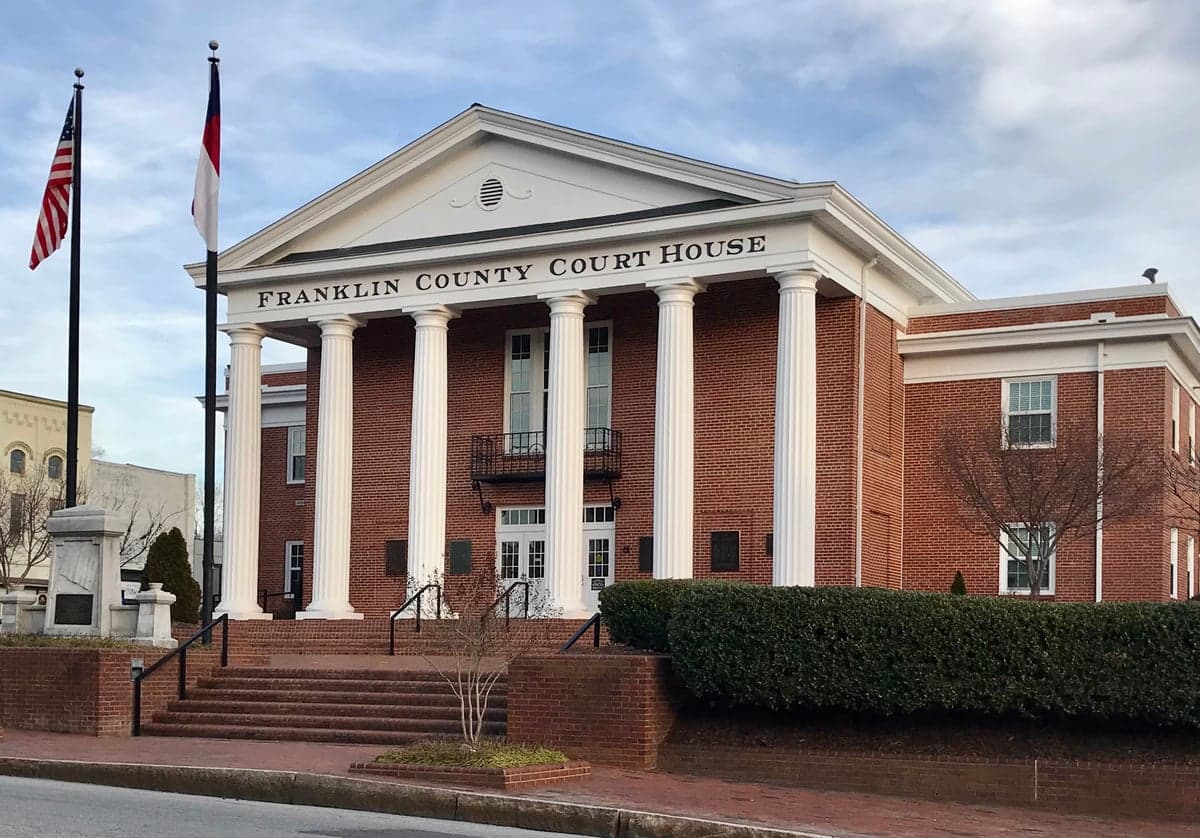
Photo: Wikipedia
Personal Sovereignty in Franklin County
Viable for self-reliance. Generally workable, though some barriers may limit total independence.
What does Personal Sovereignty tell us?
Personal Sovereignty measures your capacity for self-reliance and independence with minimal government friction. Higher scores mean fewer barriers between you and the way you want to live... but it assumes you have the space you need and good neighbors.
What does this tell us?
Personal Sovereignty measures your capacity for self-reliance and independence with minimal government friction. Higher scores mean fewer barriers between you and the way you want to live... but it assumes you have the space you need and good neighbors.
State Policy
Energy independence: Importer (24% of energy produced in-state)
Personal Liberty
Homesteading

Personal Liberty Analysis
Franklin County, North Carolina, offers a notably high degree of personal sovereignty relative to many urban and suburban areas in the state, driven by a light regulatory touch, strong gun rights protections, and a rural landscape that supports self-reliant lifestyles. The county’s autonomy environment is shaped by its location in the northeastern Piedmont, where local governance tends to favor individual choice over collective mandates, and where state-level preemption laws limit local government overreach. For a relocation reader prioritizing personal freedom—whether in tax burden, self-defense, homesteading, or parental rights—Franklin County presents a compelling balance of low interference and practical independence, though specific towns like Louisburg, Youngsville, and Franklinton each offer distinct nuances in regulatory posture and community character.
Tax burden and regulatory posture in Franklin County
Franklin County’s tax burden is among the more favorable in North Carolina for those seeking to minimize government extraction. The county’s property tax rate is $0.75 per $100 of assessed value (2025-2026), well below the state average of roughly $0.85, and significantly lower than nearby Wake County’s $0.68 rate when factoring in higher property values. There is no county-level income tax, as North Carolina imposes a flat state income tax of 4.5% (2026), and the state sales tax is 4.75%, with the county adding a local 2.25% for a total of 7%. The regulatory posture is light-touch: Franklin County has no countywide zoning in unincorporated areas, meaning property owners in places like Bunn or Castalia can build structures, operate home businesses, or keep livestock without seeking variances from a planning board. However, the towns of Louisburg (the county seat) and Youngsville do enforce municipal zoning codes, which can restrict accessory dwellings, setback requirements, and commercial activities. For a reader seeking maximum regulatory freedom, unincorporated land outside these towns is the clear choice, while those wanting basic infrastructure and services may accept the modest constraints of town living.
Self-defense and gun law specifics in Franklin County
North Carolina is a “shall-issue” state for concealed carry permits, and Franklin County’s sheriff’s office processes permits efficiently, typically within 45 days. The county is home to a strong gun culture, with multiple shooting ranges including the Franklin County Gun Club near Louisburg and the Triangle Shooting Academy just south in Youngsville. State law preempts local firearm ordinances, so no town in Franklin County—including Franklinton or Louisburg—can ban open carry or restrict magazine capacities beyond state limits. Stand-your-ground laws apply statewide, and there is no duty to retreat in any place where the individual is lawfully present. For a relocation reader, this means self-defense rights are robust and uniform across the county, with no local “gun-free zones” beyond those mandated by state law (e.g., schools, courthouses). The practical difference between towns is minimal: Youngsville has a slightly more suburban feel with newer subdivisions, but gun ownership is common and socially accepted throughout the county. The sheriff’s office also issues permits for concealed carry without a firearms safety course requirement (though training is recommended), and the county has no history of restrictive local policies.
Self-reliance and homesteading viability in Franklin County
Franklin County is a strong candidate for homesteading and off-grid living, thanks to its rural character and permissive land-use rules. Minimum lot sizes in unincorporated areas are typically 1 acre for a single-family home, though many parcels are available in 5- to 20-acre tracts, especially near Castalia and Bunn. There are no county-level restrictions on rainwater collection, composting toilets, or solar panel installation, making off-grid feasibility high. The county’s soil is well-suited for small-scale farming, with the Tar River and its tributaries providing water access for irrigation. Zoning in unincorporated areas allows for livestock (chickens, goats, cattle) without permits, and beekeeping is common. The towns of Louisburg and Youngsville do have ordinances limiting livestock to certain zones or requiring permits for more than a few animals, so homesteaders should target rural parcels outside these municipal limits. The county also has a robust agricultural extension service through NC State University, offering workshops on soil testing, pest management, and farm planning. For a reader seeking true self-reliance—growing food, generating power, and minimizing utility dependence—Franklin County’s regulatory environment is among the most accommodating in the Triangle region, with the caveat that building permits are still required for new structures (inspections are straightforward and fees modest).
Personal liberties in Franklin County: parental rights, medical autonomy, speech, and property
Personal liberties in Franklin County are broadly protected by state law and local culture. Parental rights are strong: North Carolina has a “Parents’ Bill of Rights” (enacted 2023) that requires schools to notify parents of curriculum changes, medical services, and surveys, and Franklin County Schools generally follow these provisions with minimal local deviation. Medical autonomy is less defined at the county level, but the state has no vaccine mandate for adults and allows religious exemptions for school immunizations. The county has no local mask mandates or business closure orders in recent memory, reflecting a culture that favors individual choice over government directive. Free speech is protected under the First Amendment, and the county has no history of restricting public expression beyond standard time-place-manner rules. Property rights are robust: the county does not enforce rent control, and there are no local ordinances limiting short-term rentals (like Airbnb) in unincorporated areas, though Louisburg and Youngsville have registration requirements. Eminent domain is rarely used for non-transportation projects, and the county’s tax assessment appeals process is straightforward. For a relocation reader, the key takeaway is that Franklin County’s governance aligns with a “live and let live” ethos, where personal decisions about health, education, and property are largely left to the individual, with minimal local interference.
Overall, Franklin County offers a level of personal sovereignty that is notably higher than in urban centers like Raleigh or Durham, and comparable to other rural North Carolina counties like Granville or Vance. The combination of low taxes, permissive land-use rules, strong gun rights, and a culture of self-reliance makes it a strong choice for individuals and families who prioritize autonomy. The main trade-off is access to services: the county lacks a major hospital (nearest is in Wake County) and has limited public transit, which reinforces the need for self-sufficiency. For a reader who values freedom over convenience, Franklin County—especially its unincorporated areas around Castalia, Bunn, and Franklinton—represents a solid bet in the Triangle’s orbit, with a regulatory posture that respects individual choice without the friction of more heavily governed jurisdictions.

* Values derived from national, state, county, city and local statistics and may differ in a specific area. Last updated: 2026-11-15T23:20:12.000Z
Narrative content on this page is AI-generated and may contain mistakes. Verify any details that matter before acting on them.
ReloMaps may earn a commission from affiliate links at no extra cost to you.

