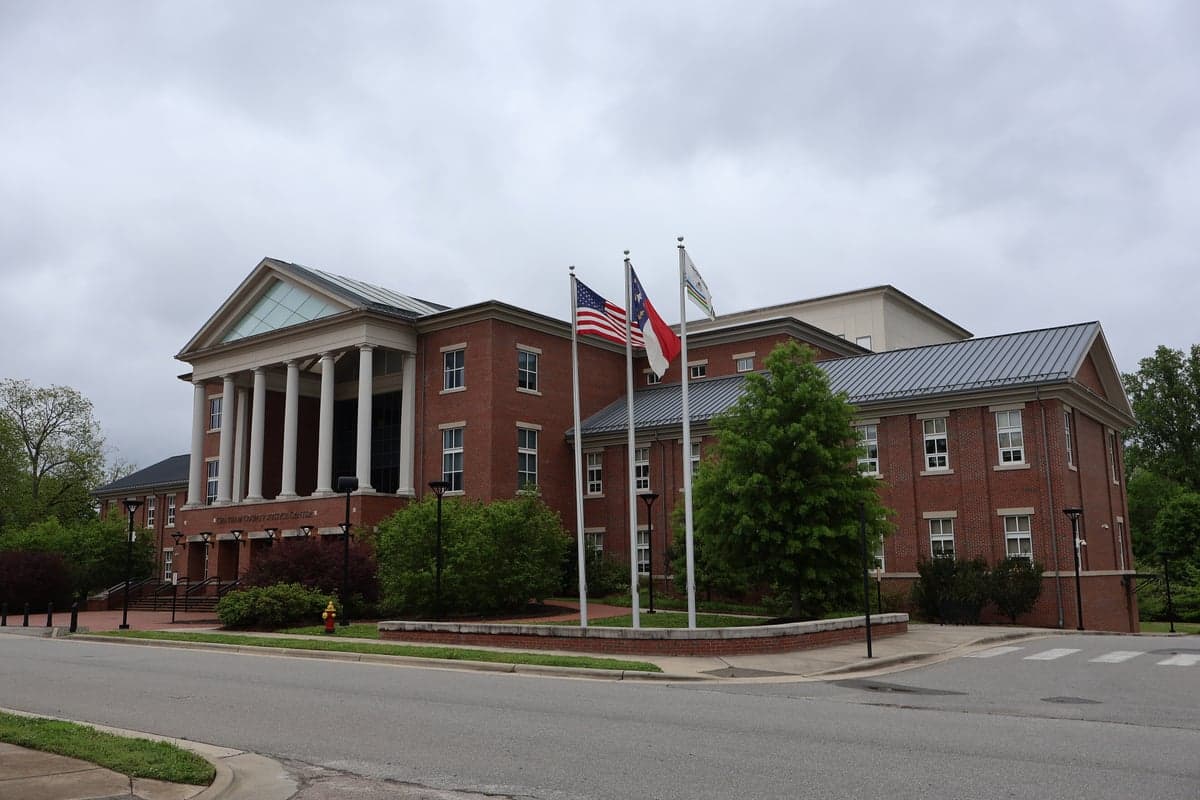
Photo: Wikipedia
Political ClimatePolitical Climate in Chatham County
Showing county-level results — no local-only data available.
Lean and PVI are calculated from this county’s 2020 and 2024 presidential results, Cook-style.
Political rankings in North Carolina
- Most Conservative Cities in North Carolina
- Most Liberal Cities in North Carolina
- Best Liberal-Leaning Towns in the South
- Best Liberal-Leaning Towns in Appalachia
- Safest Liberal-Leaning Towns in the South
- Safest Conservative-Leaning Towns in the South
- Safest Conservative-Leaning Towns on the East Coast
- Affordable Small Towns for Conservatives
- Most Conservative Counties in North Carolina
- Most Liberal Counties in North Carolina
Local Political AnalysisPolitical Analysis of Chatham County
Chatham County has shifted from a reliably conservative rural area to a Democratic-leaning suburban battleground, now carrying a Cook PVI of D+5. That’s a dramatic swing from just a decade ago, when the county was a toss-up or leaned slightly red. The change is driven almost entirely by explosive growth in the western and central parts of the county, particularly around the towns of Pittsboro and Chapel Hill’s southern fringe, where new subdivisions and tech workers from the Research Triangle Park have flooded in. Meanwhile, the eastern and southern parts of the county—places like Goldston, Bear Creek, and Moncure—still vote reliably Republican, creating a sharp urban-rural divide within a single county.
How it compares
North Carolina as a whole is a classic swing state with a Cook PVI of R+1, meaning it leans very slightly Republican but is competitive at the presidential level. Chatham County’s D+5 rating makes it significantly more Democratic than the state average, a gap of about 6 points. That’s a bigger Democratic lean than neighboring Wake County (D+4) or Orange County (D+18), but less than Durham County (D+26). In practice, this means Chatham County is a key part of the “blue wall” that Democrats need to hold to win statewide races. In 2020, Joe Biden won Chatham by about 8 points, while Donald Trump carried North Carolina by 1.3 points. The county’s shift is a microcosm of the broader suburban realignment happening across the South, where fast-growing exurbs are flipping from red to purple or blue.
What this means for residents
For conservative residents, especially those in the rural eastern half, the political shift can feel disorienting. They still hold local offices in some precincts—Goldston and Bear Creek regularly vote 65-70% Republican—but countywide elections are now dominated by the Pittsboro-area vote. The Chatham County Board of Commissioners has a Democratic majority, and the county’s legislative delegation in Raleigh is split. For liberal residents, the trend is validating but comes with growing pains: new development, traffic on US 64 and NC 87, and rising property taxes as the county invests in schools and infrastructure to keep up with population growth. Both sides agree on one thing: the pace of change is the biggest political issue, not any single party.
Culturally, the county is a study in contrasts. Pittsboro’s historic downtown has become a hub for organic farms, craft breweries, and progressive activism—home to the Chatham County Democratic Party and frequent local protests. Meanwhile, the Chatham County Fair in Goldston still feels like a classic Southern agricultural event, with livestock shows and gospel music. Policy-wise, the county has embraced some progressive measures, like a 2023 resolution supporting renewable energy and a 2024 affordable housing bond, but it has also resisted others, like a proposed moratorium on new subdivisions. The result is a place where a Trump flag on a pickup truck and a “Hate Has No Home Here” yard sign can coexist within a mile of each other—and where the real political action is less about national culture wars and more about how to manage growth without losing what makes Chatham County unique.

State Political ClimatePolitical Climate in North Carolina
State Political AnalysisPolitical Environment in the State
North Carolina is a classic purple state that has been trending rightward in recent cycles, with a Cook PVI of R+1, but its politics are far more nuanced than that single number suggests. The state has a long history of competitive elections, but since 2012, Republicans have consistently controlled the General Assembly and have won the governorship only once in that span (Pat McCrory, 2012). The real story is a deep urban-rural divide, with booming metros like Charlotte and Raleigh-Durham driving Democratic gains, while rural and exurban areas have shifted hard right, creating a political tug-of-war that defines every election.
Urban vs. rural divide
The political map of North Carolina is a study in contrasts. The major urban centers—Charlotte (Mecklenburg County), Raleigh and Durham (Wake and Durham Counties), and Greensboro and Winston-Salem (Guilford and Forsyth Counties)—are solidly Democratic, driven by a mix of college-educated professionals, younger residents, and diverse populations. Mecklenburg County alone delivered a 30-point margin for Biden in 2020. In contrast, the rural east and the mountain west are deeply Republican. Counties like Stokes and Surry in the northwest routinely vote 70%+ Republican. The real battlegrounds are the fast-growing suburban and exurban counties like Union (south of Charlotte), Johnston (southeast of Raleigh), and Cabarrus—places that were once reliably red but are now becoming more competitive as new residents arrive. Wake County flipped from red to blue in 2008 and has stayed there, while Mecklenburg has been blue for decades. The rural east, once a Democratic stronghold under the "Solid South," is now deeply Republican, driven by cultural and economic shifts.
Policy environment
North Carolina has a low-tax, business-friendly posture that appeals to conservative relocators. The state has a flat individual income tax rate of 4.5% (as of 2025), with scheduled reductions to 3.99% by 2027. The corporate income tax is 2.5% and is set to phase out entirely by 2030. There is no state tax on Social Security benefits, and the standard deduction is generous. The regulatory environment is generally light, with right-to-work laws and a tort reform system that caps non-economic damages in medical malpractice cases. On education, the state has a robust school choice program, including Opportunity Scholarships (vouchers) that have been expanded to all income levels, and a growing charter school sector. Higher education is anchored by the UNC system, which includes flagship campuses in Chapel Hill and Raleigh. Healthcare policy is a mixed bag: the state expanded Medicaid in 2023 under a bipartisan deal, but the expansion includes work requirements and a sunset clause, reflecting the conservative legislature's influence. Election laws have been a flashpoint: the state requires voter ID, has strict absentee ballot rules, and has drawn congressional maps that have been repeatedly challenged in court. The state also has a 12-week abortion ban (with exceptions for rape, incest, and life of the mother), passed in 2023.
Recent policy direction
The last few years have seen a clear conservative shift on several fronts. In 2023, the Republican supermajority (briefly held) passed a 12-week abortion ban over the governor's veto, a major change from the previous 20-week limit. Gun laws have been loosened: in 2023, the state eliminated the requirement for a permit to purchase a handgun (permitless carry), and in 2024, it passed a law allowing concealed carry in houses of worship with the church's permission. On education, the legislature expanded school vouchers to all families, regardless of income, in 2024, and passed the Parents' Bill of Rights, which requires schools to notify parents about changes in a child's health or well-being. On voting, the state enacted stricter voter ID requirements and shortened the absentee ballot request window. Property rights were strengthened with a 2023 law limiting the ability of local governments to impose rent control and restricting annexation powers. On privacy and surveillance, the state has no broad data privacy law, but it did pass a law in 2024 restricting the use of facial recognition by law enforcement without a warrant. Medical and bodily autonomy remains a contested area: the 12-week abortion ban is in effect, but the state also has a "born-alive" law and restrictions on gender-affirming care for minors (2023). Tax policy continues to trend downward, with the flat tax rate scheduled to fall and the corporate tax set to zero.
Civil unrest & political movements
North Carolina has seen its share of political flashpoints. The 2016 and 2020 elections brought protests over the state's voter ID law and gerrymandering, with large demonstrations in Raleigh and Charlotte. The 2020 protests over George Floyd's death were significant in Durham and Raleigh, with some property damage and a heavy police presence. The state has a history of organized activism on both sides: the Moral Monday movement (2013 onward) brought progressive protests to the legislature, while conservative groups like the John Locke Foundation and the North Carolina Family Policy Council have been influential in shaping policy. Immigration politics are relatively muted compared to border states, but there have been local sanctuary city debates: Durham and Orange County have declared themselves sanctuary jurisdictions, while the state legislature has passed laws (2015, 2019) banning sanctuary policies and requiring cooperation with ICE. Election integrity has been a persistent issue: the 2020 election saw lawsuits over absentee ballot rules and the state's handling of the pandemic, and the 2024 election cycle brought renewed debates over voter ID implementation. There is no serious secession or nullification rhetoric, but the state has a strong "local control" movement, particularly in rural counties pushing back against state mandates on things like mask mandates and vaccine requirements.
Projection
Over the next 5-10 years, North Carolina is likely to remain a competitive purple state, but the trajectory is toward a more stable Republican lean at the state level, even as the presidential race remains close. The key demographic driver is in-migration: the state is growing rapidly, with many new residents coming from blue states like New York, California, and New Jersey. These newcomers tend to be more moderate or conservative on economic issues but more liberal on social issues, which could push the state slightly left on cultural questions. However, the rural and exurban areas are also growing, and the Republican legislature has shown a willingness to entrench its power through redistricting and election laws. The 2024 election results (Trump won the state by about 3 points) suggest the GOP has a slight edge, but the margin is thin enough that a Democratic wave could flip it. The most likely scenario is continued divided government: a Republican legislature and a Democratic governor (or a Republican governor who is more moderate than the legislature). For a new resident, this means a state that is broadly conservative on taxes and regulation, but with ongoing fights over social issues like abortion, education, and voting rights.
For someone moving to North Carolina, the practical takeaway is that you are choosing a state with low taxes, a business-friendly environment, and a strong school choice system, but also one where the political climate is genuinely contested. If you are conservative, you will find a legislature that shares your values on taxes, guns, and education, but you may be frustrated by the governor's veto power on social issues. If you are liberal, you will find welcoming cities and a growing progressive movement, but you will face a legislature that is consistently hostile to your priorities on abortion, voting, and LGBTQ rights. The key is to choose your county wisely: Mecklenburg and Wake are blue islands, while Union and Johnston are red suburbs that are slowly diversifying. The state's future is being written by the people moving in, and the next decade will determine whether North Carolina becomes a solid red state or remains the nation's premier battleground.
* Values derived from national, state, county, city and local statistics and may differ in a specific area. Last updated: 2026-11-15T05:38:17.000Z
Narrative content on this page is AI-generated and may contain mistakes. Verify any details that matter before acting on them.
ReloMaps may earn a commission from affiliate links at no extra cost to you.

