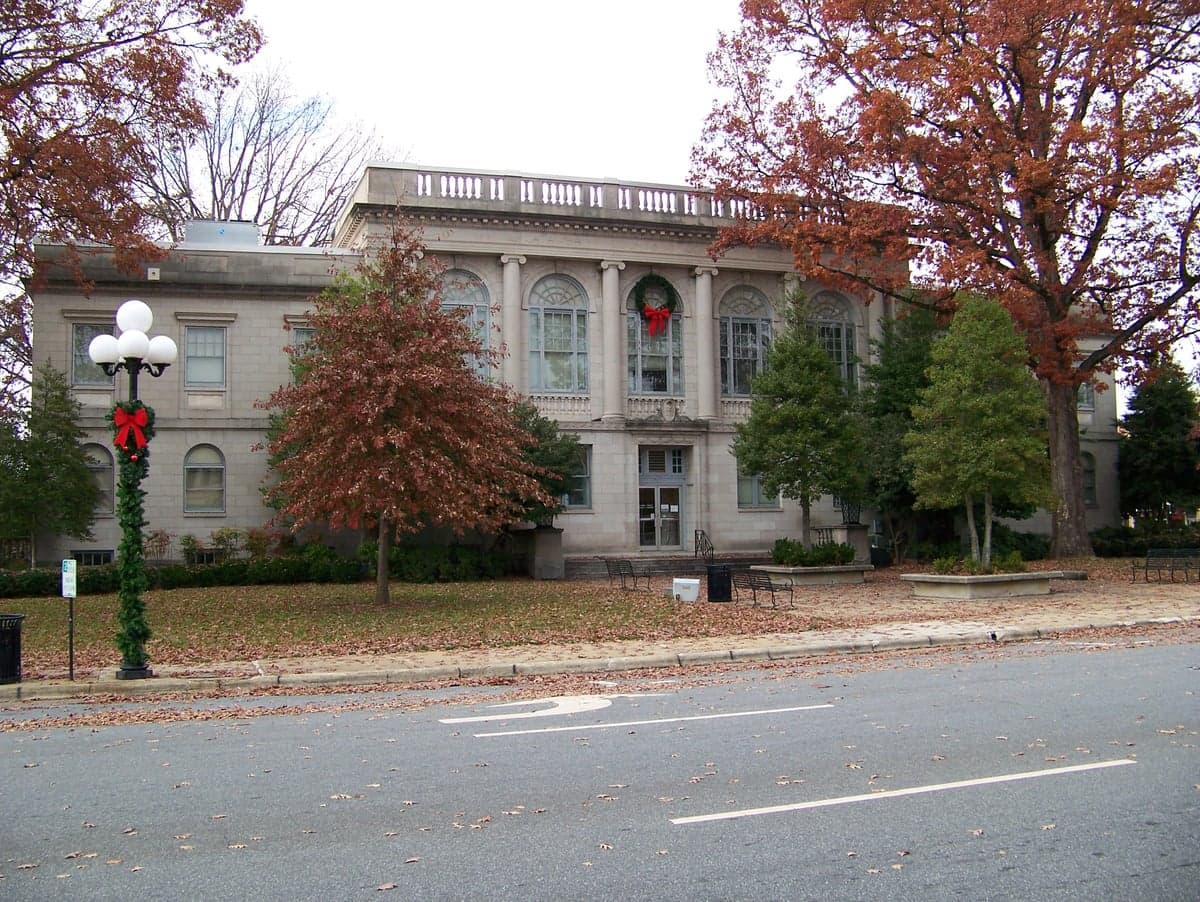
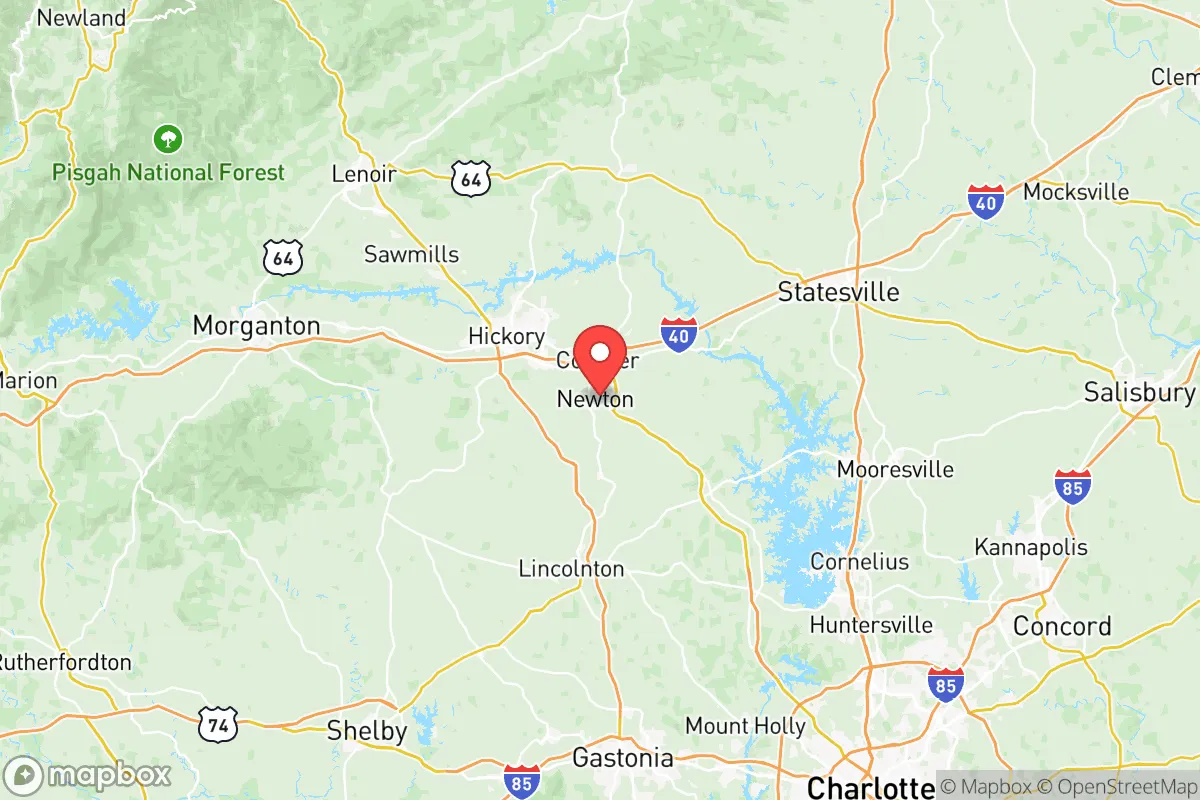
Photo: Wikipedia
Political ClimatePolitical Climate in Catawba County
Showing district-level results — no local-only data available.
Local Political AnalysisPolitical Analysis of Catawba County
Catawba County has long been a solidly conservative stronghold in western North Carolina, and that hasn't changed much despite the state trending closer to purple. The Cook Partisan Voting Index (PVI) sits at R+9, meaning the county votes about nine points more Republican than the national average. That's a far cry from the state's overall R+1 rating, which reflects how close races have gotten statewide. If you've lived here a while, you remember when you could practically call the election results before the polls closed. These days, you still can for the county itself, but you'll notice some towns are starting to shift in ways that raise an eyebrow.
How it compares
North Carolina as a whole has become a battleground state, with the R+1 PVI reflecting razor-thin margins in presidential and Senate races. Catawba County, by contrast, remains reliably red. In 2024, Donald Trump carried the county by roughly 30 points, while the statewide margin was under 3 points. That gap tells you everything about how different the local political culture is from the state's urban centers. Hickory, the county seat, still leans Republican overall, but its precincts near Lenoir-Rhyne University and the downtown core have trended bluer in recent cycles. Towns like Conover and Newton are more reliably conservative, while the rural areas around Maiden and Claremont are about as red as it gets. The real swing precincts are in the suburban fringe of Hickory, where new transplants from Charlotte and other metros have brought more progressive voting patterns. It's not a flood, but it's a trickle that's worth watching.
What this means for residents
For folks who value limited government and personal freedoms, Catawba County still offers a refuge from the overreach you see in places like Raleigh or Charlotte. Local officials here generally resist the kind of zoning mandates, mask mandates, and business restrictions that became common during the pandemic. Property taxes remain low compared to the state average, and there's no county-level income tax. The school board has pushed back against controversial curriculum changes that some see as government intrusion into family values. That said, the growing progressive influence in Hickory's core is starting to show up in city council debates over things like affordable housing mandates and police funding. It's not a crisis yet, but longtime residents are keeping an eye on it. If you're moving here from a blue state, you'll find the local culture refreshingly hands-off—but don't be surprised if the county's politics feel a generation behind the state's coastal cities.
Culturally, Catawba County still holds onto its furniture-manufacturing roots and evangelical Christian character, which shapes policy in ways that matter day-to-day. You won't see the same push for sanctuary city policies or drag story hours that you'd find in Asheville or Durham. The county commission has passed resolutions affirming Second Amendment rights and pushed back against state-level environmental regulations that would burden local businesses. For someone concerned about government overreach, this is still one of the safer corners of North Carolina. But the demographic shift is real—more remote workers, more retirees from out of state, more young families priced out of Charlotte. If that trend continues, the county's R+9 rating could start to slip. For now, though, it's a place where conservative values still carry the day, and where you can expect your local government to stay out of your business.

State Political ClimatePolitical Climate in North Carolina
State Political AnalysisPolitical Environment in the State
North Carolina is a classic swing state with a Cook PVI of R+1, meaning it leans just slightly Republican at the statewide level, but the real story is how that margin has tightened and shifted over the last 20 years. For most of the 2000s and 2010s, the state was a reliable red dot in presidential elections, going for GOP candidates from 1980 through 2012 except for Obama’s narrow win in 2008. But the 2020 and 2024 cycles showed a state that’s become a true battleground, with Trump winning by less than 1.5 points in 2020 and by about 3 points in 2024. The dominant coalitions are a mix of rural conservatives, suburban moderates, and a rapidly growing urban progressive base, making it a state where no single faction can rest easy.
Urban vs. rural divide
The political map of North Carolina is a textbook example of the urban-rural split. The major metros—Charlotte (Mecklenburg County), Raleigh-Durham (Wake and Durham Counties), and Greensboro-Winston-Salem (Guilford and Forsyth Counties)—are the engines of Democratic growth. Mecklenburg County alone delivered over 300,000 votes for Biden in 2020, and Wake County added another 280,000. These areas are driven by transplants from the Northeast and California, tech and finance workers, and a growing minority population. Meanwhile, the rural east and west—places like Wilmington (New Hanover County), Fayetteville (Cumberland County), and the mountain counties around Asheville (Buncombe County)—are more mixed. Asheville is a blue island in a sea of red, while Wilmington and Fayetteville are purple, with military bases and retiree populations pulling them right. The real battlegrounds are the exurban and suburban counties like Union County (Charlotte suburbs), Johnston County (Raleigh suburbs), and Cabarrus County—these areas have been trending red but are seeing in-migration that could flip them in the next decade. The rural counties in the east, like Robeson County and Columbus County, are heavily Democratic on paper but culturally conservative, often splitting tickets for GOP candidates at the state level.
Policy environment
North Carolina’s policy environment is a mixed bag that reflects its divided government. The state has a flat income tax rate of 4.5% (down from 7% in 2013), and the GOP-controlled legislature has been pushing for further cuts, with a goal of 3.99% by 2027. Sales tax is around 4.75% state-level, with local add-ons that can push it to 7.5% in some counties. Property taxes are low by national standards, averaging about 0.8% of home value. On education, the state has a robust school choice program, including the Opportunity Scholarship Program that now provides vouchers for private school tuition, expanded in 2023 to cover all income levels. This is a major draw for conservative families. Healthcare is a sore spot: the state refused Medicaid expansion for a decade under GOP leadership, but finally expanded it in December 2023 under a bipartisan deal, adding 600,000 people to the rolls. Election laws have been a flashpoint: the state has voter ID requirements (passed in 2018, implemented in 2023 after court battles), early voting is generous (17 days), and same-day registration is allowed during early voting. The state also has a Republican supermajority in the legislature that can override gubernatorial vetoes, which has been used to pass abortion restrictions (12-week ban in 2023) and a parental rights bill (the Parents’ Bill of Rights, 2023).
Trajectory & freedom
On the freedom front, North Carolina has been a mixed story. The good news for conservatives: the state has expanded gun rights significantly. In 2023, the legislature passed a permitless carry law (HB 189), allowing anyone 18 or older who can legally own a firearm to carry it concealed without a permit. This was a major win for Second Amendment advocates. Property rights got a boost with the 2023 repeal of the state’s Certificate of Need (CON) laws for certain medical facilities, making it easier to build hospitals and clinics. On the concerning side, the state has seen a slow creep of progressive policies in the cities. Charlotte and Raleigh have passed local non-discrimination ordinances that include sexual orientation and gender identity, and the state’s 2016 “bathroom bill” (HB2) was a national embarrassment that got repealed in 2017, but the replacement (HB142) still restricts local governments from passing their own anti-discrimination laws until 2020—and that moratorium has expired, leading to a patchwork of local rules. Parental rights got a boost with the 2023 Parents’ Bill of Rights, which requires schools to notify parents about changes in a child’s health or well-being and prohibits instruction on gender identity and sexuality in K-4 classrooms. Medical autonomy is a mixed bag: the 12-week abortion ban is restrictive but includes exceptions for rape, incest, and fetal anomalies, and the state has a strong conscience clause for medical providers. The biggest red flag for freedom-minded folks is the state’s heavy reliance on federal funding (about 30% of the state budget) and the growing influence of corporate interests in the Research Triangle, which often pushes for DEI and ESG policies that conflict with conservative values.
Civil unrest & political movements
North Carolina has seen its share of political flashpoints. The 2020 protests in Charlotte and Raleigh over George Floyd’s death were large but mostly peaceful, though there were some instances of property damage and looting in Charlotte’s South End. The state has a strong activist presence on both sides: the left has groups like the NC NAACP and the Poor People’s Campaign, while the right has the NC GOP’s grassroots network and groups like the John Locke Foundation. Immigration politics are relatively quiet compared to border states, but there’s a sanctuary city debate: Durham and Orange County have declared themselves “welcoming cities,” limiting cooperation with ICE, while the state legislature passed a law in 2015 (HB 318) requiring sheriffs to honor ICE detainers, though some sheriffs in blue counties refuse. Election integrity was a major issue after 2020, with the GOP-led legislature passing a series of laws to tighten voting rules, including the voter ID requirement and restrictions on absentee ballot drop boxes. The state also saw a controversial redistricting process in 2023, with the GOP drawing maps that gave them a 10-4 advantage in the US House delegation (though one seat was later flipped in a special election). The most visible flashpoint for a new resident would be the constant political advertising—North Carolina is a top-5 swing state, so you’ll see non-stop campaign ads for president, governor, and legislature every two years.
Projection
Over the next 5-10 years, North Carolina is likely to become more competitive, not less. The in-migration from blue states (especially New York, New Jersey, and California) is accelerating, with the state adding about 100,000 new residents per year. Most of these transplants are settling in the urban and suburban counties around Charlotte and the Triangle, which will continue to push those areas leftward. However, the rural counties are also growing, driven by retirees and remote workers moving to places like Wilmington and the Foothills. The net effect is that the state will likely remain a toss-up for the foreseeable future, with the GOP holding a slight edge in state legislative races due to gerrymandering and the Democratic advantage in presidential races narrowing. The biggest wild card is the state’s growing Hispanic population, which is concentrated in the eastern counties and is trending more conservative than national averages. If the GOP can hold onto these voters, they’ll maintain their edge. If not, the state could flip blue by 2032. For a conservative moving in now, expect a state that’s still red-leaning but requires constant vigilance—the legislature is solidly GOP, but the governor’s mansion is currently held by Democrat Roy Cooper (term-limited in 2024), and the next governor race in 2024 will be a major test.
Bottom line for a new resident: North Carolina offers a relatively low-tax, gun-friendly, school-choice-friendly environment with a strong economy and beautiful geography. But you’ll need to pick your county carefully—Union County or Johnston County will feel like solid conservative ground, while Durham or Orange County will feel like a blue state enclave. The state’s political future is uncertain, but for now, it’s one of the best bets in the South for someone who wants conservative policies without the extreme heat of Texas or Florida. Just be prepared for the constant political noise—this is a state where every election matters, and your vote actually counts.
* Values derived from national, state, county, city and local statistics and may differ in a specific area. Last updated: 2026-06-06T09:10:36.000Z
Narrative content on this page is AI-generated and may contain mistakes. Verify any details that matter before acting on them.
ReloMaps may earn a commission from affiliate links at no extra cost to you.

