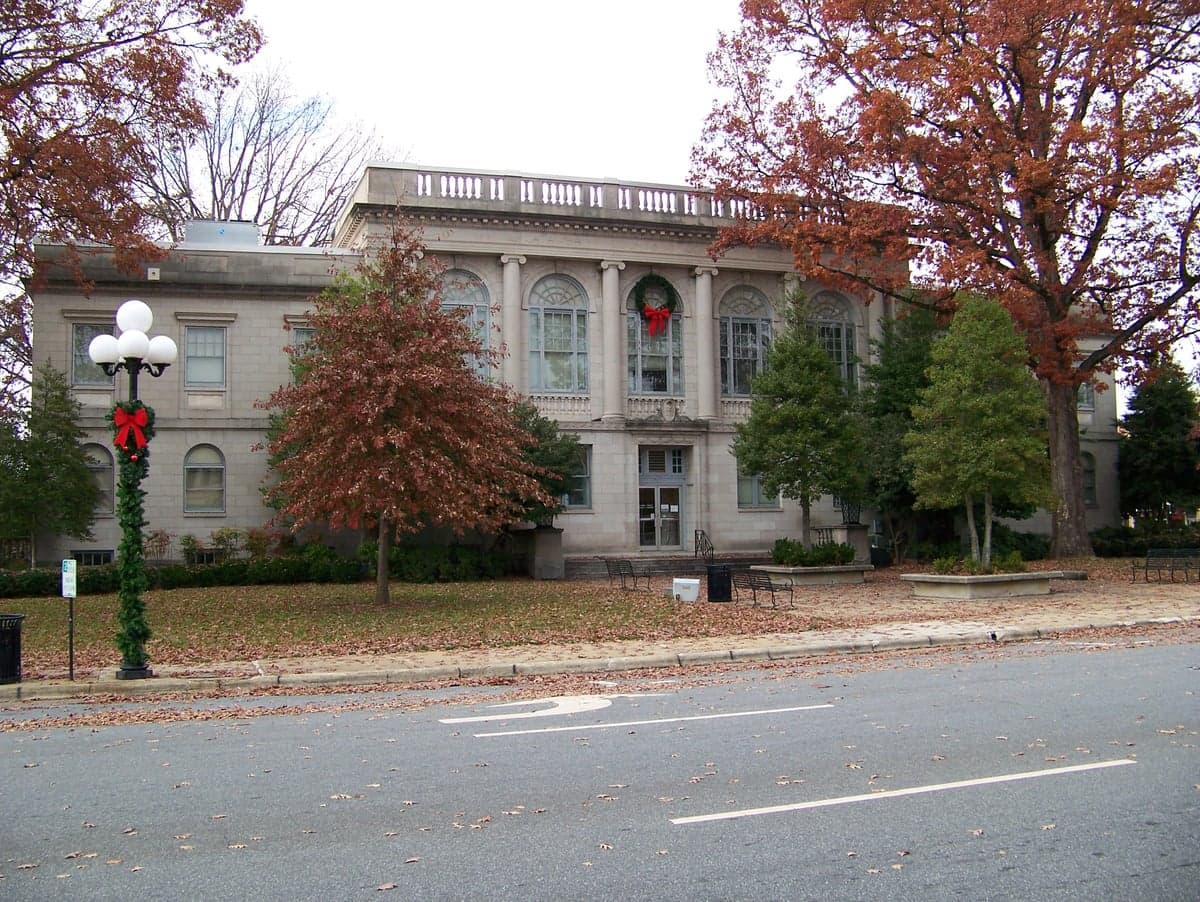
Photo: Wikipedia
Personal Sovereignty in Catawba County
Viable for self-reliance. Generally workable, though some barriers may limit total independence.
What does Personal Sovereignty tell us?
Personal Sovereignty measures your capacity for self-reliance and independence with minimal government friction. Higher scores mean fewer barriers between you and the way you want to live... but it assumes you have the space you need and good neighbors.
What does this tell us?
Personal Sovereignty measures your capacity for self-reliance and independence with minimal government friction. Higher scores mean fewer barriers between you and the way you want to live... but it assumes you have the space you need and good neighbors.
State Policy
Energy independence: Importer (15% of energy produced in-state)
Personal Liberty
Homesteading

Personal Liberty Analysis
Catawba County, North Carolina, offers a notably high degree of personal sovereignty compared to many urban and coastal areas, particularly for those who prioritize autonomy over government convenience. The county’s political culture, rooted in a blend of traditional Appalachian self-reliance and Piedmont industrial pragmatism, creates an environment where individual decision-making is broadly respected, though not without local constraints. For the strategic relocator—especially a single person or parent concerned with federal overreach and cultural erosion—this region presents a viable middle ground between rural isolation and suburban oversight, with the key trade-offs being proximity to state power centers versus genuine local control.
Tax burden and regulatory posture in Catawba County
North Carolina’s flat income tax rate of 4.5% (as of 2025) and a state sales tax capped at 7% provide a baseline fiscal environment that favors earners and consumers over government expansion. Catawba County itself levies a property tax rate of approximately $0.57 per $100 of assessed value, which is moderate for the region—lower than Mecklenburg County (Charlotte) but higher than more rural counties like Mitchell or Yancey. The regulatory posture here is distinctly business-friendly, with the county’s economic development office actively courting manufacturing and logistics firms rather than imposing burdensome zoning or environmental mandates. However, the cities within the county vary: Hickory, the largest municipality, has a more developed code enforcement apparatus, while Conover and Newton maintain lighter touch regulations, particularly for home-based businesses and small-scale agriculture. For the prepper-minded, the county’s lack of a local income tax and its relatively low property tax burden mean more capital retained for self-sufficiency investments—though one must still navigate state-level building codes and septic system requirements that can complicate off-grid setups.
Self-defense and gun law specifics in the region
North Carolina is a shall-issue state for concealed carry permits, and Catawba County’s sheriff’s office processes permits efficiently, typically within the statutory 45-day window. The state preempts local firearm ordinances, meaning Hickory, Newton, and Claremont cannot enact their own bans or restrictions—a critical protection for gun owners. Stand-your-ground law is in effect, and the state does not require registration of long guns or handguns. For the survivalist, the practical reality is that Catawba County’s gun culture is robust but not extreme: you’ll see open carry in rural areas like St. Stephens or Long View, but it’s less common in Hickory’s commercial districts. The key advantage is the lack of magazine capacity restrictions and the ability to purchase NFA items (suppressors, short-barreled rifles) with a federal tax stamp, as the state does not prohibit them. For parents, the legal framework supports teaching children firearm safety without government interference, though school zones remain off-limits for carry without a permit. The county’s proximity to the Blue Ridge Mountains also means ample public land for shooting practice, with the Pisgah National Forest and Game Lands just a 30-minute drive west.
Self-reliance and homesteading viability across the county
Homesteading potential in Catawba County varies dramatically by location, driven by zoning and lot size requirements. In unincorporated areas like Mountain View or Sherrills Ford, parcels of 1-5 acres are common, and the county’s agricultural zoning allows for livestock, gardens, and even small-scale aquaculture without special permits. However, the county’s growth management plan has tightened rules near Lake Norman (southern Catawba), where Terrell and Denver (though Denver is in Lincoln County) see more restrictive covenants and HOAs that ban chickens, rainwater collection, or visible solar panels. For true off-grid feasibility, the northern and western parts of the county—around Balls Creek and Hildebran—offer the best prospects: well water is generally accessible at depths of 100-300 feet, and septic systems are permitted on lots of 1 acre or more with percolation tests. The county does not prohibit solar panels or wind turbines, but net metering with Duke Energy is limited, so battery storage is advisable. For the prepper, the critical constraint is that Catawba County does not allow permanent off-grid living without a septic permit—meaning you cannot legally live in a camper or shed full-time without a permitted dwelling. This is a common sticking point for those seeking total autonomy, but it’s less restrictive than counties like Wake or Mecklenburg, which ban such setups outright.
Personal liberties: parental rights, medical autonomy, speech, and property
North Carolina’s Parents’ Bill of Rights, enacted in 2023, gives Catawba County families strong legal backing to direct their children’s education and medical care, including the right to opt out of curriculum materials and to be notified of any changes in a child’s mental or physical health services at school. The county’s school board in Newton has been notably conservative, resisting state-level mandates on gender identity policies and maintaining parental notification requirements. Medical autonomy is more nuanced: while the state does not have a broad health freedom law, Catawba County’s healthcare landscape is dominated by private providers (Frye Regional Medical Center in Hickory, Catawba Valley Medical Center) that generally respect patient choice, though vaccine mandates have been a point of contention in local hospitals. Speech protections are strong under state law, with no local hate speech ordinances or social media censorship mandates. Property rights are the bedrock of sovereignty here: the county’s zoning board rarely exercises eminent domain for private development, and property taxes are predictable. For the strategic relocator, the key liberty advantage is the county’s lack of a local health department that aggressively enforces state-level nuisance codes—meaning you can store supplies, maintain a garden, and keep firearms without bureaucratic harassment, unlike in more urbanized counties.
Overall, Catawka County offers a sovereignty profile that sits comfortably between the heavy-handed regulation of Charlotte’s suburbs and the near-total autonomy of the far western mountains. The trade-off is that you must accept some state-level oversight—building codes, septic permits, and sales tax—but the county’s political culture and economic incentives align with personal responsibility and minimal government intrusion. For the single individual or parent seeking a base where self-reliance is respected, gun rights are secure, and homesteading is viable without constant legal battles, this region ranks favorably against comparable areas in Virginia or Tennessee, with the added advantage of lower property costs and a more temperate climate. The real test for the prepper-minded will be navigating the specific zoning in Hickory versus the unincorporated areas—choose the latter for maximum sovereignty, and you’ll find a community that largely leaves you alone to live as you see fit.

* Values derived from national, state, county, city and local statistics and may differ in a specific area. Last updated: 2026-06-06T09:10:36.000Z
Narrative content on this page is AI-generated and may contain mistakes. Verify any details that matter before acting on them.
ReloMaps may earn a commission from affiliate links at no extra cost to you.

