Photo: Wikipedia
Political ClimatePolitical Climate in Newark, CA
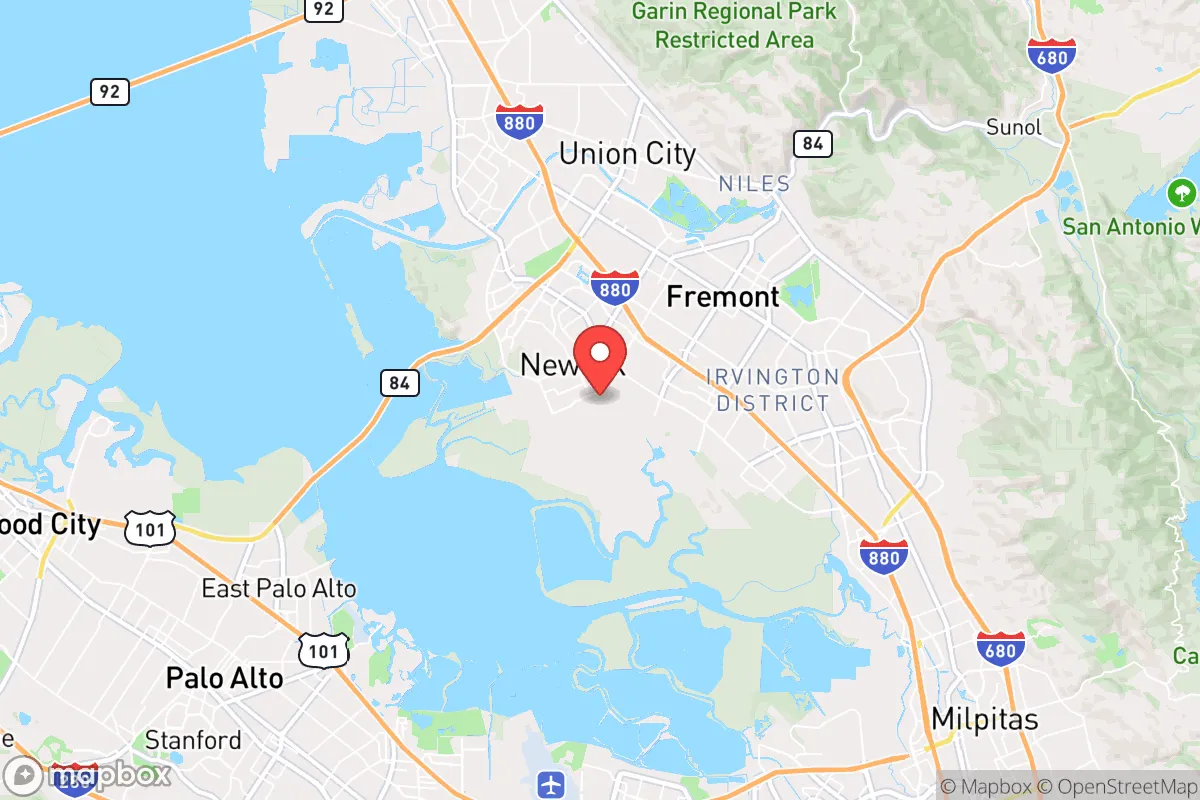
District shown is the primary district for this city’s centroid. Cities may span multiple districts.
Local Political AnalysisPolitical Analysis of Newark, CA
Newark, California, is a solidly Democratic city with a Cook Partisan Voting Index (PVI) of D+21, meaning it votes about 21 points more Democratic than the national average. This isn't a recent shift—the city has been a reliable blue stronghold for decades, driven by its diverse, working- and middle-class population, many of whom are union members, tech commuters, or first-generation immigrants. If you look at recent presidential elections, Newark has consistently backed Democratic candidates by margins of 60-70%, and there's no sign of that changing anytime soon; the city's growing Asian American and Latino communities, along with its proximity to Silicon Valley, reinforce this trajectory.
How it compares
Compared to the rest of California, Newark is actually a bit more Democratic than the state average. California as a whole has a Cook PVI of D+13, so Newark's D+21 puts it about 8 points to the left of the state. That might not sound like much, but it's noticeable when you look at neighboring cities. For instance, Fremont to the north is also heavily Democratic (D+22), but Union City to the east is slightly less so (D+18). The real contrast comes when you drive just 20 minutes east to places like Pleasanton or Livermore, which lean more moderate or even Republican-leaning in some precincts (Pleasanton is roughly D+5). So Newark feels like a deep-blue island in a sea of blue, but with a distinctly working-class, family-oriented vibe that sets it apart from the more affluent, tech-heavy liberal enclaves like Palo Alto or Cupertino.
What this means for residents
For liberal residents, Newark's political climate means their values are largely reflected in local policy—think strong support for public schools, affordable housing initiatives, and environmental regulations. The city council and school board are reliably progressive, so issues like rent control, tenant protections, and sanctuary city policies tend to get traction. For conservative residents, life is still perfectly fine, but you'll be in the minority. You won't find many overtly conservative candidates winning local office, and social issues like gun rights or tax cuts are rarely front-burner topics. That said, Newark is a practical, no-drama place—people are more focused on traffic, school ratings, and the cost of living than on political grandstanding. You can absolutely be a Republican here and have good neighbors; you just won't see many "Trump 2024" signs in front yards.
Culturally, Newark stands out for its pragmatic, family-first ethos. Unlike some Bay Area cities where politics can feel like a lifestyle brand, Newark's political discussions tend to be grounded in concrete issues: how to manage growth along the 880 corridor, how to keep the local parks funded, or how to support the many small businesses run by immigrant families. The city has a strong sense of community identity that transcends party lines—people here are proud of Newark's diversity and its reputation as a safe, affordable (by Bay Area standards) place to raise kids. If you're moving here, expect a place where politics matter, but they don't dominate daily life. The biggest political debate you'll overhear at a coffee shop is probably about whether the new apartment complex on Thornton Avenue will ease the housing crunch or just make traffic worse.

State Political ClimatePolitical Climate in California
State Political AnalysisPolitical Environment in the State
California is a solidly Democratic state, with Democrats holding every statewide office and supermajorities in both legislative chambers, but its reputation as a monolithic liberal bastion oversimplifies a deeply fractured political landscape. The state hasn't voted Republican in a presidential election since 1988, and the partisan gap has widened steadily over the past two decades — from a roughly 10-point Democratic margin in 2000 to a consistent 20-30 point spread in recent cycles. However, that blue veneer masks one of the most dramatic urban-rural divides in the country, and the state's policy trajectory has created a political reality where conservative residents in places like Bakersfield or Redding live under a completely different set of cultural and economic conditions than their counterparts in San Francisco or Los Angeles.
Urban vs. rural divide
The political map of California is essentially a story of coastal metros versus the interior. The Bay Area, Los Angeles County, and the Sacramento-Sacramento region drive the state's Democratic supermajority — San Francisco routinely votes 85% Democratic, and Los Angeles County alone provides more Democratic votes than most entire states. Meanwhile, the Central Valley and far northern counties are deeply Republican: Kern County (Bakersfield) voted +22 for Trump in 2020, and Shasta County (Redding) went +35. The Inland Empire shows more competition — San Bernardino County has been trending rightward, flipping from Clinton +15 in 2016 to Biden +8 in 2020, while Orange County, once a Republican stronghold, has shifted dramatically left and now votes Democratic in most statewide races. The practical effect is that a conservative moving to Bakersfield will find a reliably red community with conservative local governance, while a liberal moving to Redding will feel politically isolated.
Policy environment
California's policy environment is defined by high taxes, heavy regulation, and expansive state government. The state has the highest top marginal income tax rate in the country at 13.3%, a statewide sales tax base rate of 7.25% (with local add-ons pushing many areas above 10%), and some of the highest gas taxes and property tax rates when factoring in Proposition 13's limitations. Regulatory costs are substantial — housing development faces extensive environmental review under the California Environmental Quality Act (CEQA), energy regulations are among the strictest nationally, and labor laws mandate things like paid sick leave, overtime rules that exceed federal standards, and a $16 minimum wage as of 2024. Education policy is centralized: the state controls curriculum standards, teacher credentialing, and funding formulas, with school choice limited compared to many states. Healthcare is heavily regulated, with the state operating its own insurance exchange (Covered California) and moving toward a single-payer model, though it hasn't been implemented. Election laws are among the most accessible in the country — universal mail-in voting, same-day registration, and automatic voter registration are all in place.
Recent policy direction
The last five years have seen California accelerate its progressive policy agenda across multiple fronts. On gun and self-defense law, the state has passed some of the nation's strictest measures: SB 2 (2023) banned concealed carry in most public places, and the state maintains an assault weapons ban, magazine capacity limits, and a "may issue" permitting system that effectively prohibits most public carry. Parental and education rights have become a flashpoint — AB 1955 (2024) prohibits school districts from requiring parental notification when a child changes their gender identity, and the state has mandated ethnic studies and LGBTQ-inclusive curriculum. Speech and privacy are protected by the California Consumer Privacy Act (CCPA) and its expansion, the CPRA, which give residents strong data privacy rights, but the state has also passed laws targeting disinformation and hate speech that critics argue chill expression. Medical and bodily autonomy is broadly protected — California has codified abortion rights into state law, expanded Medicaid coverage for gender-affirming care, and passed shield laws protecting providers who serve out-of-state patients. Property rights are constrained by rent control expansion (AB 1482 caps annual rent increases at 5% plus inflation), strict tenant protections, and CEQA's use as a tool to block development. Taxation has moved leftward with a wealth tax proposal gaining traction and the state's "millionaire's tax" funding mental health services. Voting and ballot access has been expanded through universal mail-in ballots, automatic registration, and felony re-enfranchisement.
Civil unrest & political movements
California has been a national epicenter for political activism on both sides. The 2020 George Floyd protests in Los Angeles and Oakland were among the largest and most destructive in the country, with billions in property damage and ongoing debates about police reform and defunding. The state's sanctuary laws — SB 54 (2017) limits local law enforcement cooperation with federal immigration authorities — have made California a flashpoint in national immigration politics, with the Trump administration repeatedly suing the state. On the right, the "State of Jefferson" movement in far northern counties like Siskiyou and Modoc continues to push for secession from California, though it remains a fringe effort. Election integrity controversies have been less intense than in swing states, but the 2021 recall election of Governor Gavin Newsom saw organized Republican efforts that ultimately failed by a 24-point margin. More recently, homelessness and property crime have become major political flashpoints, with Proposition 36 (2024) rolling back some criminal justice reforms and increasing penalties for theft and drug offenses — a sign that even in deep-blue California, public safety concerns are shifting the conversation.
Projection
Over the next 5-10 years, California's political trajectory points toward continued Democratic dominance at the state level, but with growing internal friction. Demographic trends — an aging white population, declining birth rates among native-born residents, and continued immigration from Asia and Latin America — favor the Democratic coalition. However, the state is losing population to Texas, Arizona, and other states, and the people leaving are disproportionately middle-income and conservative-leaning, which could further concentrate Democratic power. The housing crisis is the wild card: if the state fails to build enough housing, it will continue to price out young families and working-class residents, potentially accelerating the exodus and creating a more elite, left-leaning electorate. The recent passage of Proposition 36 suggests a modest rightward shift on crime, but don't expect major reversals on taxes, regulation, or social policy. A conservative moving to California in 2026 should expect to live under Democratic governance for the foreseeable future, with their political influence limited to local elections in red counties and the occasional statewide ballot initiative.
For a new resident, the bottom line is that California offers a clear trade-off: you get a state with immense economic opportunity, natural beauty, and cultural dynamism, but you also get high taxes, heavy regulation, and a political environment where conservative voices have limited influence at the state level. If you're a conservative who values local community and can find work in a red county like Kern or Shasta, you can build a good life with like-minded neighbors — but you'll be fighting an uphill battle on state policy. If you're liberal, you'll find your values reflected in state law and a supportive political infrastructure, but you'll also contend with the practical consequences of those policies, from high housing costs to homelessness. Either way, know what you're signing up for.
* Values derived from national, state, county, city and local statistics and may differ in a specific area. Last updated: 2026-09-26T17:40:15.000Z
Narrative content on this page is AI-generated and may contain mistakes. Verify any details that matter before acting on them.
ReloMaps may earn a commission from affiliate links at no extra cost to you.

