Photo: Wikipedia
Political ClimatePolitical Climate in Rockland County
Showing district-level results — no local-only data available.
Local Political AnalysisPolitical Analysis of Rockland County
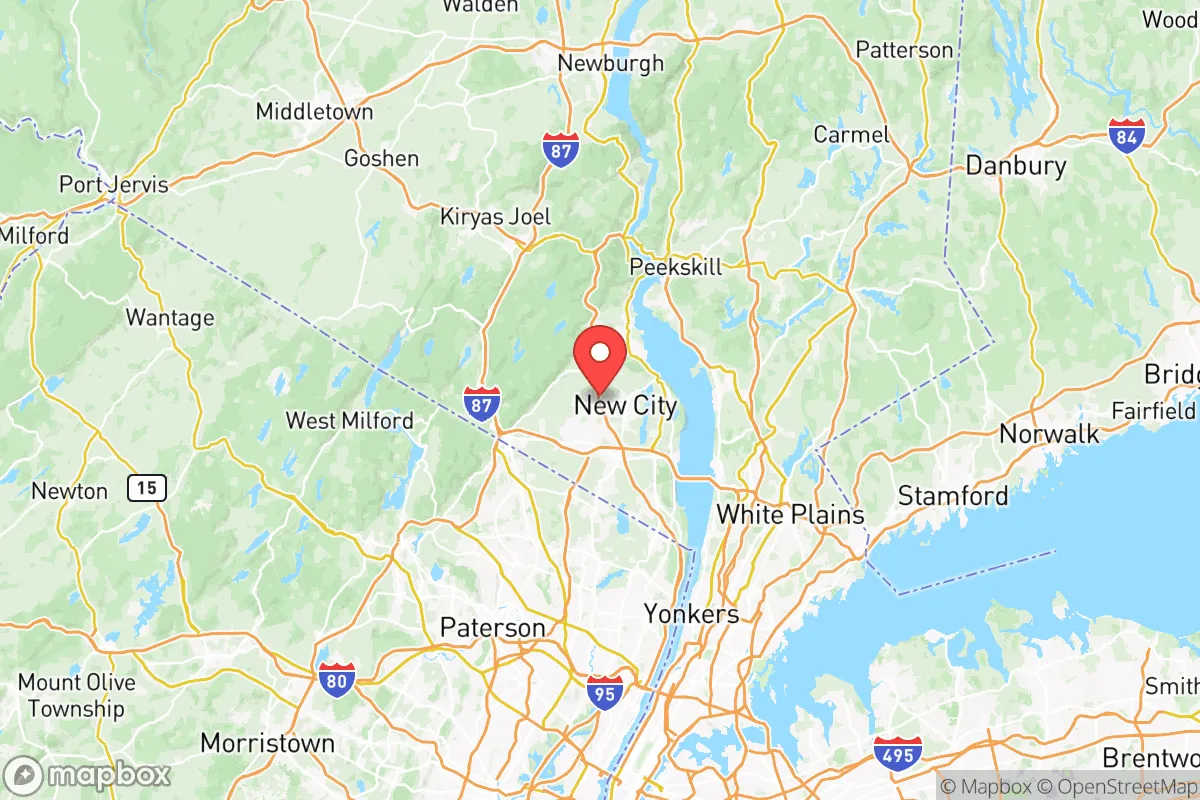
Rockland County has shifted from a reliable Republican stronghold to a genuine swing county, now rated D+1 on the Cook Partisan Voting Index. In 2020, Joe Biden carried it by just 1.2 points, and in 2024, Donald Trump actually flipped the county by a similar margin, reflecting a national trend of suburban drift to the right. The real story, though, is the internal split: the county’s Orthodox Jewish communities in Monsey, New Square, and Kaser vote overwhelmingly Republican, while Nyack, Piermont, and parts of New City remain solidly blue. The swing precincts are in Clarkstown and Ramapo, where moderate voters in developments like Willowbrook and Bardonia decide elections.
How it compares
Compared to New York City, Rockland is a political universe apart. While Manhattan and Brooklyn vote D+40 or higher, Rockland’s D+1 rating puts it closer to a place like Erie County (Buffalo) than to the five boroughs. The county’s large Hasidic and Orthodox populations—about 30% of residents—drive a uniquely conservative voting bloc on social issues and school funding, something you simply don’t see in NYC’s secular, progressive electorate. Meanwhile, the liberal river towns along the Hudson, like Nyack and Piermont, vote similarly to Park Slope, but they’re outnumbered by the suburban and religious voters inland. The result is a county that swings between parties every few cycles, unlike the city’s permanent Democratic lock.
What this means for residents
For conservatives, Rockland is one of the few places in the downstate region where a Republican can win a county executive race or a State Assembly seat—Mike Lawler flipped the 17th Congressional District in 2022, and Ed Day served as county executive for a decade. You’ll find GOP signs on lawns in New City and Nanuet without getting side-eye. For liberals, the county still funds robust public services, including the Rockland County Health Department and a strong public school system in South Orangetown and Clarkstown, and progressive candidates win local races in Nyack and Spring Valley. The practical effect is that policy tends to be moderate: taxes are high but not as high as Westchester, and zoning battles over housing and yeshivas are constant, reflecting the cultural divide.
Culturally, Rockland feels more like a Midwestern suburb than a NYC exurb. The county has a strong tradition of volunteer fire departments, local diners, and a slower pace of life. The biggest policy distinction from NYC is the school funding model: Rockland has dozens of separate school districts, each with its own tax levy, and the Orthodox community often runs private yeshivas, creating tension over public school budgets. The county also has a notable gun culture—there are several shooting ranges and sportsmen’s clubs—which is rare so close to the city. Looking ahead, expect Rockland to stay a bellwether: if national Democrats move left on Israel or school choice, they’ll lose more ground here; if Republicans overplay social issues, the river towns will push the county back to blue. Either way, it’s the most politically interesting county in the state outside of NYC.

State Political ClimatePolitical Climate in New York
State Political AnalysisPolitical Environment in the State
New York State has been a solidly Democratic stronghold for decades, but the picture is more complicated than a simple blue label. The state’s overall partisan lean is driven overwhelmingly by New York City and its immediate suburbs, which deliver massive Democratic margins. Over the last 10-20 years, the state has shifted further left on social and economic policy, but the rural and upstate regions have swung hard in the opposite direction, creating one of the sharpest urban-rural political divides in the country. For a conservative-leaning relocator, the practical reality is that your experience will vary dramatically depending on whether you land in Manhattan, Buffalo, or a small town in the Finger Lakes.
Urban vs. rural divide
The political map of New York is a tale of two states. New York City’s five boroughs—Manhattan, Brooklyn, Queens, The Bronx, and Staten Island—cast about 40% of the state’s vote and consistently deliver 70-85% Democratic margins. The immediate suburbs of Nassau and Suffolk counties on Long Island, plus Westchester and Rockland counties north of the city, lean Democratic but are more competitive, often flipping in statewide races. In contrast, the vast majority of upstate New York—places like Erie County (Buffalo), Monroe County (Rochester), and Onondaga County (Syracuse)—are Democratic-leaning only in their urban cores, while the surrounding rural towns and counties like Allegany, Steuben, and Lewis vote Republican by 20-40 points. A notable exception is Staten Island, which is the only NYC borough that has voted Republican in recent presidential elections, and Suffolk County’s eastern end, where conservative sentiment is strong. The divide isn’t just about population density—it’s about economic base, with the NYC metro tied to finance, tech, and media, while upstate relies on manufacturing, agriculture, and natural resources.
Policy environment
New York’s policy environment is among the most progressive in the nation, with a tax structure that reflects that. The state has a progressive income tax with rates from 4% to 10.9% on income over $25 million, and property taxes are among the highest in the U.S., especially in upstate school districts. Sales tax varies by county, typically 8-8.875%. The regulatory posture is heavy: rent control in NYC, strict environmental regulations (the Climate Leadership and Community Protection Act mandates 70% renewable energy by 2030), and a robust public sector. Education policy is centralized, with the state’s Board of Regents setting curriculum standards, and New York has some of the nation’s strongest teacher union protections. Healthcare is heavily regulated, with the state expanding Medicaid and running its own health insurance exchange. Election laws are relatively liberal: no-excuse absentee voting, early voting, and same-day registration are all in place. For a conservative, the policy environment can feel stifling, especially on taxes and regulation, but the state also offers strong public services, including well-funded schools and infrastructure.
Recent policy direction
Over the past five years, New York has accelerated its progressive agenda. In 2019, the state passed the Reproductive Health Act, codifying abortion rights into state law and removing restrictions. The NY SAFE Act (2013) remains the baseline for gun control, requiring background checks on private sales and banning assault weapons; in 2022, the state passed the Concealed Carry Improvement Act after the Supreme Court’s Bruen decision, making it harder to get a permit by requiring “good moral character” and banning guns in sensitive places. On parental and education rights, the state has moved left: it eliminated gifted and talented programs in NYC, expanded ethnic studies requirements, and passed the Gender Expression Non-Discrimination Act (GENDA) in 2019, which protects gender identity in housing and employment. On speech and privacy, the state passed the New York Privacy Act (still pending as of 2025) and has strict data breach notification laws. Property rights are constrained by rent control in NYC and strong tenant protections statewide. On voting, the state expanded mail-in voting and passed the John R. Lewis Voting Rights Act of New York in 2022, which requires pre-clearance for local election changes. For a relocator, the key takeaway is that New York is actively legislating on the frontier of progressive policy, especially on guns, gender, and voting access.
Civil unrest & political movements
New York has a long history of political activism, and recent years have seen intense polarization. The Black Lives Matter protests in summer 2020 were massive, particularly in NYC and Buffalo, leading to calls to defund the police and the eventual passage of police reform laws like the Eric Garner Anti-Chokehold Act. On the right, the Second Amendment sanctuary movement has gained traction in upstate counties like Delaware and Otsego, where local sheriffs have refused to enforce parts of the SAFE Act. Immigration politics are a flashpoint: New York is a sanctuary state, with the Green Light Law (2019) allowing undocumented immigrants to get driver’s licenses, and NYC has seen tensions over migrant shelters. Election integrity controversies have been relatively muted compared to swing states, but there were disputes over the 2020 absentee ballot counting in NYC. A visible flashpoint for new residents is the congestion pricing plan for Manhattan (paused as of 2025), which has sparked lawsuits and protests from suburban commuters. The overall atmosphere is one of high political engagement, with protests and rallies common in Albany and NYC, but quieter in rural areas.
Projection
Over the next 5-10 years, New York’s political trajectory points further left, but with growing friction. Demographic shifts are key: NYC continues to lose population to lower-tax states like Florida and Texas, while upstate sees slow growth or decline. The in-migration from abroad, however, keeps NYC’s electorate young and diverse, reinforcing Democratic dominance. The upstate rural backlash will likely intensify, with more counties declaring Second Amendment sanctuaries and resisting state mandates on energy and education. The state’s fiscal situation is a wildcard: high taxes and out-migration could force a reckoning, but the progressive coalition is unlikely to moderate. A relocator moving in now should expect that in a decade, New York will be even more regulated on guns, more protective of tenant and immigrant rights, and more aggressive on climate policy. The urban-rural divide will widen, meaning a conservative in upstate will feel increasingly out of step with state government, while a liberal in NYC will see their priorities enacted.
For a conservative-leaning relocator, the bottom line is that New York offers a high-quality public infrastructure and cultural amenities, but at the cost of high taxes, heavy regulation, and a political environment that is often hostile to traditional values. If you choose to live in a rural upstate county like Wyoming or Schoharie, you’ll find a like-minded community but constant friction with Albany. If you’re in the NYC suburbs, you’ll be in a more mixed environment but paying top dollar for housing and taxes. The state is not going to flip red anytime soon, so the decision comes down to whether the trade-offs—especially on taxes, guns, and education—are worth it for your family’s specific priorities.
* Values derived from national, state, county, city and local statistics and may differ in a specific area. Last updated: 2026-06-18T01:42:31.000Z
Narrative content on this page is AI-generated and may contain mistakes. Verify any details that matter before acting on them.
ReloMaps may earn a commission from affiliate links at no extra cost to you.

