
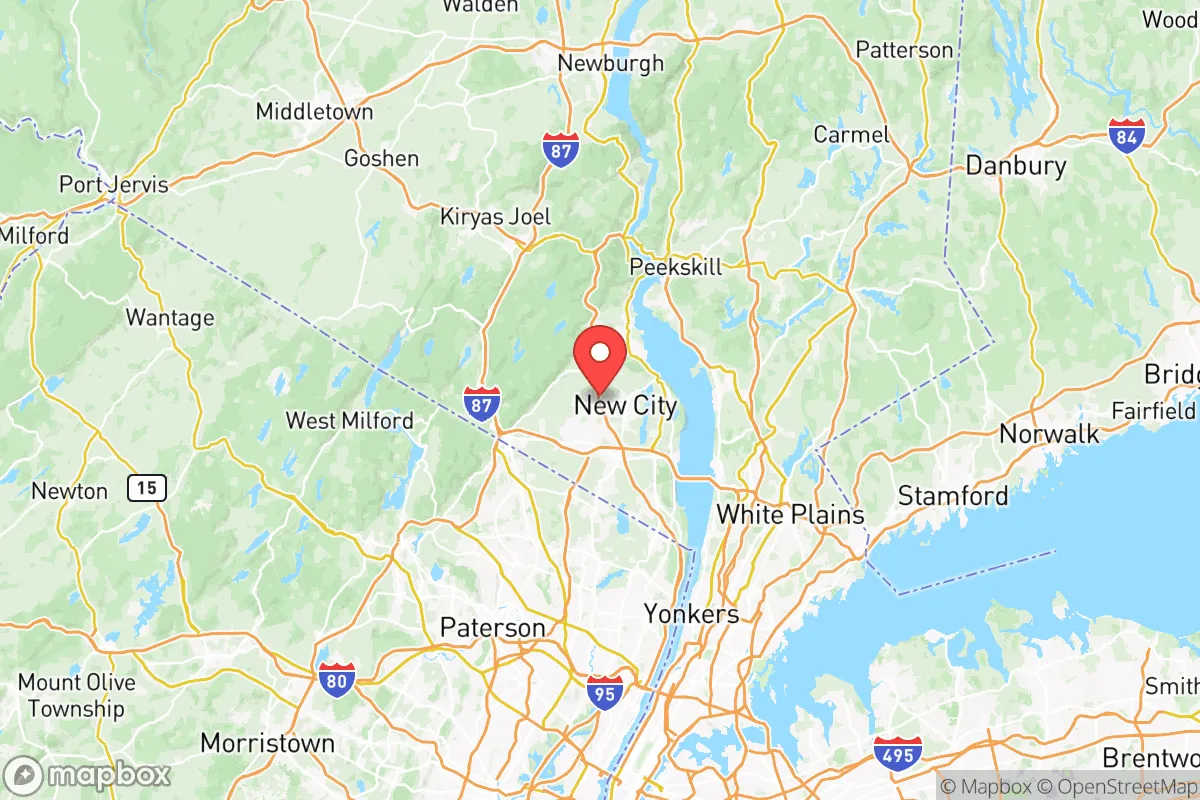
Photo: Wikipedia
Personal Sovereignty in Rockland County
Moderate friction. Expect trade-offs in some aspect of personal liberty and independence.
What does Personal Sovereignty tell us?
Personal Sovereignty measures your capacity for self-reliance and independence with minimal government friction. Higher scores mean fewer barriers between you and the way you want to live... but it assumes you have the space you need and good neighbors.
What does this tell us?
Personal Sovereignty measures your capacity for self-reliance and independence with minimal government friction. Higher scores mean fewer barriers between you and the way you want to live... but it assumes you have the space you need and good neighbors.
State Policy
Energy independence: Importer (12% of energy produced in-state)
Personal Liberty
Homesteading

Personal Liberty Analysis
Rockland County, New York, presents a complex personal sovereignty environment where high taxes and dense state-level regulation are partially offset by strong property rights, active parental involvement in education, and a vocal local culture of self-advocacy. For individuals and families prioritizing autonomy, the county offers a distinctly suburban, community-oriented form of freedom rather than the rural, low-regulation independence found in upstate or southern states. The balance of personal liberty here is heavily shaped by New York State’s progressive legal framework, but local enforcement and community norms in towns like Stony Point, Clarkstown, and Ramapo create meaningful variation in day-to-day autonomy.
Tax burden and regulatory posture: what relocation research reveals
Rockland County carries one of the highest combined tax burdens in the United States, driven by property taxes that average roughly $12,000 to $15,000 annually for a median-priced home, plus a county sales tax of 8.375% and New York State income tax that can exceed 10% for top earners. This fiscal environment directly reduces personal sovereignty by limiting how much of one’s income remains under individual control. The regulatory posture is similarly heavy: New York State mandates strict building codes, environmental review processes (SEQRA), and zoning laws that make significant property modifications slow and costly. In towns like Clarkstown and Orangetown, homeowners face additional layers of local permitting for fences, sheds, and home businesses, while Stony Point and Haverstraw have somewhat more permissive enforcement due to less dense development and a stronger tradition of DIY property maintenance. The county’s overall regulatory environment is best described as high-touch, with the state setting a floor that local governments can raise but rarely lower.
Self-defense and gun law specifics: what residents can and cannot do
New York State’s gun laws are among the most restrictive in the nation, and Rockland County residents operate entirely within that framework. The SAFE Act, passed in 2013, requires universal background checks, bans certain semi-automatic firearms defined as “assault weapons,” and limits magazine capacity to ten rounds. In 2022, the state’s Concealed Carry Improvement Act (CCIA) further tightened requirements: to carry a concealed handgun, applicants must demonstrate “proper cause” (effectively a good moral character standard), complete 16 hours of in-person training plus 2 hours of live-fire practice, and provide four character references. Rockland County’s pistol permit office in New City processes applications with typical wait times of 6–12 months, though renewals are faster. Open carry is effectively prohibited outside of hunting or target shooting contexts. For self-defense at home, no permit is needed to possess a handgun kept in the residence, but transporting it to a range or gunsmith requires a permit. The towns of Stony Point and Hillburn have a more gun-friendly culture, with active sportsmen’s clubs and fewer local restrictions beyond state law, while Nyack and Spring Valley have local ordinances that further restrict discharge of firearms within village limits. For the autonomy-minded individual, Rockland County offers legal self-defense options but with significant bureaucratic hurdles and no equivalent of constitutional carry.
Self-reliance and homesteading viability: lot sizes, zoning, and off-grid feasibility
Rockland County’s dense suburban character limits traditional homesteading and off-grid living, but opportunities exist in specific areas. Minimum lot sizes vary dramatically: in Stony Point and parts of Haverstraw, zoning allows one-acre lots, and some rural pockets permit two to three acres, while in Clarkstown and Ramapo, quarter-acre lots are the norm. Raising chickens is legal in most towns with permit requirements (typically a $25–$50 fee and a site plan), but livestock like goats or pigs is restricted to agricultural zones, which are rare. Off-grid living—solar panels, rainwater collection, composting toilets—faces significant regulatory barriers: New York State building codes require grid-tied electrical connections for new construction, and the county health department mandates septic systems that meet strict standards, making true self-sufficiency legally difficult. Hillburn and Sloatsburg, both in the western, more rural part of the county, offer the best prospects for self-reliance, with larger lots, fewer HOAs, and a more permissive enforcement culture. However, even there, the county’s proximity to New York City (30–40 miles) means property values remain high, and the tax burden makes large-scale homesteading economically challenging. For most residents, self-reliance takes the form of vegetable gardens, home energy efficiency upgrades, and community barter networks rather than full off-grid independence.
Personal liberties: parental rights, medical autonomy, speech, and property
Parental rights in Rockland County are robust in practice, driven by a strong local culture of school board engagement and active parent-teacher associations. The county’s school districts—including Clarkstown, North Rockland, and Ramapo Central—have seen heated debates over curriculum transparency, library materials, and health education, with parent groups successfully influencing policy in several cases. Medical autonomy is constrained by New York State mandates: the state requires childhood vaccination for school attendance (with narrow medical exemptions), and COVID-era vaccine mandates for healthcare workers remain in effect. However, Rockland County’s large Orthodox Jewish and Hasidic communities in Ramapo and Monsey have successfully advocated for religious exemptions to certain public health orders, demonstrating that organized community action can carve out space for medical choice. Free speech is fully protected under the First Amendment, and the county’s diverse population ensures a wide range of political and religious expression, though local ordinances in Nyack and Spring Valley regulate signage and public assembly permits. Property rights are the strongest pillar of personal liberty here: while zoning and environmental regulations are strict, once a property is purchased, owners have broad latitude to use, improve, and sell it, with eminent domain rarely exercised outside of major infrastructure projects. The county’s strong tradition of private property ownership, with homeownership rates around 65%, reinforces this sense of control.
Overall, personal sovereignty in Rockland County is best understood as a trade-off: residents accept high taxes and dense regulation in exchange for excellent public services, strong schools, and proximity to New York City’s economic opportunities. Compared to areas like upstate New York’s rural counties (e.g., Delaware or Sullivan), or states like Texas or Florida, the autonomy environment is significantly more constrained. However, within the New York metropolitan region, Rockland County offers more personal freedom than Westchester or Nassau counties, with lower density, more rural pockets, and a more politically diverse population that includes both progressive and conservative voices. For the relocation researcher focused on self-reliance and independence, Rockland County is a viable option only if the individual or family is willing to work within a high-regulation, high-tax framework and leverage local community action to protect specific liberties. It is not a destination for those seeking minimal government interference, but it can work for those who value strong property rights and active civic engagement as forms of personal sovereignty.

* Values derived from national, state, county, city and local statistics and may differ in a specific area. Last updated: 2026-06-18T01:42:31.000Z
Narrative content on this page is AI-generated and may contain mistakes. Verify any details that matter before acting on them.
ReloMaps may earn a commission from affiliate links at no extra cost to you.

