Photo: Wikipedia
Demographics of Rockland County
Affluence Level in Rockland County
A middle-class area roughly in line with national averages across income, home values, education, and employment.
People of Rockland County
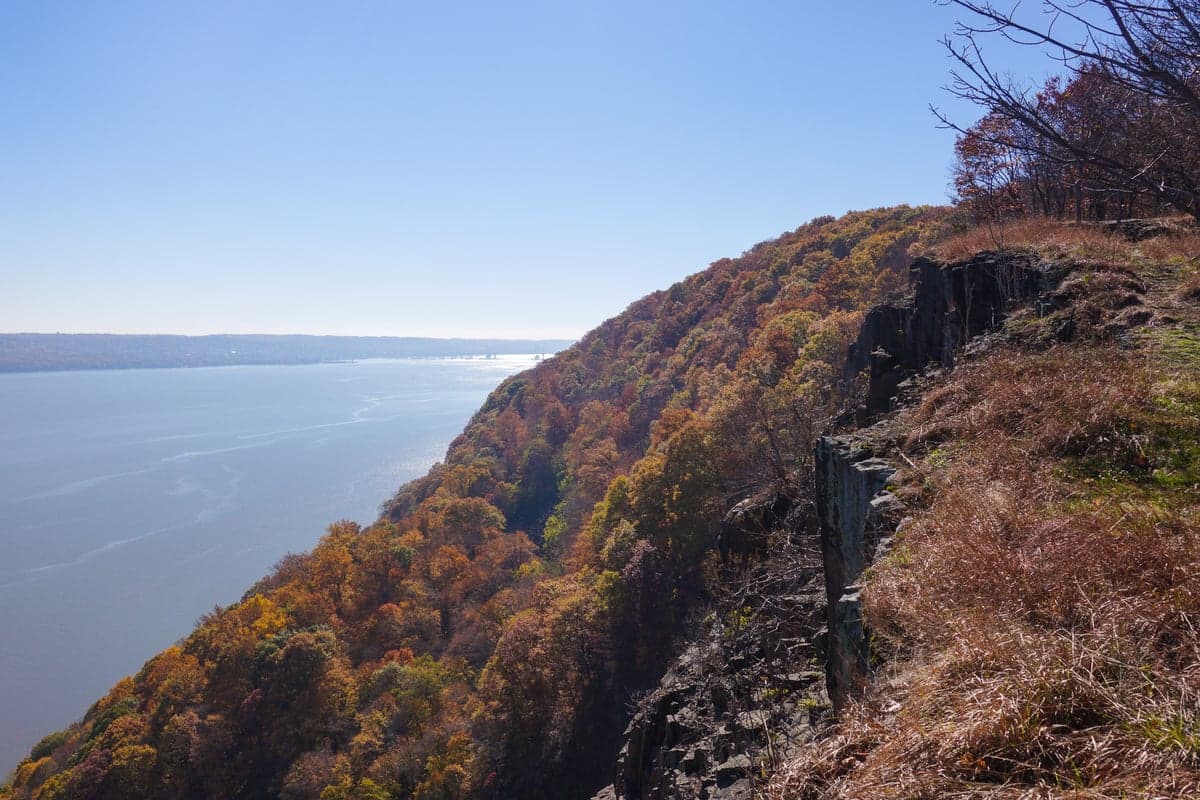
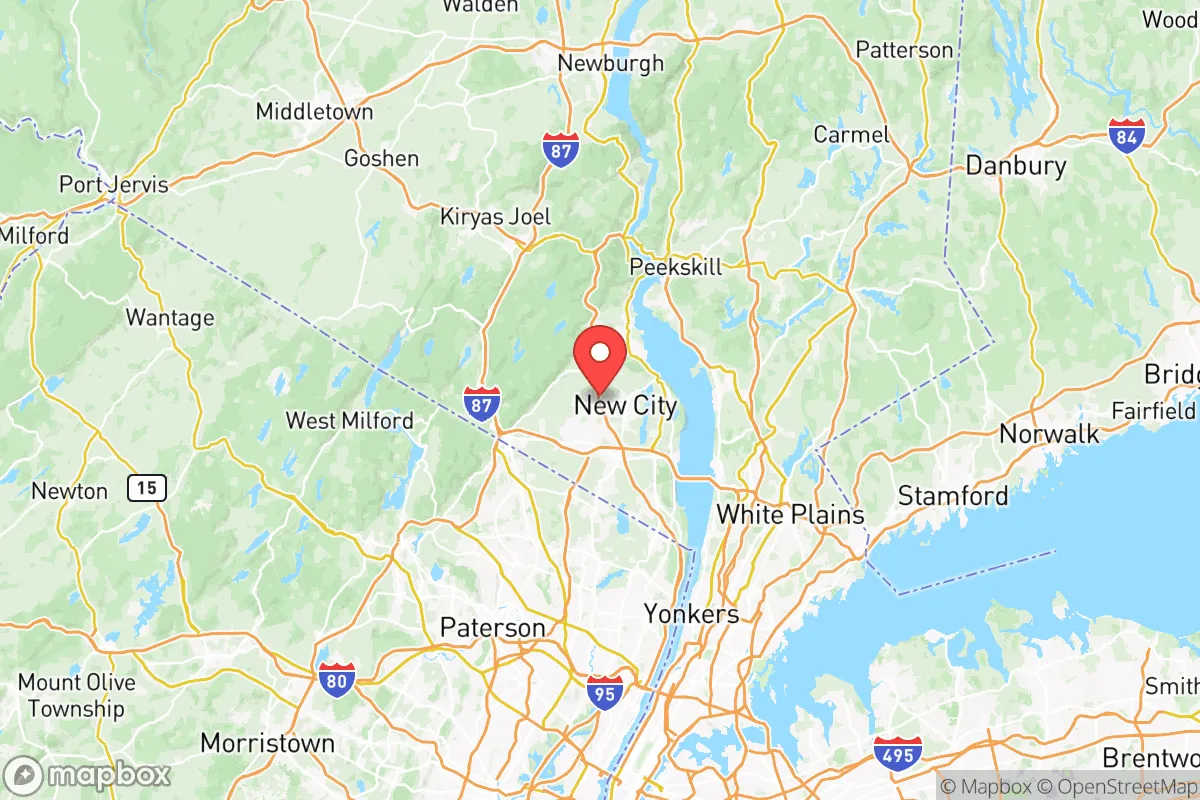
Rockland County’s 338,936 residents form a dense, culturally layered suburban ring just northwest of New York City, defined by its steep hills, Hudson River views, and a population that is 60.6% white, 20.0% Hispanic, 10.5% Black, 3.0% East/Southeast Asian, and 2.9% Indian. With 42.1% of adults holding a college degree and a foreign-born share of 8.9%, the county is notably more educated and slightly less immigrant-heavy than neighboring Bergen or Westchester. Its identity is shaped by a strong Orthodox Jewish presence in communities like Monsey and New Square, alongside long-standing Irish, Italian, and African American enclaves, creating a place where tradition and suburban affluence coexist with visible religious and ethnic diversity.
Settlement & growth (pre-1960)
Before European contact, the region was home to the Munsee-speaking Lenape people, who used the Hudson and Ramapo rivers for travel and fishing. The Dutch West India Company claimed the area in the 1600s, and by the late 17th century, Dutch and English farmers had established small settlements along the riverfront in what is now Nyack and Piermont. The colonial economy was built on gristmills, ferries, and small-scale agriculture, with the first major non-English wave arriving in the mid-1700s: Palatine Germans, who settled in the Ramapo Valley and founded the hamlet of New Hempstead, where their descendants still live.
The 19th century brought two transformative groups. Irish immigrants arrived in large numbers during the 1840s and 1850s, fleeing the Great Famine and finding work building the Erie Railroad and later the Croton Aqueduct. They concentrated in Haverstraw and Garnerville, where brickmaking became a dominant industry—Haverstraw was once the brickmaking capital of the world, and Irish laborers formed the backbone of that workforce. Italian immigrants followed in the 1880s through 1910s, drawn by railroad construction and stone quarrying in Stony Point and Thiells. By 1920, Italians and Irish together made up roughly a third of the county’s population, and their cultural imprint remains visible in the Catholic parishes and social clubs of Pearl River and Suffern.
The post-World War II period triggered explosive suburbanization. The Tappan Zee Bridge opened in 1955, slashing commute times to Manhattan and turning Rockland into a bedroom community. Returning GIs and white ethnic families from New York City—especially Jews, Italians, and Irish—flooded into new developments in Nanuet, Spring Valley, and Clarkstown. The county’s population more than doubled between 1950 and 1970, from 89,000 to 229,000, as ranch houses and shopping centers replaced apple orchards. This wave was overwhelmingly white and middle-class, and it set the county’s conservative-leaning, family-oriented character that persists today.
Modern era (post-1965)
The 1965 Hart-Cellar Act reshaped Rockland’s demographics, though the effects came later than in New York City proper. The most visible post-1965 change was the growth of the Orthodox Jewish community, which began accelerating in the 1970s and 1980s as families moved from Brooklyn and Queens seeking affordable housing and space for large families. Monsey became the epicenter, with its densely packed neighborhoods of single-family homes, yeshivas, and kosher markets. New Square, founded in 1954 by Skverer Hasidic Jews, grew into an insular village of roughly 10,000 residents, while Kaser and Wesley Hills also saw significant Orthodox settlement. Today, Rockland has one of the highest concentrations of Orthodox Jews of any U.S. county, and this community’s high birth rate is a primary driver of population growth.
Hispanic migration to Rockland began in earnest in the 1980s and 1990s, primarily from Puerto Rico and the Dominican Republic, with smaller streams from Mexico and Central America. Spring Valley and Haverstraw saw the largest influx; Spring Valley’s Hispanic population now exceeds 40%, and the village has a distinctly Dominican and Puerto Rican character, with bodegas, Pentecostal churches, and annual parades. The county’s Hispanic share rose from roughly 5% in 1980 to 20.0% today, making it the fastest-growing demographic group.
Black residents, who make up 10.5% of the population, are concentrated in Spring Valley (historically a destination for African American families leaving New York City in the 1960s and 1970s) and in Nyack, which has a smaller but established Black middle-class community. The East/Southeast Asian population (3.0%) is newer and more dispersed, with clusters of Chinese and Korean families in Clarkstown and Nanuet, drawn by the county’s strong public schools. The Indian subcontinent population (2.9%) is concentrated in Pearl River and Suffern, where tech and healthcare professionals have settled since the 1990s, attracted by proximity to pharmaceutical and biotech employers in the region.
Domestic migration patterns have shifted in the 21st century. Rockland lost some population to cheaper areas in the Hudson Valley and the Sun Belt between 2010 and 2020, but the Orthodox Jewish community’s natural increase—families averaging 5-7 children—has kept the county growing. The non-Orthodox white population has aged and declined slightly, while Hispanic and Asian shares continue to rise.
The future
Rockland County is becoming more diverse, but the change is uneven and politically charged. The Orthodox Jewish population is projected to grow from roughly 30% of the county today to 40-45% by 2040, driven by high birth rates and continued migration from Brooklyn. This will concentrate further in Monsey, New Square, and the surrounding towns of Ramapo, where zoning battles over housing density and school funding are already intense. The Hispanic share is likely to rise to 25-28% by 2040, with Spring Valley and Haverstraw becoming majority-Hispanic. The non-Hispanic white population (excluding Orthodox Jews) will continue to shrink, as younger families leave for lower-cost areas and the remaining population ages.
East/Southeast Asian and Indian communities are growing slowly but steadily, drawn by the county’s schools and proximity to jobs in White Plains and Manhattan. They are dispersing rather than forming enclaves, settling in Clarkstown, Orangetown, and Pearl River. The county’s cultural identity is evolving from a mid-century white ethnic suburb into a tripartite society: Orthodox Jewish, Hispanic, and a shrinking secular white population. This has created friction over school curricula, housing policy, and political representation, but also a distinctive religious and ethnic texture rare in the suburbs.
For someone moving in now, Rockland offers strong schools, low crime relative to nearby counties, and a dense network of religious and community institutions—but also high taxes, traffic congestion, and a housing market where the median home price exceeds $550,000. The county is not becoming a melting pot in the classic sense; rather, it is a place where distinct communities live side by side, often with limited interaction. New arrivals should expect to find their niche—whether in the Orthodox neighborhoods of Ramapo, the Hispanic villages along the Hudson, or the secular suburbs of Clarkstown—and understand that Rockland’s future will be shaped by how these groups negotiate shared space and resources.

* Values derived from national, state, county, city and local statistics and may differ in a specific area. Last updated: 2026-06-18T01:42:31.000Z
Narrative content on this page is AI-generated and may contain mistakes. Verify any details that matter before acting on them.
ReloMaps may earn a commission from affiliate links at no extra cost to you.

