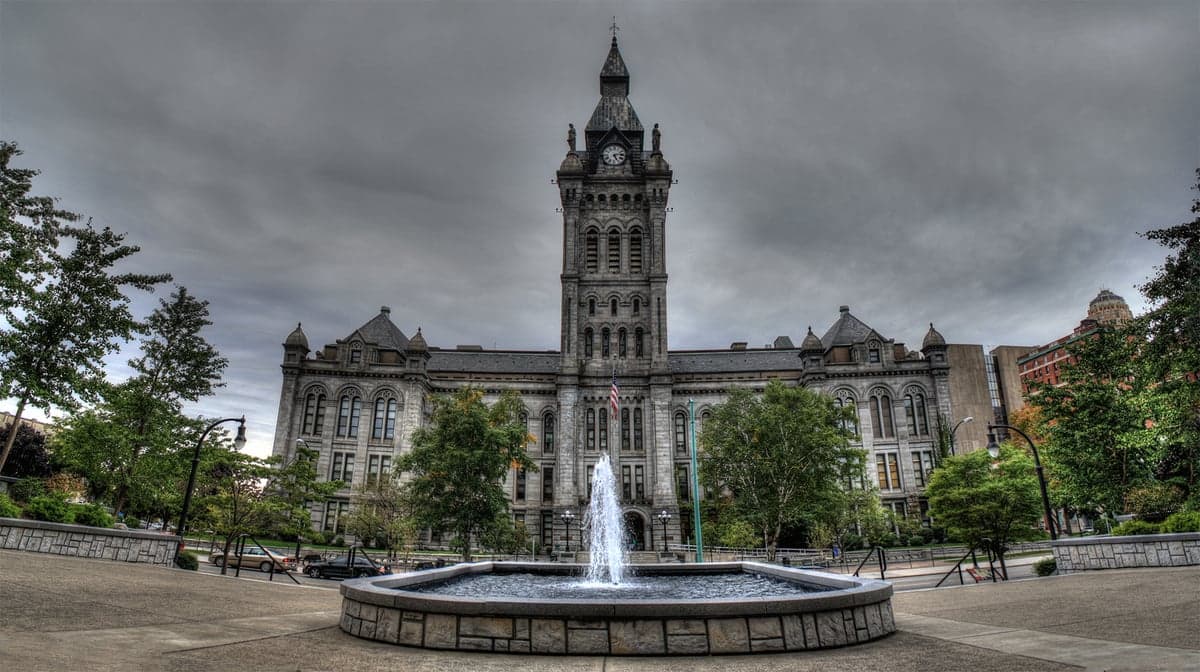
Photo: Wikipedia
Political ClimatePolitical Climate in Erie County
Showing district-level results — no local-only data available.
Local Political AnalysisPolitical Analysis of Erie County
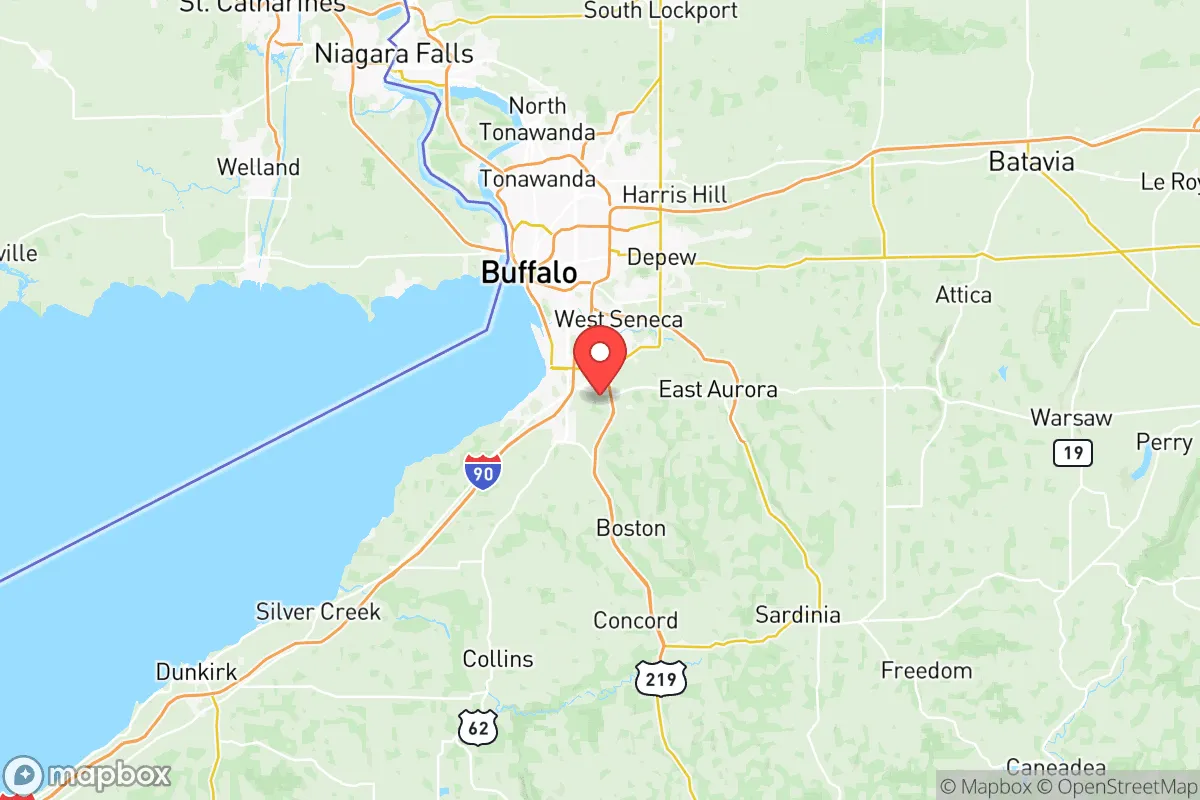
Erie County, New York, leans solidly Republican with a Cook PVI of R+10, meaning it typically votes about 10 points more Republican than the nation as a whole. This makes it a stark contrast to the rest of the state and especially to the city of New York, which remains one of the most reliably Democratic regions in the country. Over the last couple of decades, the county has shifted rightward, driven largely by the growing conservatism of its outer suburbs and rural towns, while the city of Buffalo itself still votes heavily Democratic. The gap between Buffalo and the rest of the county has widened, and that split defines the area's politics today.
How it compares to New York, NY
The difference between Erie County and New York City is night and day. New York City — Manhattan, Brooklyn, Queens, the Bronx, and Staten Island — is a Democratic stronghold with a Cook PVI somewhere in the D+30 to D+40 range. Erie County's R+10 is a full 40 to 50 points more conservative than NYC. But it's not just the numbers: the political cultures are almost opposites. In places like the Southtowns — including Orchard Park, Hamburg, and West Seneca — you'll find a lot of Reagan Democrats and Trump-friendly voters who feel alienated by the progressive policies coming out of Albany and New York City. In contrast, the Northtowns — Amherst, Williamsville, and parts of Tonawanda — are more mixed, with suburban liberals and moderate Republicans often deciding tight races. Buffalo's Elmwood Village and Allentown neighborhoods are reliably blue, while Lackawanna, Cheektowaga, and Buffalo's South Side have historically been working-class swing areas. So while NYC is a homogeneously liberal metropolis, Erie County is a patchwork where a ten-minute drive can take you from a progressive coffee shop to a hunting camp.
What this means for residents
For conservative residents, Erie County feels like home turf. Republican candidates routinely win countywide races, and local offices — especially in the towns of Clarence, Lancaster, and Aurora — are held by conservatives. Policies here tend to be more pragmatic than ideological: taxes are lower than in downstate New York, though still high by national standards. For liberal residents, it's a different story. While Buffalo is a safe harbor, the surrounding towns can feel inhospitable, especially on cultural issues like gun rights or public health mandates. Blue-leaning residents often find themselves voting in primaries more than general elections, and they may feel outnumbered in local school board or town council races. That said, Erie County isn't a one-party monopoly: there are enough moderate Republicans and registered Democrats — about a third of the county is registered Democratic, a third Republican, and a third independent — that competitive races happen regularly, especially in state legislative districts and the occasional county executive election.
Culturally, Erie County has a distinct identity that sets it apart from downstate. It's a place where hunting, snowmobiling, and the Bills are taken very seriously, but also where the arts scene in Buffalo punches well above its weight. Politically, the county has a tradition of maverickism — think of figures like former Congressman Chris Collins (a Republican who represented the county until his resignation in 2019) or current Buffalo Mayor Byron Brown, a Democrat who often butts heads with the party's progressive wing. That independent streak means no one should assume Erie County votes as a bloc: it's a place where a conservative can feel comfortable and a liberal can find their community, as long as both understand which part of the county they're in.

State Political ClimatePolitical Climate in New York
State Political AnalysisPolitical Environment in the State
New York State has been a solidly Democratic stronghold for decades, with Democrats holding every statewide office and commanding supermajorities in both legislative chambers. The state hasn't voted Republican in a presidential election since 1984, and in 2024, Kamala Harris carried it by roughly 12 points. But that top-line number masks a deep and widening urban-rural chasm. New York City and its inner suburbs drive the blue wave, while vast stretches of upstate—places like the Southern Tier, the North Country, and the Finger Lakes region—vote reliably red. Over the past 20 years, the state has lurched leftward on social and fiscal policy, but the trajectory is not uniform: downstate Democrats have consolidated power, while upstate Republicans have grown more entrenched and vocal.
Urban vs. rural divide
The political map of New York is essentially a tale of two states. New York City’s five boroughs—Manhattan, Brooklyn, Queens, the Bronx, and Staten Island—cast roughly 40% of the state’s vote and deliver margins of 70-80% for Democrats. The immediate suburbs of Long Island (Nassau and Suffolk counties) and the lower Hudson Valley (Westchester, Rockland, and Putnam) lean blue but are more competitive; Nassau County, for instance, went for Biden by 8 points in 2020 after being a swing county for years. Head north of the I-84 corridor, and the map flips. Erie County (Buffalo) and Monroe County (Rochester) are blue islands in a sea of red, but the rest of upstate—counties like Allegany, Wyoming, Orleans, and Chenango—routinely vote 60-70% Republican. The Capital Region (Albany, Schenectady, Rensselaer) is a purple zone, with Albany city itself deeply blue but the surrounding towns trending red. The North Country (Jefferson, St. Lawrence, Franklin counties) is solidly Republican, driven by military families near Fort Drum and a rural, conservative culture. The Finger Lakes wine country (Yates, Seneca, Ontario counties) leans red, though the college towns of Ithaca (Tompkins County) and Geneva are progressive outliers. This divide means that a resident of Manhattan and a resident of Chautauqua County live under the same state laws but experience vastly different political realities.
Policy environment
New York’s policy environment is among the most progressive in the nation. The state has a progressive income tax with rates from 4% to 10.9% on high earners, plus a state sales tax of 4% (localities add up to 4.5% more, so total can hit 8.875% in NYC). Property taxes are among the highest in the country, especially in upstate counties like Monroe and Onondaga, where school taxes are a major burden. The regulatory posture is dense: New York has strict environmental regulations (the Climate Leadership and Community Protection Act mandates net-zero emissions by 2050), a $15 minimum wage (higher in NYC), and robust tenant protections that include rent stabilization in NYC and some suburbs. Education policy is centralized: the state sets curriculum standards, mandates universal pre-K, and funds schools heavily through property taxes, with the Board of Regents controlling graduation requirements. Healthcare is heavily regulated, with the state running its own health insurance exchange (NY State of Health) and expanding Medicaid under the ACA. Election laws are liberal: no-excuse absentee voting, early voting (9 days), automatic voter registration at the DMV, and same-day registration. New York also has a closed primary system, meaning only registered party members can vote in primaries, which tends to amplify the influence of the party’s activist base.
Recent policy direction
Over the past five years, New York has moved decisively left on a range of issues. On gun and self-defense law, the state passed the SAFE Act in 2013 (expanded after the 2022 Bruen decision with the Concealed Carry Improvement Act, which restricts where guns can be carried and requires “good moral character” for permits). The state also bans assault weapons and high-capacity magazines. On parental and education rights, New York has no parental bill of rights; school districts control curriculum, and the state mandates LGBTQ-inclusive instruction and ethnic studies. The Green Light Law (2019) allows undocumented immigrants to obtain driver’s licenses, and the state is a sanctuary state, limiting cooperation with federal immigration enforcement. On speech and privacy, New York has strong data privacy laws (the SHIELD Act) but also broad hate-crime statutes that some critics argue chill speech. Medical and bodily autonomy is protected: abortion is legal up to viability (codified in 2019’s Reproductive Health Act), and the state has shield laws protecting providers who serve out-of-state patients. Property rights are constrained by rent control in NYC and strong eminent domain powers (the state used it for the Atlantic Yards project in Brooklyn). Taxation has increased: the top marginal rate was raised to 10.9% in 2021 for incomes over $25 million, and the estate tax exemption is only $6.58 million (indexed). Voting and ballot access has expanded, but the state’s independent redistricting commission was overridden by the legislature in 2022, leading to gerrymandered maps that favor Democrats. The Less Is More Act (2021) ended cash bail for most non-violent offenses, a major shift in criminal justice policy that has been a flashpoint in upstate communities.
Civil unrest & political movements
New York has a long history of political activism, from the 2011 Occupy Wall Street protests in Zuccotti Park to the 2020 Black Lives Matter marches that swept NYC, Buffalo, and Rochester. The state’s sanctuary policies have made it a magnet for immigration activism, with groups like the New York Immigration Coalition pushing for further protections. On the right, the New York State Rifle & Pistol Association is a powerful lobby, and the Conservative Party (which cross-endorses Republicans) remains influential in local races. The secession movement is real but fringe: the “Break Up New York” campaign, which proposes splitting the state into three (NYC, Long Island, and upstate), has gained some traction in rural counties like Delaware and Sullivan, but it’s a long shot. Election integrity controversies have flared, particularly around the 2020 absentee ballot expansion and the 2022 redistricting fight, which the Court of Appeals (the state’s highest court) ultimately struck down as partisan gerrymandering. Visible flashpoints include the Migrant crisis in NYC, where the city has struggled to house tens of thousands of asylum seekers, leading to tensions in neighborhoods like Staten Island and parts of Queens. Upstate, the fracking ban (2014) remains a sore point in the Southern Tier, where some residents wanted the economic boost. A new resident will notice the political divide in everyday life: in NYC, you’ll see “Defund the Police” signs in some windows; in upstate, you’ll see “Back the Blue” flags on pickup trucks.
Projection
Over the next 5-10 years, New York’s political trajectory is likely to continue leftward, but with growing friction. Demographic shifts are key: New York City’s population has declined slightly since 2020 (down about 5% from the peak), while upstate counties like Saratoga and Warren are growing as remote workers flee high taxes. But the state’s in-migration is overwhelmingly from abroad (immigrants tend to settle in NYC and its suburbs), which reinforces the Democratic base. The suburban swing is the wildcard: Nassau and Westchester counties are trending bluer, but places like Orange and Dutchess counties are becoming more competitive as exurban growth brings in both liberal and conservative transplants. The state’s fiscal health is a looming issue: the budget relies heavily on high-earner taxes, and any economic downturn could trigger a crisis. The Democratic supermajority in Albany is likely to hold, meaning further leftward moves on housing (rent control expansion), climate (the “Cap and Invest” program), and criminal justice (more bail reform). A resident moving in now should expect that the state will remain a national leader on progressive policy, but that the urban-rural divide will only deepen, with upstate Republicans becoming more vocal and possibly winning a few more state assembly seats through gerrymandering challenges. The 2026 gubernatorial race will be a bellwether: if a moderate Democrat wins, the state may moderate slightly; if a progressive wins, expect more of the same.
For a new resident, the bottom line is this: New York offers a world-class urban experience and stunning natural beauty, but it comes with high taxes, dense regulation, and a political culture that is deeply polarized. If you lean conservative, you’ll find like-minded communities in upstate counties like Livingston or Ontario, but you’ll be fighting an uphill battle on state policy. If you lean liberal, you’ll feel at home in NYC, Ithaca, or Albany, but you’ll pay for it in cost of living and taxes. The state is not for everyone, but for those who value its specific mix of opportunity, diversity, and natural resources, it remains a place where you can carve out a life—just be prepared to navigate the political currents.
* Values derived from national, state, county, city and local statistics and may differ in a specific area. Last updated: 2026-06-20T16:41:43.000Z
Narrative content on this page is AI-generated and may contain mistakes. Verify any details that matter before acting on them.
ReloMaps may earn a commission from affiliate links at no extra cost to you.

