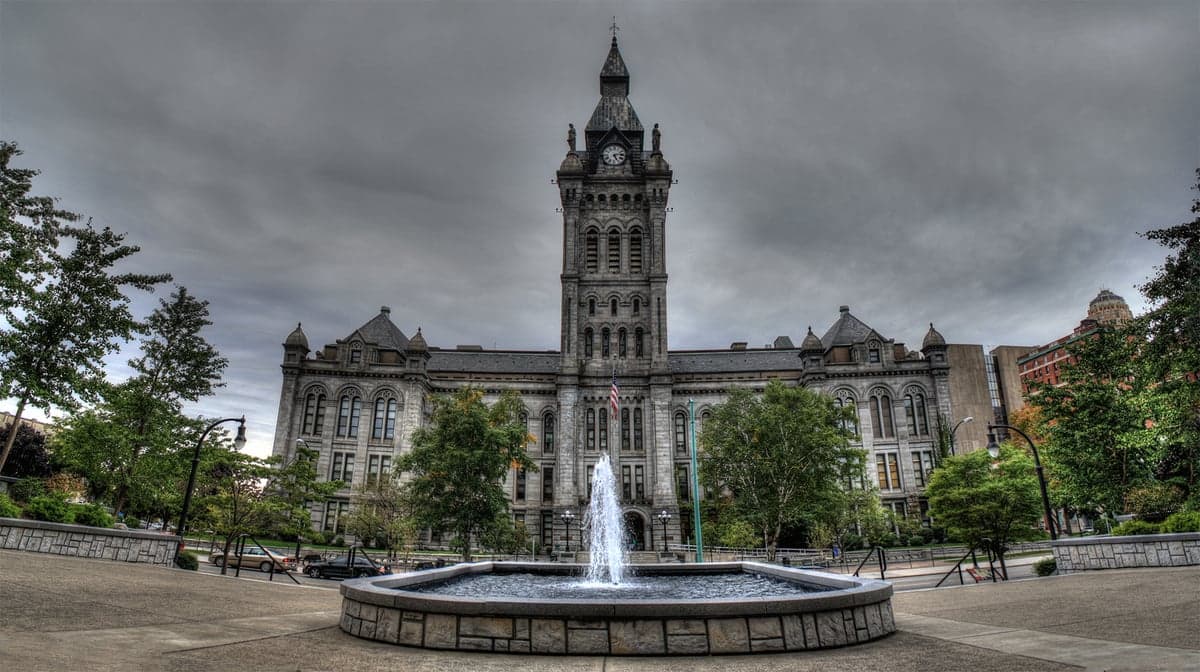
Photo: Wikipedia
Personal Sovereignty in Erie County
Moderate friction. Expect trade-offs in some aspect of personal liberty and independence.
What does Personal Sovereignty tell us?
Personal Sovereignty measures your capacity for self-reliance and independence with minimal government friction. Higher scores mean fewer barriers between you and the way you want to live... but it assumes you have the space you need and good neighbors.
What does this tell us?
Personal Sovereignty measures your capacity for self-reliance and independence with minimal government friction. Higher scores mean fewer barriers between you and the way you want to live... but it assumes you have the space you need and good neighbors.
State Policy
Energy independence: Importer (12% of energy produced in-state)
Personal Liberty
Homesteading

Personal Liberty Analysis
Personal sovereignty in Erie County, New York, operates within a distinctly mixed environment shaped by New York State’s heavy regulatory framework and the county’s own local variations. While the state imposes some of the nation’s highest taxes and strictest gun laws, Erie County offers pockets of relative autonomy—particularly in its rural towns and suburban communities—where residents can exercise more self-reliance than in neighboring urban centers like Buffalo. For a conservative-leaning individual or family weighing relocation, the key is understanding where within the county the regulatory touch lightens and where it remains heavy, as the difference between, say, the city limits of Buffalo and the town of Wales can be substantial.
Tax burden and regulatory posture across Erie County
New York State’s tax burden is among the highest in the country, and Erie County residents feel it directly. The combined state and local sales tax rate is 8.75%, and property taxes are steep: the median effective property tax rate in Erie County is roughly 2.5% of home value, compared to a national average around 1.1%. For a home valued at $250,000, that means annual property taxes near $6,250. Income taxes add another layer, with New York’s progressive rate topping out at 10.9% for high earners. However, within Erie County, tax rates vary significantly by municipality. Towns like Clarence and Orchard Park have lower property tax rates than Buffalo or Lackawanna, thanks to more robust commercial tax bases and less reliance on residential levies. Regulatory posture follows a similar pattern: Buffalo enforces strict zoning, rental registration, and business licensing, while rural towns like Wales and Colden have minimal local codes, allowing more freedom for home-based businesses and property modifications. The county’s overall regulatory environment is heavy by national standards, but the rural towns offer a noticeably lighter touch than the urban core.
Self-defense and gun law specifics in Erie County
New York’s gun laws are among the strictest in the nation, and Erie County residents must comply with the state’s permitting regime. Since the 2022 Bruen decision and subsequent NY SAFE Act updates, obtaining a concealed carry permit requires a 16-hour training course, a background check, and a character reference process administered by the county sheriff. Erie County’s pistol permit office in Buffalo processes applications, and wait times have historically ranged from 6 to 12 months. Open carry is effectively prohibited. However, the county’s gun culture is not monolithic. In rural towns like Boston and North Collins, firearm ownership is common, and local sheriff’s deputies are generally supportive of Second Amendment rights. In contrast, Buffalo and its inner suburbs have a more restrictive atmosphere, with some local officials advocating for additional local ordinances (though state law preempts most local gun regulation). For self-defense at home, no permit is required for long guns, and handguns kept in the home are covered under the same permit system. The practical reality: if you want to carry daily, Erie County is a high-hassle environment; if you want to keep firearms for home defense and hunting, it’s manageable but still requires navigating state bureaucracy.
Self-reliance and homesteading viability: lot sizes, zoning, off-grid feasibility
Homesteading and off-grid living are viable in Erie County’s southern and eastern towns, but not in the urbanized north. Zoning in towns like Wales, Colden, and Marilla permits agricultural use, livestock, and accessory structures on parcels as small as 2 to 5 acres, though 10+ acres is more practical for serious self-reliance. Off-grid feasibility is limited by state building codes: New York requires a certificate of occupancy for any dwelling, which typically mandates connection to a septic system (permitted by the county health department) and either grid electricity or an approved alternative (solar with battery storage is allowed, but must meet code). Rainwater collection for potable use is restricted; New York law requires a permit and treatment system. In practice, residents in Springville and Holland run small farms, keep chickens and goats, and use solar panels to offset grid power, but full off-grid independence is rare due to code requirements. The county’s soil quality varies—southern towns have better drainage for gardens—and growing seasons run about 150 days, suitable for cold-hardy crops. For a family seeking a self-reliant lifestyle, the rural towns offer reasonable space and a tolerant local government, but New York’s state-level codes impose a baseline of regulation that limits full autonomy.
Personal liberties: parental rights, medical autonomy, speech, property
Parental rights in Erie County are shaped by New York State law, which grants parents broad authority over education and healthcare decisions but also mandates school vaccination requirements (with a religious exemption available but increasingly contested in court). Homeschooling is legal and regulated: parents must submit an annual individualized home instruction plan (IHIP) to their local school district, which varies in scrutiny by district. The Clarence and Williamsville districts are known for efficient processing, while Buffalo’s district can be more demanding. Medical autonomy is limited: New York does not allow direct primary care arrangements to bypass insurance, and vaccine mandates for school attendance remain in effect. Speech protections follow the First Amendment, but local governments in Buffalo have enacted social media policies for public employees; no significant local censorship exists. Property rights are constrained by state environmental regulations, particularly the Freshwater Wetlands Act, which restricts development on wetlands—common in Erie County’s rural areas. Eminent domain is rare but possible; the county has used it for road projects. Overall, personal liberties in Erie County are moderate: the state imposes notable restrictions on medical and educational choices, but local enforcement in rural towns is often more lenient than in urban centers.
Compared to other regions of the United States, Erie County offers a lower level of personal sovereignty than the Sun Belt or Mountain West, but it is not uniformly restrictive. The rural towns—Wales, Colden, Boston, North Collins, and Marilla—provide a meaningful degree of autonomy in property use, homesteading, and gun ownership, while the urban and suburban areas of Buffalo, Amherst, and Cheektowaga lean heavily toward regulation. For a conservative-leaning individual or family, the strategic choice is to locate in the county’s southern and eastern townships, where the local culture and lighter enforcement create a more self-reliant environment, even as state-level constraints remain inescapable. Erie County is not a freedom haven, but it offers viable niches for those willing to navigate its complexities.

* Values derived from national, state, county, city and local statistics and may differ in a specific area. Last updated: 2026-06-20T16:41:43.000Z
Narrative content on this page is AI-generated and may contain mistakes. Verify any details that matter before acting on them.
ReloMaps may earn a commission from affiliate links at no extra cost to you.

