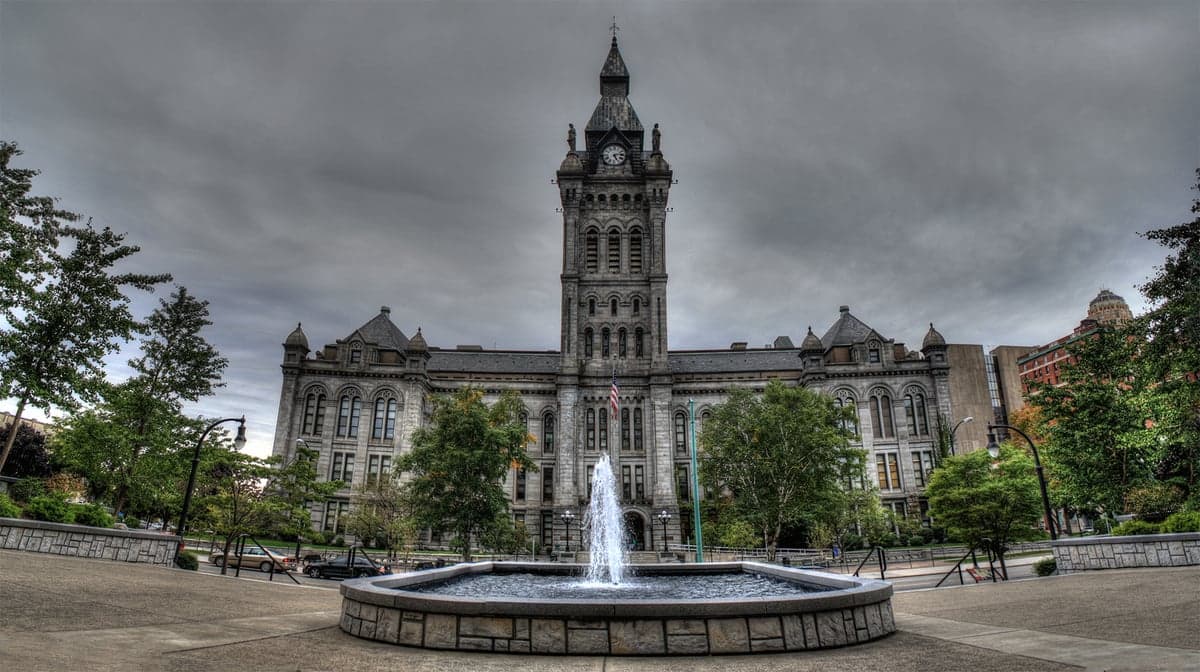
Photo: Wikipedia
Demographics of Erie County
Affluence Level in Erie County
A middle-class area roughly in line with national averages across income, home values, education, and employment.
People of Erie County
Erie County, New York, is home to roughly 950,000 residents, a population shaped by successive waves of European immigration, industrial expansion, and more recent suburbanization. The county’s character is defined by its urban core of Buffalo, a historic Great Lakes manufacturing hub, surrounded by a ring of older suburbs and rural towns. Distinctive identity markers include a strong blue-collar work ethic, deep ethnic enclaves (Polish, Italian, German, Irish), and a population that is notably older and less diverse than the national average, with a foreign-born share of just 3.1%.
Settlement & growth (pre-1960)
The original inhabitants of the Erie County area were the Neutral Nation, later displaced by the Seneca Nation of the Haudenosaunee (Iroquois) Confederacy. European contact began with French explorers and missionaries in the 17th century, but permanent settlement did not take hold until after the American Revolution. The region was part of the Holland Purchase, a vast tract of western New York sold to Dutch investors, which opened the land for systematic settlement after 1800.
The first major wave of American settlers were Yankees from New England and upstate New York, arriving between 1800 and 1825. They founded the county’s earliest villages, including Buffalo (incorporated 1832), Hamburg, and Clarence. The completion of the Erie Canal in 1825 transformed Buffalo from a frontier outpost into a booming transshipment hub, connecting the Great Lakes to the Hudson River and New York City. This canal-driven prosperity triggered the first large-scale immigration wave: Germans and Irish, arriving from the 1830s through the 1850s. Germans settled heavily in Buffalo’s East Side and in the town of Cheektowaga, while the Irish concentrated near the waterfront and in the South Buffalo neighborhood.
Industrialization after the Civil War brought a second, larger wave. By the 1880s, Buffalo’s steel mills, grain elevators, and rail yards were drawing Poles, who became the county’s largest ethnic group. Polish immigrants clustered in Buffalo’s Broadway-Fillmore neighborhood and in the town of Lancaster. Italians arrived in force between 1890 and 1920, settling in Buffalo’s West Side and in the village of Kenmore. Smaller but significant groups included Jews (fleeing Eastern European pogroms, settling on Buffalo’s East Side and later in Amherst), and a modest number of Black migrants from the South during the Great Migration (1910-1960), who settled primarily in Buffalo’s East Side and Fruit Belt neighborhoods. By 1950, Erie County’s population peaked at over 1.1 million, with Buffalo alone housing 580,000 residents.
Modern era (post-1965)
The post-1965 era in Erie County is defined not by new immigration but by domestic out-migration and suburbanization. The 1965 Hart-Cellar Act, which liberalized immigration, had a muted effect here compared to coastal metros. The county’s foreign-born share remains low at 3.1%, far below the national average of roughly 14%. The primary demographic story since 1970 has been the decline of Buffalo’s industrial base and the flight of white residents to the suburbs.
Between 1970 and 2000, Buffalo lost over 200,000 residents, many of them white families moving to towns like Amherst, Clarence, and Orchard Park. This suburbanization reshaped the county’s racial geography. Today, the city of Buffalo is roughly 47% white, 35% Black, and 11% Hispanic, while the surrounding suburbs remain overwhelmingly white. The county’s overall racial composition is 73.0% white, 12.3% Black, 6.3% Hispanic, 2.2% East/Southeast Asian, and 2.3% Indian (subcontinent).
The modest post-1965 immigration that did occur came in two phases. A small wave of refugees from Vietnam and Cambodia arrived in the late 1970s and 1980s, settling in Buffalo’s West Side and in Tonawanda. More recently, a growing Indian-subcontinent community has formed, concentrated in the suburbs of Amherst and Williamsville, drawn by jobs in healthcare and engineering at institutions like the University at Buffalo. Hispanic growth has been driven by Puerto Ricans (who are U.S. citizens) and a smaller number of Mexican and Central American immigrants, settling in Buffalo’s Lower West Side and Lackawanna.
The future
Erie County’s population is projected to continue a slow decline, from 950,044 today to roughly 900,000 by 2040, driven by an aging population and low birth rates. The county is becoming slightly more diverse, but at a much slower pace than the nation as a whole. The white share is expected to fall from 73% to around 65% by 2040, while the Hispanic and Asian shares will grow modestly. The Indian-subcontinent community in Amherst and Williamsville is likely to expand, as the University at Buffalo and local hospitals continue to recruit skilled professionals.
New immigrant communities are dispersing rather than forming dense ethnic enclaves. Unlike the historic Polish or Italian neighborhoods of Buffalo, newer groups are settling directly in first-ring suburbs like Cheektowaga and West Seneca, where housing is affordable and schools are perceived as better than Buffalo’s. The county’s cultural identity is slowly shifting from a white ethnic, blue-collar character toward a more diverse, professional-class identity, particularly in the suburbs around the university and medical corridor.
For someone moving in now, Erie County offers a stable, affordable, and safe environment with a strong sense of place, but with limited demographic dynamism. The population is older, less diverse, and more rooted than in fast-growing Sun Belt metros. Newcomers will find a community that values tradition, local institutions, and a slower pace of life, but should expect a region that is gradually, not rapidly, changing.

* Values derived from national, state, county, city and local statistics and may differ in a specific area. Last updated: 2026-06-20T16:41:43.000Z
Narrative content on this page is AI-generated and may contain mistakes. Verify any details that matter before acting on them.
ReloMaps may earn a commission from affiliate links at no extra cost to you.

