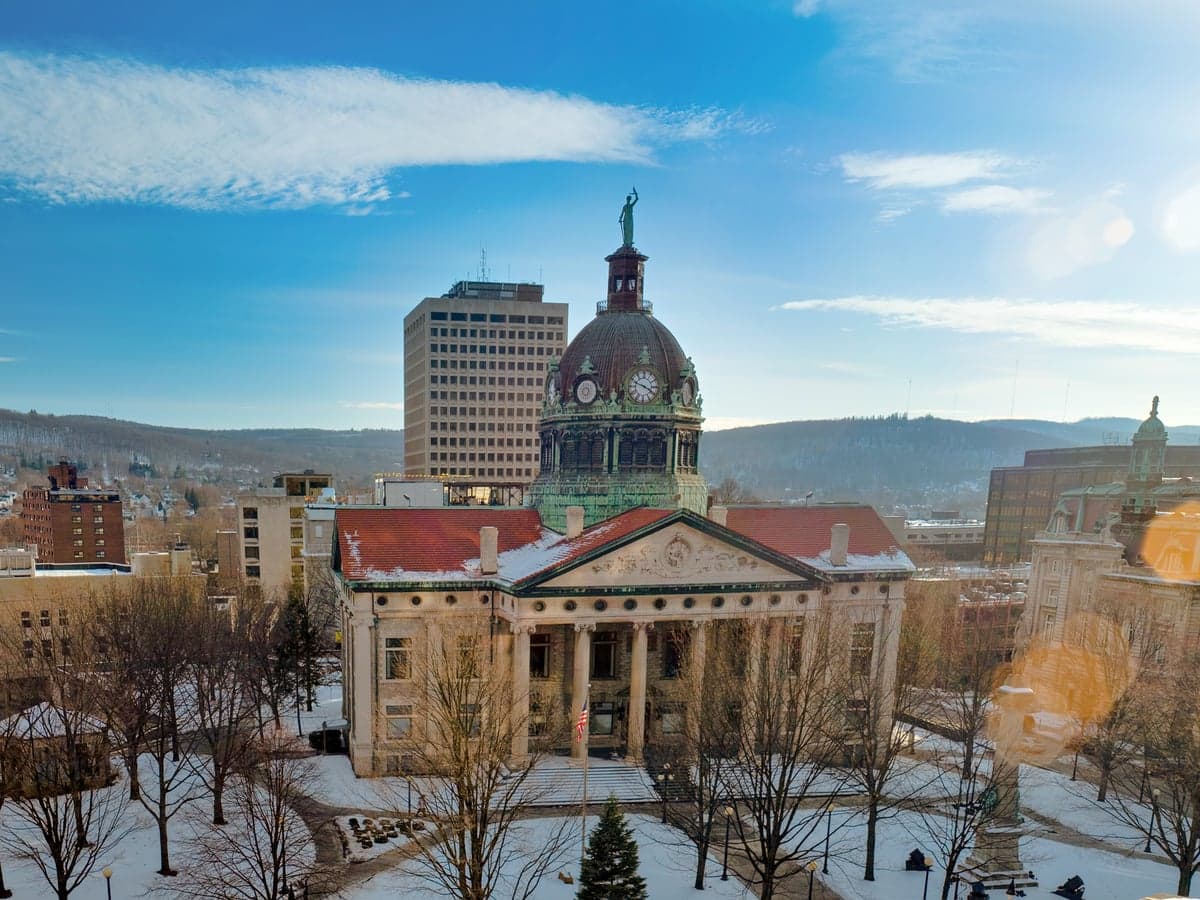
Photo: Wikipedia
Political ClimatePolitical Climate in Broome County
Showing district-level results — no local-only data available.
Local Political AnalysisPolitical Analysis of Broome County
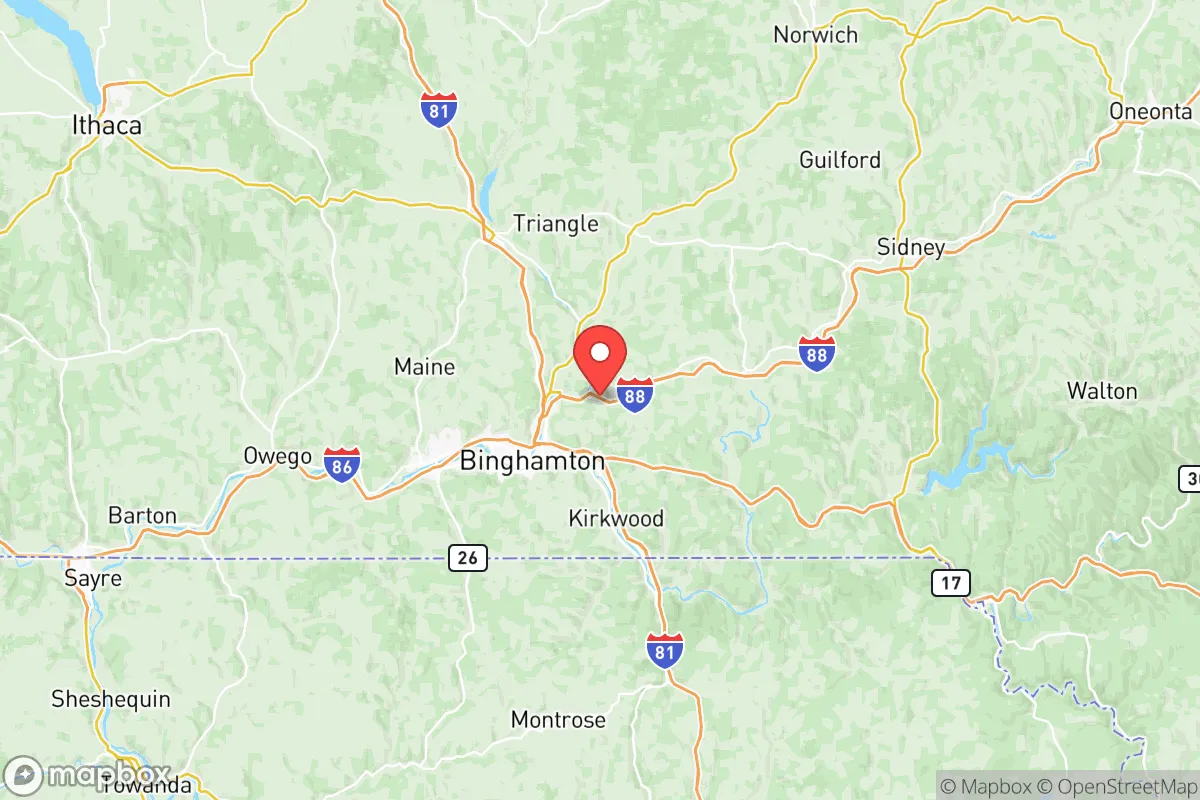
Broome County, anchored by Binghamton, is a classic purple battleground in a blue state, with a Cook PVI of D+1 that reflects its razor-thin Democratic lean in presidential elections. This isn't a deep-blue urban stronghold like Manhattan or a ruby-red rural outpost—it's a place where elections are won and lost in the swing precincts of the Town of Union and the southern reaches of the Town of Vestal. Over the past decade, the county has shifted rightward, driven by working-class voters in the City of Binghamton's outer wards and the exurban towns of Chenango and Fenton, while the college-heavy precincts around Binghamton University and the historic downtown core have held steady for Democrats. The result is a political climate that feels more like a competitive Rust Belt county than a downstate suburb.
How it compares to New York City
The contrast with New York City is stark. While the five boroughs deliver massive Democratic margins—often 80% or more in presidential races—Broome County's D+1 PVI means it's essentially a toss-up. In 2020, Joe Biden won Broome by just 1.5 points, while he carried New York City by over 60 points. The political culture here is far more moderate: local Democrats in Broome often run on fiscal conservatism and pro-law enforcement platforms, while Republicans focus on taxes and rural issues rather than culture-war flashpoints. The City of Binghamton itself is a microcosm of this divide—its West Side and downtown lean blue, while the East Side and South Side have trended red in recent cycles. In contrast, the Town of Union (which includes the village of Johnson City) is the county's bellwether, swinging between parties by just a few hundred votes in most elections.
What this means for residents
For conservative residents, Broome County offers a more welcoming environment than much of New York State. The county legislature has a Republican majority, and property taxes are lower than the state average—though still high by national standards. Gun laws are enforced less aggressively here than in New York City, and the local GOP is active in town halls from Endicott to Windsor. For liberal residents, the county's blue lean in presidential years means their votes matter more than in deep-blue districts, but they face a constant fight to hold ground. The Binghamton City Council is Democratic-controlled, and the university's presence keeps progressive activism alive on issues like climate and housing. Both sides find common ground on economic development: the region's struggle with population loss and job retention means that politicians of all stripes prioritize attracting employers like BAE Systems and UHS Hospitals.
Culturally, Broome County feels more like Pennsylvania's Northern Tier than New York City. The local news cycle is dominated by potholes, school budgets, and the Binghamton Rumble Ponies baseball team, not state-level political drama. The county's strong union presence—particularly among public-sector workers and the former IBM/Endicott Johnson workforce—creates a pragmatic, deal-making political style. The biggest policy distinction from New York City is on housing and land use: Broome has little zoning controversy, and development battles are more about farmland preservation in the Town of Maine than about density in downtown Binghamton. For anyone moving here, the takeaway is simple: you'll find neighbors on both sides of the aisle, and your vote will actually count in a way it simply doesn't in New York City's one-party districts.

State Political ClimatePolitical Climate in New York
State Political AnalysisPolitical Environment in the State
New York State has been a solidly Democratic stronghold for decades, with no Republican presidential candidate winning it since 1984. The state’s overall partisan lean is roughly D+10 to D+15 in statewide elections, driven overwhelmingly by New York City and its inner suburbs. However, the past 10-20 years have seen a sharpening of the urban-rural divide, with upstate and western regions trending redder while the downstate metroplex becomes more dominant in statewide outcomes. For a conservative-leaning relocator, this means your experience of the state’s politics will vary dramatically depending on whether you settle in Manhattan, Buffalo, or a small town in the Finger Lakes.
Urban vs. rural divide
The political map of New York is a tale of two states. New York City (Brooklyn, Manhattan, Queens, The Bronx, Staten Island) and its immediate suburbs—Nassau, Suffolk, Westchester, and Rockland counties—cast roughly 60% of the state’s vote and lean heavily Democratic. The city itself is D+50 or more in most elections. In contrast, upstate regions like the North Country (St. Lawrence, Jefferson counties), the Southern Tier (Steuben, Chemung, Allegany), and the Mohawk Valley (Oneida, Herkimer) are reliably Republican, often voting +20 to +30 points red. The Buffalo metro (Erie County) is a swing area—Erie County went for Biden by about 17 points in 2020, but its suburbs and rural fringe are redder. Rochester (Monroe County) and Syracuse (Onondaga County) are Democratic-leaning but not as lopsided as NYC. The Capital Region around Albany is a purple-to-blue area, with the city itself Democratic and surrounding counties like Rensselaer and Saratoga more competitive. The Hudson Valley counties—Dutchess, Ulster, Orange—have been trending blue, especially in the last decade, as NYC exurbs expand northward. The net effect: a conservative living in Buffalo’s Southtowns or Rochester’s eastern suburbs will experience a very different political environment than one in Manhattan or Brooklyn.
Policy environment
New York’s state-level policies are among the most progressive in the nation, which directly impacts daily life. Tax structure: The state has a progressive income tax with rates from 4% to 10.9% on high earners, plus some of the highest property taxes in the country—averaging 1.7% of home value, with rates in upstate counties like Monroe and Erie often exceeding 2.5%. Sales tax is 8.875% in NYC, lower upstate (7-8%). Regulatory posture: New York has strict environmental regulations, rent control in NYC, and a strong labor-friendly stance (e.g., a $15 minimum wage that rises with inflation). Education policy: The state funds public schools heavily, with per-pupil spending among the highest nationally, but also mandates a controversial “Foundation Aid” formula that favors downstate districts. Healthcare: New York expanded Medicaid under the ACA and has its own state-run health insurance exchange. Election laws: New York has no-excuse absentee voting, early voting (10 days), and automatic voter registration at the DMV. It also has a closed primary system—only registered party members can vote in primaries, which can frustrate independents.
Recent policy direction
Over the last five years, New York has moved decisively left on several fronts. Gun and self-defense law: The 2022 Concealed Carry Improvement Act (CCIA) was passed after the Supreme Court’s Bruen decision, requiring “good moral character” for permits, banning guns in “sensitive places” (including Times Square, subways, and private businesses unless posted), and mandating 18 hours of training. This law is being challenged in court but remains in effect. Parental and education rights: The state has expanded “sanctuary” policies for undocumented students and mandates LGBTQ+ inclusive curricula in public schools. A 2023 law requires schools to adopt policies on gender identity and expression, which has sparked local backlash in conservative districts. Speech and privacy: New York has strong anti-SLAPP laws protecting free speech, but also a 2023 law requiring social media platforms to disclose content moderation policies. Medical and bodily autonomy: Abortion is legal up to 24 weeks, and a 2019 law (the Reproductive Health Act) removed criminal penalties and allowed late-term abortions for health reasons. The state has also legalized recreational marijuana (2021) and allows medical aid-in-dying (2023). Property rights: Rent stabilization laws in NYC and some upstate cities limit rent increases, but property taxes remain high. Voting and ballot access: Same-day voter registration was enacted in 2023, and the state has no voter ID requirement—a point of contention for conservatives who argue it weakens election integrity.
Civil unrest & political movements
New York has a long history of protest and activism. The Black Lives Matter protests in summer 2020 were massive, especially in NYC and Buffalo, leading to police reform laws like the Eric Garner Anti-Chokehold Act (2020) and the repeal of 50-a (which had shielded police disciplinary records). On the right, the “Second Amendment Sanctuary” movement has seen over 30 upstate counties pass resolutions opposing the CCIA, though these are symbolic. Immigration politics: New York is a “sanctuary state” (2017 executive order, codified in 2023), limiting cooperation between local law enforcement and ICE. This has caused friction in upstate cities like Rochester and Buffalo, where some residents feel overwhelmed by migrant arrivals. Election integrity: The 2020 election saw Trump’s campaign challenge results in NYC, and conservative groups have pushed for voter ID laws, which have been blocked by the Democratic legislature. Secession rhetoric: There is a small but vocal movement in upstate counties (e.g., Steuben, Allegany) to secede from New York and join Pennsylvania or form a new state, but it has no realistic path. A new resident will notice political polarization in everyday life—yard signs, bumper stickers, and local news coverage often reflect the urban-rural split.
Projection
Over the next 5-10 years, New York’s political trajectory points toward continued Democratic dominance at the state level, but with growing friction. Demographic shifts: The state lost population in the 2020 census (down 1.4% from 2010), driven by out-migration from upstate and even some NYC suburbs. In-migration is heavily from international immigrants, who tend to vote Democratic. The Hudson Valley and Capital Region are growing slowly, but the North Country and Southern Tier are shrinking. This means the political center of gravity will continue to shift downstate. However, the 2024 election showed that Trump improved his margins in upstate counties, and the GOP could flip a few state Assembly seats in the Buffalo and Rochester suburbs. Expect more battles over gun rights, school curriculum, and property taxes. A conservative moving in now should anticipate that state-level policies will remain liberal, but local control in red counties will allow some buffer—for example, sheriffs in Wyoming County or Livingston County may decline to enforce certain CCIA provisions. The state’s fiscal health is a wild card: high taxes and out-migration could force a reckoning, but the Democratic supermajority in Albany shows no appetite for major tax cuts.
For a new resident, the bottom line is simple: choose your location carefully. If you’re conservative, you’ll find a more comfortable political climate in the Southern Tier (e.g., Corning, Elmira), the North Country (e.g., Watertown, Plattsburgh), or the Buffalo suburbs (e.g., Clarence, Orchard Park). If you’re liberal, NYC, Ithaca, or Albany will feel like home. Either way, expect high taxes, strong state-level regulation, and a political culture that is intensely polarized along geographic lines. You’ll have to navigate state laws that may conflict with your values, but local communities often provide a degree of insulation. It’s not a state for the faint of heart politically, but for those who pick the right county, it can still offer a good quality of life.
* Values derived from national, state, county, city and local statistics and may differ in a specific area. Last updated: 2026-06-16T00:36:40.000Z
Narrative content on this page is AI-generated and may contain mistakes. Verify any details that matter before acting on them.
ReloMaps may earn a commission from affiliate links at no extra cost to you.

