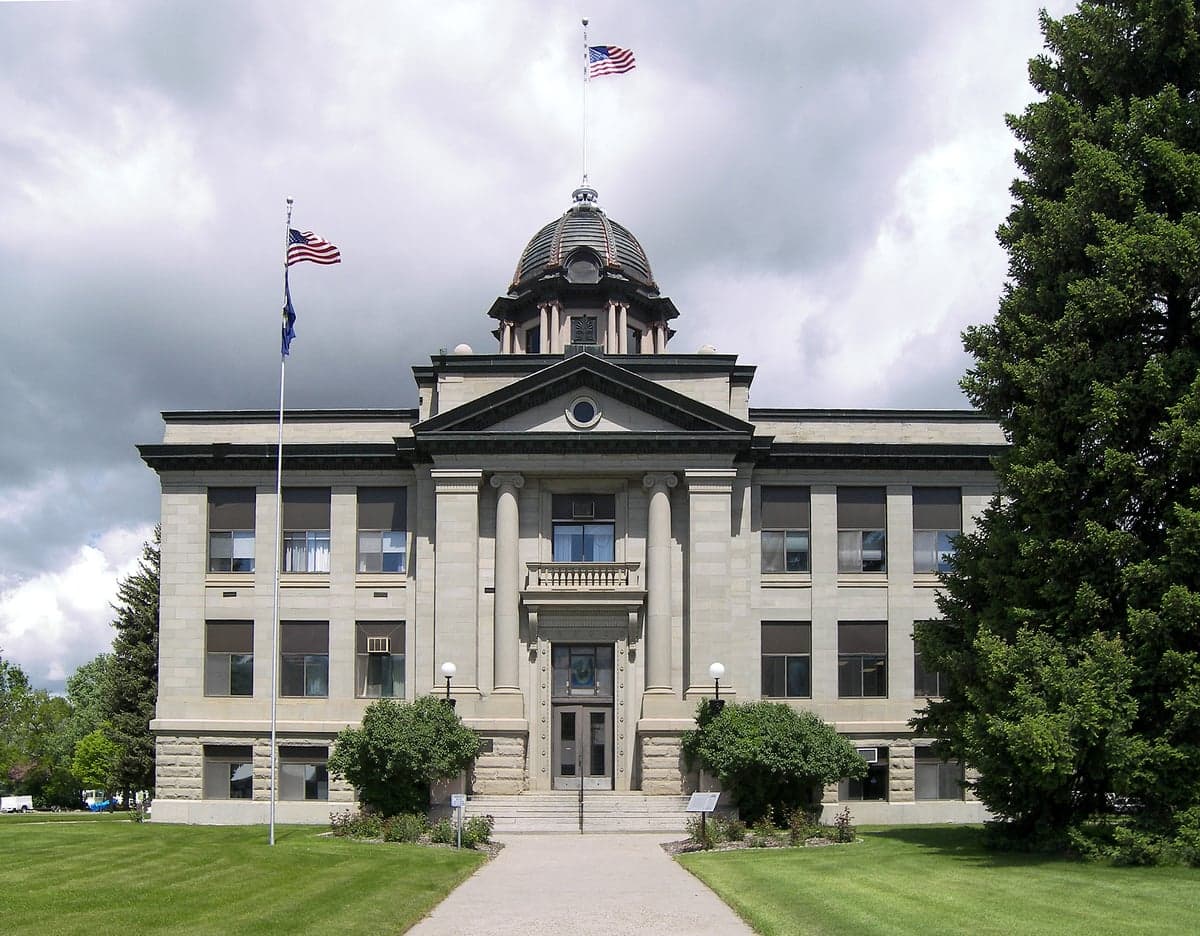
Photo: Wikipedia
Political ClimatePolitical Climate in Rosebud County
Showing district-level results — no local-only data available.
Local Political AnalysisPolitical Analysis of Rosebud County
Rosebud County, Montana, is a reliably Republican stronghold with a Cook PVI of R+15, making it significantly more conservative than the state of Montana as a whole, which sits at R+10. This isn't a new development; the county has voted for the GOP presidential candidate in every election since 2000, often by margins exceeding 30 points. However, the political landscape isn't a monolith, and the real story lies in the sharp divide between the county's two main population centers: the coal-mining hub of Colstrip and the county seat of Forsyth.
How it compares
The R+15 PVI means Rosebud County is about 5 points more Republican than the state average, which itself is already a solid red state. To put that in perspective, while Montana has seen competitive statewide races in recent years—like the 2024 Senate race—Rosebud County rarely flinches. The difference is driven by the county's heavy reliance on the energy sector, particularly coal and natural gas, which fosters a pro-industry, anti-regulation political culture. In contrast, Montana's more purple lean is influenced by its growing urban centers like Bozeman and Missoula, which have no equivalent in Rosebud County. The county's rural, resource-extraction economy creates a political reality where Democrats are almost invisible in local elections, and the primary contest is often the only real race.
What this means for residents
For conservative residents, this means their values are deeply reflected in local governance. The county commission, school boards, and law enforcement are all reliably Republican, and there's little political friction in daily life. A conservative family in Colstrip will find that their views on energy policy, land use, and gun rights are the default. For liberal residents, the experience is different. They are a distinct minority, and while they aren't actively suppressed, they often feel politically isolated. There is no organized Democratic Party presence in the county, and progressive voices are largely confined to personal conversations rather than public forums. The practical effect is that a liberal resident in Forsyth might find their vote for a statewide candidate feels symbolic, as the county's margin will overwhelmingly go the other way. The political climate is stable, but it lacks the ideological diversity found in more competitive parts of Montana.
Culturally, Rosebud County's politics are intertwined with its identity as an energy-producing region. The debate over coal plant closures and the transition to renewable energy is not an abstract policy discussion here; it's a matter of local employment and economic survival. This creates a distinct policy distinction from the rest of Montana, where the conversation is often more about tourism, tech growth, and housing affordability. In Rosebud County, the political conversation is grounded in the realities of a working-class, industrial economy. The county's strong Republican lean is not just about social issues; it's a pragmatic stance on economic survival. Looking ahead, the trajectory is likely to hold steady, as the county's demographics and economic base show no signs of shifting toward the urban, college-educated voters who are pulling other parts of Montana to the center. For anyone moving here, understanding that this is a place where politics is personal, local, and deeply tied to the land and its resources is key to fitting in.

State Political ClimatePolitical Climate in Montana
State Political AnalysisPolitical Environment in the State
Montana is a reliably Republican state with a Cook PVI of R+10, but its political reality is far more nuanced than that number suggests. The state has shifted rightward over the past 20 years, driven by rural realignment and an influx of conservative-leaning transplants, but it still retains a strong libertarian streak and a Democratic foothold in a few key population centers. For a relocator, the practical takeaway is that Montana is a state where conservative policies dominate at the state level, but local politics vary dramatically depending on which valley you land in.
Urban vs. rural divide
The political map of Montana is a textbook case of urban-rural polarization. The Democratic strongholds are concentrated in a handful of places: Missoula (home to the University of Montana), Bozeman (Montana State University), and Butte (a historic union town). These three cities consistently vote blue, with Missoula County delivering margins of 20-30 points for Democrats in recent cycles. Helena, the state capital, leans Democratic but is more moderate, reflecting its mix of state workers and retirees. In contrast, the vast rural expanse — the eastern plains, the Hi-Line, and the ranching counties — votes overwhelmingly Republican. Billings, the largest city, is a conservative anchor: Yellowstone County voted +18 for Trump in 2024, and its growth is pulling the state's center of gravity further right. Kalispell and the Flathead Valley have seen explosive growth from out-of-state conservatives, flipping what was once a swing area into a solid red stronghold. The divide isn't just geographic — it's cultural. A Missoula resident and a Glendive resident live in different political worlds, even though they share a state.
Policy environment
Montana's state-level policy is unmistakably conservative, shaped by a Republican trifecta that has held the governorship and both legislative chambers for most of the last two decades. There is no state sales tax, which keeps the overall tax burden low, though property taxes fund most local services. The regulatory posture is business-friendly: Montana is a right-to-work state, and environmental permitting for energy and agriculture is streamlined compared to western neighbors like Washington or Oregon. Education policy is decentralized — school funding is local, and there is no statewide mask or vaccine mandate for students. Election laws have tightened: the state requires a photo ID to vote, same-day registration was restricted in 2021, and mail-in ballots are still universal but subject to ongoing legislative scrutiny. Healthcare policy is mixed: Montana expanded Medicaid under the Affordable Care Act in 2015, a decision that has been renewed by the legislature, but the state also has some of the most restrictive abortion laws in the West, with a near-total ban after 20 weeks and a 2023 law requiring parental consent for minors.
Recent policy direction
The last five years have seen Montana move decisively rightward on a broad set of issues. On gun and self-defense law, the state passed constitutional carry in 2021, allowing permitless concealed carry, and preempted local governments from enacting their own firearm ordinances. On parental and education rights, the legislature passed a 2023 law requiring school districts to notify parents of any curriculum involving "sexuality" and allowing parents to opt their children out of such instruction — a direct response to debates over library books and gender identity. On speech and privacy, Montana was the first state to ban TikTok on government devices and state networks in 2023, citing data security concerns. On medical and bodily autonomy, the state banned gender-affirming care for minors in 2023, a law that is currently being challenged in court. Property rights remain strong: there is no statewide rent control, and the state has a robust "right to farm" law protecting agricultural operations from nuisance lawsuits. On taxation, the 2021 session passed a significant income tax cut, flattening the rate to a top marginal rate of 5.9%, with further cuts phased in through 2026. Voting access has been restricted: the 2021 law requiring a photo ID for absentee ballots and eliminating same-day voter registration was upheld by the state supreme court in 2022.
Civil unrest & political movements
Montana is not a state known for street protests, but it has its share of organized political movements. On the right, the Montana Freedom Caucus has become a powerful force in the legislature, pushing for further tax cuts, school choice, and restrictions on land-use planning. On the left, groups like the Montana Human Rights Network and Indivisible chapters in Missoula and Bozeman organize around abortion access, LGBTQ rights, and public lands protection. Immigration politics are relatively low-key compared to border states, but there have been flashpoints: in 2023, the legislature passed a bill requiring law enforcement to cooperate with federal immigration authorities, though it was vetoed by Governor Greg Gianforte. Election integrity controversies have surfaced: the 2020 and 2022 cycles saw lawsuits over mail-in ballot procedures, and a 2022 audit of the 2020 election in Ravalli County found no evidence of fraud but fueled ongoing distrust among some conservative activists. There is no serious secession or nullification movement in Montana, though "county supremacy" rhetoric occasionally surfaces in rural areas frustrated with state-level land-use decisions. A new resident is unlikely to encounter visible political unrest, but they will hear the tension between local control and state preemption in nearly every policy debate.
Projection
Over the next 5-10 years, Montana is likely to become more Republican, not less. In-migration is the key driver: the state has grown by roughly 10% since 2020, and the new arrivals are disproportionately conservative-leaning retirees, remote workers, and second-home owners from California, Washington, and Oregon. These transplants are reshaping the Flathead Valley, Gallatin County, and the Bitterroot, turning swing areas into solid red ones. The Democratic strongholds in Missoula and Bozeman will remain blue, but they will be increasingly isolated as the rural and exurban vote grows. The state's demographic profile — older, whiter, and more rural than the national average — reinforces this trend. The wildcard is climate change: if wildfires and drought intensify, they could slow in-migration and shift political priorities toward conservation and disaster preparedness, which might benefit Democrats. But for now, the trajectory is clear: Montana is moving right, and a relocator arriving in 2026 should expect to live in a state where conservative policies are the norm and the political center of gravity is in the Flathead and Yellowstone counties, not Missoula.
For a new resident, the bottom line is this: Montana offers a low-tax, low-regulation environment with strong gun rights and local control over schools, but those benefits come with trade-offs. Public services are lean, healthcare access is limited outside the major towns, and the political climate can feel insular if you land in a county where everyone votes the same way. If you are conservative, you will find a state that largely aligns with your values. If you are liberal, you will find welcoming communities in Missoula, Bozeman, and Helena, but you will be swimming against the current at the state level. Either way, the key is to choose your valley carefully — the politics of Kalispell and Missoula are not the same politics, even if they share a state line.
* Values derived from national, state, county, city and local statistics and may differ in a specific area. Last updated: 2026-07-16T18:28:30.000Z
Narrative content on this page is AI-generated and may contain mistakes. Verify any details that matter before acting on them.
ReloMaps may earn a commission from affiliate links at no extra cost to you.

