Photo: Wikipedia
Political ClimatePolitical Climate in Kalamazoo County
Showing district-level results — no local-only data available.
Local Political AnalysisPolitical Analysis of Kalamazoo County
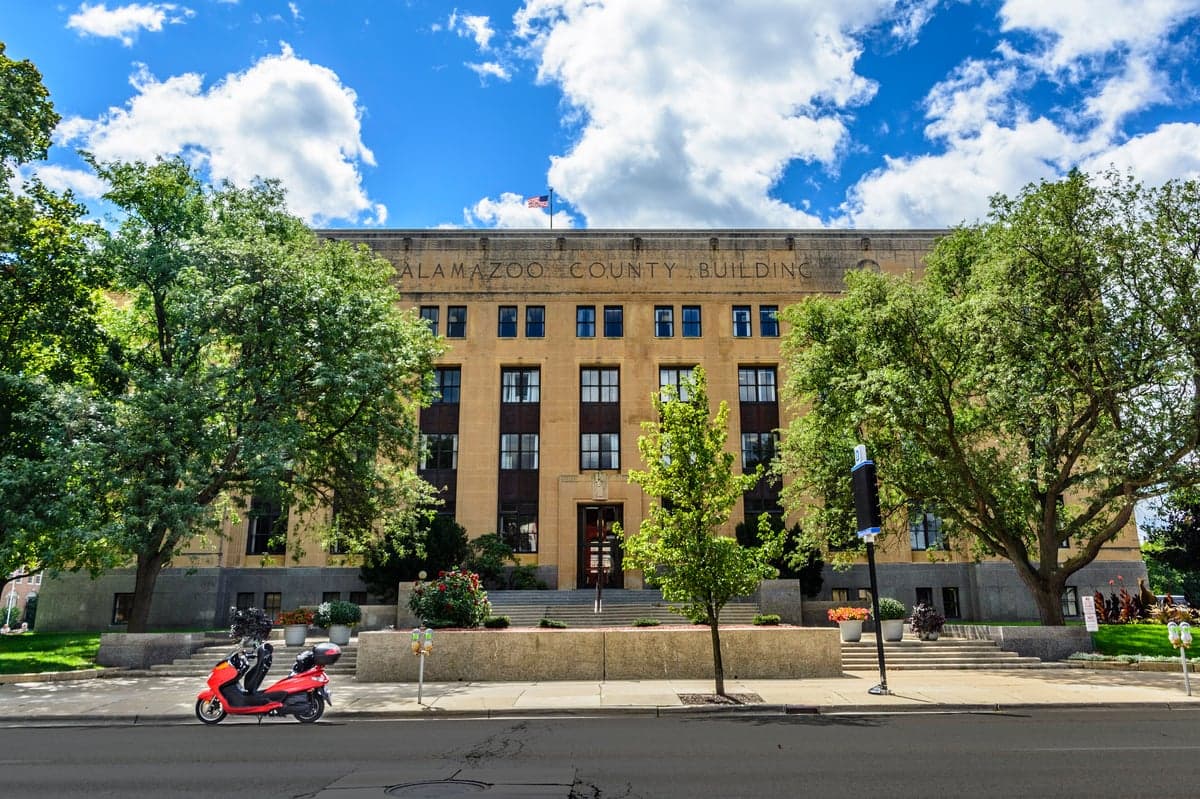
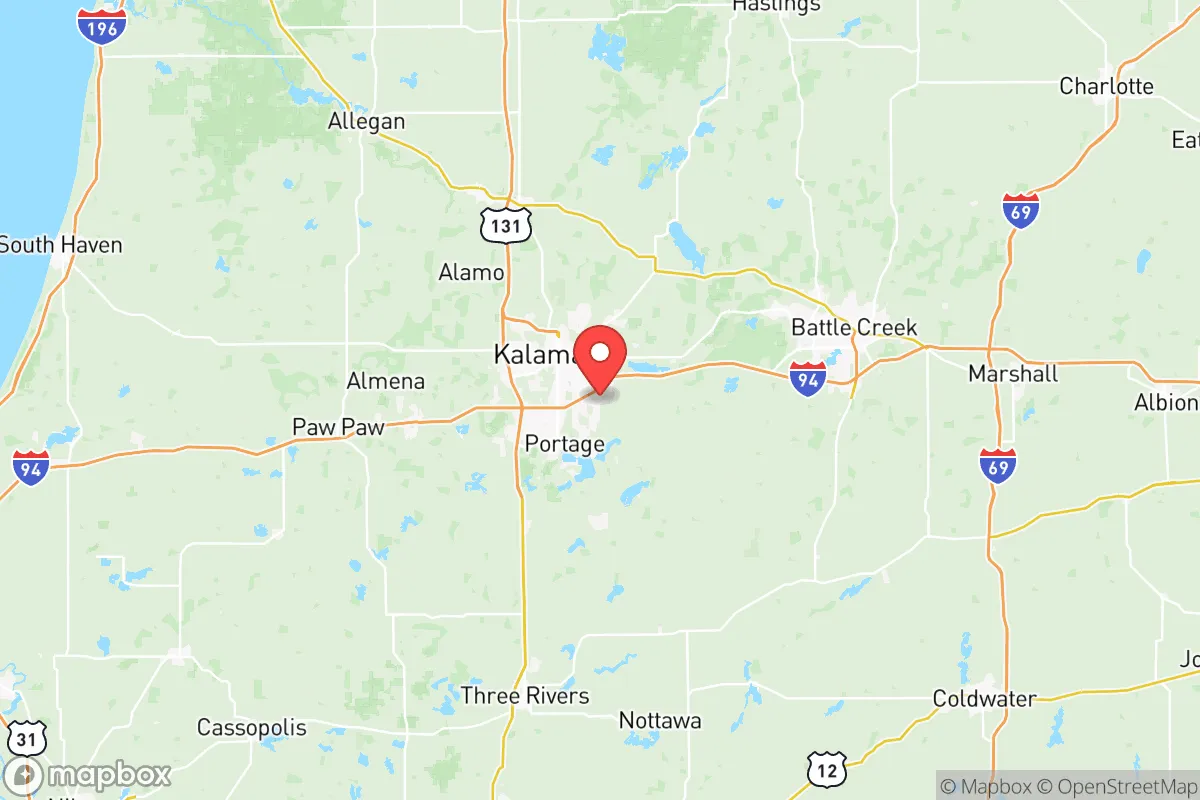
Kalamazoo County has been a reliable Democratic stronghold in recent presidential elections, but its political lean is more nuanced than a simple blue label suggests. The county's Cook Partisan Voting Index (PVI) of D+13 reflects a solid Democratic advantage, a shift from its more competitive past. This Democratic tilt is driven largely by the city of Kalamazoo itself, home to Western Michigan University and Kalamazoo College, which consistently delivers heavy Democratic margins. However, the county is far from monolithic; the rural townships and smaller communities like Oshtemo, Texas Township, and Richland lean more conservative, creating a distinct urban-rural divide that shapes local politics.
How it compares to Michigan as a whole
Kalamazoo County is significantly more Democratic than the state of Michigan, which has a Cook PVI of EVEN. While Michigan is a quintessential swing state, Kalamazoo County has voted for the Democratic presidential candidate in every election since 1992, with the exception of 2004. This makes it a reliable blue anchor in a state that often flips between parties. The county's Democratic performance is comparable to other college towns like Ann Arbor (Washtenaw County) and East Lansing (Ingham County), but it's less liberal than those areas. The surrounding rural counties, such as Allegan and Van Buren, are deeply Republican, meaning Kalamazoo County is a Democratic island in a sea of red Southwest Michigan. This dynamic makes the county a key battleground for state-level races, where candidates must appeal to both the progressive city voters and the more moderate suburban and rural residents.
What this means for residents
For liberal residents, Kalamazoo County offers a comfortable political environment, especially within the city limits. Local policies tend to be progressive, with a focus on sustainability, public transit, and social services. The county government is also Democratic-controlled, which means liberal priorities often get a fair hearing. For conservative residents, the political reality is more mixed. While they may feel out of step with the county's overall direction, they are not without representation. The rural townships and some suburban areas elect Republican officials to local boards and commissions. In practice, this means that while the county's overall political climate is liberal, there is still room for conservative voices, particularly on issues like land use, taxes, and school policy. The key is that the political conversation is often shaped by the urban core, but the rural and suburban areas provide a necessary counterbalance.
One of the most distinctive cultural and policy distinctions in Kalamazoo County is the Kalamazoo Promise, a universal scholarship program for graduates of Kalamazoo Public Schools. This program, funded by anonymous donors, has had a profound impact on the community, fostering a sense of shared investment in education and economic development. It's a policy that transcends typical partisan divides, with both Democrats and Republicans generally supporting it. Another notable feature is the county's relatively strong environmental consciousness, with initiatives like the Kalamazoo River cleanup and a growing network of bike paths and parks. These efforts tend to be championed by Democrats but often find support among moderate Republicans who value quality of life. The county's political identity is thus a blend of progressive urban energy and pragmatic, community-focused conservatism, making it a unique and often surprisingly collaborative place to live.

State Political ClimatePolitical Climate in Michigan
State Political AnalysisPolitical Environment in the State
Michigan is the ultimate swing state, with a Cook PVI of EVEN that perfectly captures its knife-edge political balance. Over the last 20 years, the state has lurched from reliably blue in the 1990s and early 2000s, to a narrow Republican win for Trump in 2016, to a Democratic trifecta in 2022 that enacted a sweeping progressive agenda. Today, the state is defined by a razor-thin partisan split, where a few thousand votes in the suburbs of Detroit, Grand Rapids, and Traverse City can flip the entire state. For a conservative-leaning relocator, Michigan offers a mix of blue-leaning urban centers and deeply red rural and exurban areas, but the state-level policy direction has shifted sharply leftward since 2022.
Urban vs. rural divide
The political map of Michigan is a classic story of urban vs. rural, but with a few unique twists. The Democratic stronghold is Detroit and its inner-ring suburbs like Southfield and Dearborn, which produce massive vote margins. Ann Arbor, home to the University of Michigan, is the state's most liberal city. The other major blue engine is Grand Rapids, which has been trending leftward as its downtown and near-west side gentrify, though the surrounding Kent County suburbs like Byron Center and Caledonia remain deeply red. The rural Upper Peninsula, once a Democratic bastion, has flipped hard to the right, voting for Trump by double digits in 2024. The key battlegrounds are the "blue wall" suburbs of Macomb County (e.g., Sterling Heights, Clinton Township) and the exurbs of Oakland County (e.g., Rochester Hills, Novi), where ticket-splitting is still alive. The 2022 gubernatorial race was decided by less than 11 points, with Democrat Gretchen Whitmer winning by carrying the Detroit and Grand Rapids metros while losing most of the rest of the state.
Policy environment
Michigan's tax structure is relatively moderate. The state has a flat income tax of 4.25%, which was temporarily reduced from 4.35% in 2023 due to a 2015 law that triggers automatic cuts when revenue exceeds inflation. Property taxes are levied at the local level, with an average effective rate of about 1.5%, but the Proposal A system from 1994 caps annual increases on primary residences at the rate of inflation or 5%, whichever is lower, providing predictability. The state has no sales tax on groceries or prescription drugs, but a 6% sales tax on most other goods. On regulation, Michigan is a "right-to-work" state, but the Democratic trifecta repealed the right-to-work law in 2023, a major shift that will affect union dynamics. Education policy is a flashpoint: the state has a universal school choice program (the "Schools of Choice" system) that allows students to transfer between districts, but there is no private school voucher program. The state's third-grade reading law, which requires retention for students who are more than a grade level behind, remains in effect, though enforcement has been uneven. Healthcare policy is dominated by the expansion of Medicaid under the Affordable Care Act, which was adopted in 2013. Election laws are relatively accessible: Michigan has no-excuse absentee voting, same-day voter registration, and early voting, all of which were expanded by a 2022 ballot initiative (Proposal 2) and subsequent legislation.
Recent policy direction
The 2023-2024 legislative session was a whirlwind of progressive legislation. On gun policy, the Democratic trifecta passed universal background checks, safe storage laws, and a red flag law (extreme risk protection orders), all of which were signed by Governor Whitmer. For a conservative relocator, this means Michigan is no longer a permissive gun state; the new laws are among the strictest in the Midwest. On education, the state repealed the 1935 law that allowed school districts to hire uncertified teachers, and it expanded the state's preschool program. Parental rights have been a battleground: the state passed a law requiring schools to adopt policies on notifying parents about a student's mental health, but it also passed a law prohibiting school districts from requiring teachers to out LGBTQ+ students to parents, a direct conflict with some conservative school boards. On bodily autonomy, Michigan codified abortion rights into state law in 2023, following the 2022 ballot initiative (Proposal 3) that amended the state constitution to protect reproductive freedom. On property rights, the state has not enacted any major reforms, but the Michigan Environmental Protection Act has been used to block some development projects. On voting, the state expanded early voting and absentee ballot access, and it passed a law requiring independent redistricting commissions, which has led to more competitive legislative maps. On privacy and surveillance, the state passed a law restricting the use of facial recognition technology by police, but it has not passed a comprehensive data privacy law.
Civil unrest & political movements
Michigan has been a flashpoint for political activism. The 2020 lockdown protests at the state capitol in Lansing, where armed protesters entered the building, drew national attention and remain a symbol of the state's deep divisions. The Wolverine Watchmen kidnapping plot against Governor Whitmer in 2020 further polarized the state. On the left, the Michigan Democratic Party has been energized by the 2022 trifecta, and groups like Progress Michigan push for more aggressive climate and labor policies. On the right, the Michigan Republican Party has been fractured between the establishment and the "America First" wing, leading to a series of contentious primaries. Immigration politics are less visible than in border states, but the city of Detroit has a "sanctuary city" policy that limits cooperation with federal immigration enforcement, while rural counties like Lenawee and Hillsdale have passed resolutions declaring themselves "Second Amendment sanctuaries." Election integrity remains a hot-button issue: the 2020 election in Michigan was subject to numerous audits and lawsuits, and the state's new independent redistricting commission has been praised by good-government groups but criticized by some Republicans for producing maps that favor Democrats. A new resident would notice the prevalence of political yard signs and bumper stickers, especially in the swing suburbs of Macomb and Oakland counties, where the "Whitmer vs. Trump" dynamic is a constant topic of conversation.
Projection
Over the next 5-10 years, Michigan is likely to remain a competitive swing state, but the demographic trends favor Democrats. The state's population is aging and slowly declining, but the growth in the Grand Rapids metro and the Traverse City area is attracting younger, more diverse residents. The Detroit metro is also seeing a modest revival, with new investment in downtown and midtown. However, the rural areas are depopulating, which will reduce the Republican base. The 2024 election will be a key test: if Trump wins Michigan again, it will signal that the Democratic trifecta's policies are out of step with the state's median voter. If Democrats hold the state, it will confirm the trend toward a blue-leaning swing state. For a conservative relocator, the most likely scenario is that Michigan remains a purple state with a slight Democratic lean at the state level, but with many deeply red counties and school districts where conservative values are the norm. The state's policy direction will depend on which party controls the governorship and the legislature after the 2026 midterms.
For a new resident, the bottom line is that Michigan offers a high degree of local political diversity. You can live in a deeply red rural county like Hillsdale or Lapeer and have minimal exposure to state-level progressive policies, or you can live in a blue suburb like Ann Arbor or Ferndale and be fully immersed in them. The state's tax structure is moderate, but the recent repeal of right-to-work and the new gun laws are significant shifts that will affect your daily life. If you are a conservative who values local control and a lower cost of living, Michigan's rural and exurban areas are still very welcoming. If you are a liberal who wants a state with strong labor protections and abortion rights, the urban centers are a good fit. The key is to choose your county and school district carefully, because the state's political divide is not just between cities and farms—it's between neighborhoods and townships that are only a few miles apart.
* Values derived from national, state, county, city and local statistics and may differ in a specific area. Last updated: 2026-06-15T23:40:36.000Z
Narrative content on this page is AI-generated and may contain mistakes. Verify any details that matter before acting on them.
ReloMaps may earn a commission from affiliate links at no extra cost to you.

