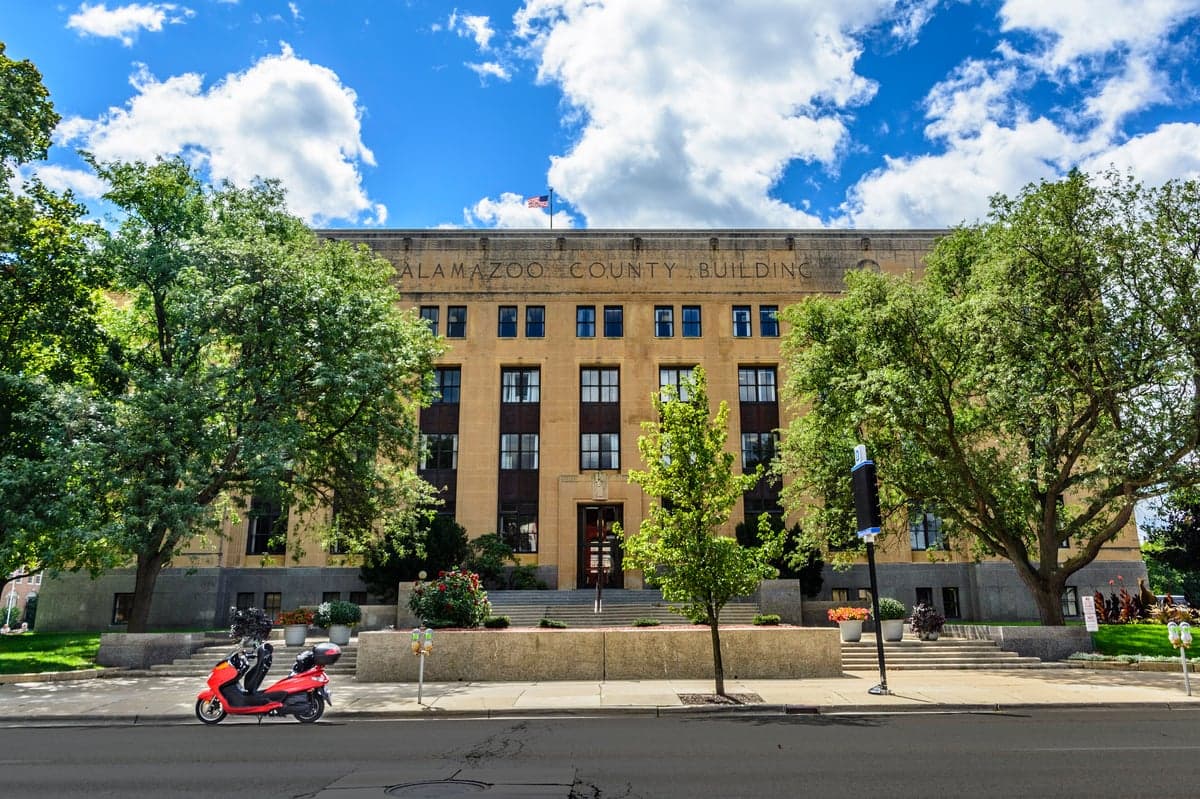
Photo: Wikipedia
Quality of Life in Kalamazoo County
A livable area that tracks near national norms for affordability, walkability, and neighborhood health.
What does Quality of Life tell us?
Quality of Life measures an area by evaluating factors like cost of living, nearby amenities, country club access, airport proximity, socioeconomic signals and neighborhood character. For large states, this is a general average — quality of life can vary dramatically between metro areas, suburbs, and rural communities within the same state.
What does this tell us?
Quality of Life measures an area by evaluating factors like cost of living, nearby amenities, country club access, airport proximity, socioeconomic signals and neighborhood character. For large states, this is a general average — quality of life can vary dramatically between metro areas, suburbs, and rural communities within the same state.
Cost of Living
14% below national average
109%
The Real Cost of Living in Kalamazoo County for 2026
| Tier | Individual | Family (4) |
|---|---|---|
| Survival | $17k | $31k |
| Comfortable | $44k | $65k |
| Luxury | $127k+ | $197k+ |
| Elite (Top 5%) | $157k+ | $243k+ |
Quality-of-Life Analysis
Kalamazoo County offers a broad spectrum of quality-of-life options, from the dense, amenity-rich urban core of Kalamazoo city to quiet, agricultural townships and lakefront communities. The county draws a diverse population: young professionals and students gravitate to the walkable neighborhoods near Western Michigan University and downtown Kalamazoo, while families and retirees often settle in the suburban townships of Portage, Texas Township, and Oshtemo for their top-rated schools and larger lots. Further out, rural pockets like Climax, Scotts, and Fulton provide a slower pace of life with direct access to farmland and smaller community schools.
Largest town(s) & population centers
The county's primary population centers are Kalamazoo (pop. ~73,000) and Portage (pop. ~49,000). Kalamazoo city offers a vibrant, walkable downtown with a dense concentration of breweries, restaurants, and cultural venues like the Kalamazoo Institute of Arts and the State Theatre. Daily life here is defined by a mix of college-town energy and urban amenities, with a strong bike culture and a robust public transit system. Portage, by contrast, is a classic suburban city with a strong employment base anchored by Pfizer and Stryker, featuring extensive parks, a highly rated school district, and a more car-dependent layout centered around Westnedge Avenue and the Portage Creek Bicentennial Trail. The townships of Oshtemo and Texas Township function as high-growth suburban corridors, offering newer housing developments and easy access to US-131 and I-94.
Smaller towns & rural pockets
Beyond the urban core, the county contains distinct smaller communities. Vicksburg (pop. ~3,200) is a historic village with a walkable downtown, a popular farmers market, and direct access to Sunset Lake and the Vicksburg Recreation Area. Schoolcraft (pop. ~1,500) centers on its historic downtown and the Prairie Ronde area, offering a tight-knit community feel with a strong local school system. Galesburg (pop. ~1,800) and Augusta (pop. ~800) are smaller villages along the Kalamazoo River corridor, providing affordable housing stock and a quieter, more rural lifestyle. The unincorporated communities of Climax and Fulton are true rural hamlets, surrounded by active farmland and offering little in the way of commercial services but significant land and privacy.
Cost & lifestyle range
The cost of living across Kalamazoo County varies noticeably by location, though the overall county index sits at 86 (14% below the national average). The most affordable housing is typically found in the city of Kalamazoo itself, where the median home value of $227,500 and median rent of $1,049 stretch further, especially in neighborhoods like Edison and the Northside. The highest price points are concentrated in Texas Township and Oshtemo Township, where newer subdivisions and lakefront properties on lakes like Little Long Lake and Sugarloaf Lake can push home values well above the county median. The average commute across the county is a short 20.3 minutes, but this varies: a resident of Climax may drive 25-30 minutes to a job in downtown Kalamazoo, while someone living in Portage's central neighborhoods may have a commute under 10 minutes. Lifestyle options range from urban loft living in downtown Kalamazoo to suburban cul-de-sacs in Portage to rural acreage in Alamo or Cooper Townships, each with corresponding trade-offs in access to services, schools, and recreational amenities.
Kalamazoo County is best suited for those who want access to a mid-sized city's cultural and employment base without sacrificing the option of a small-town or rural lifestyle within a short drive. The county's compact geography means a resident can live on a farm in Climax, work at a biotech firm in Portage, and catch a concert in downtown Kalamazoo, all within a 30-minute radius. This flexibility makes it particularly attractive to professionals in healthcare and manufacturing, families seeking diverse school options, and retirees looking for a lower-cost alternative to Michigan's larger metro areas.

Crime in Kalamazoo County
Crime rates similar to the national median for U.S. locations.
Violent CrimeViolent Crime Analysis
Property CrimeProperty Crime Analysis
Crime Analysis
Kalamazoo County, Michigan, reports a violent crime rate of 414.4 per 100,000 residents and a property crime rate of 1,248.9 per 100,000, figures that place it above both the state of Michigan and national averages for overall crime. While the county contains a mix of urban, suburban, and rural communities, the city of Kalamazoo itself drives the majority of reported incidents, particularly in its downtown core and near the Western Michigan University campus. Residents in outlying towns like Portage, Mattawan, and Richland experience significantly lower crime rates, though property crime remains a concern countywide.
Crime in context
Kalamazoo County’s violent crime rate of 414.4 per 100,000 is roughly 15% higher than the Michigan state average of approximately 360 per 100,000 and well above the national median. Property crime at 1,248.9 per 100,000 is similarly elevated, driven largely by larceny, motor vehicle theft, and burglary. The county’s crime index is heavily weighted by incidents within the city of Kalamazoo, which reports violent crime rates near 700 per 100,000 — comparable to larger Michigan cities like Flint and Saginaw. By contrast, Portage, the county’s second-largest city, posts violent crime rates roughly half the county average, around 200 per 100,000. The disparity between these two municipalities illustrates how a single urban core can distort the county-level picture. Property crime is more evenly distributed, with suburban areas like Oshtemo Township and Texas Township still reporting rates above 1,000 per 100,000, largely due to vehicle break-ins and package theft.
What residents experience
Residents in the city of Kalamazoo frequently cite property crime as the most visible public safety issue, with car break-ins and porch thefts common in neighborhoods near downtown and the WMU campus. Violent crime, while less frequent in daily life, is concentrated in specific corridors — notably along the North Side and parts of the Edison neighborhood — where aggravated assault and robbery are more common. The Kalamazoo County Prosecutor’s Office, under a progressive administration, has implemented diversion programs and reduced charging for certain low-level offenses, a policy that has drawn criticism from law enforcement and some residents who argue it contributes to repeat property crime. In Portage, residents report a markedly different experience, with police response times averaging under 5 minutes and community policing programs that maintain visible patrols in retail corridors like Westnedge Avenue and Shaver Road. Mattawan and Richland, smaller villages in the county’s rural west and east, respectively, see minimal violent crime and property crime rates below 500 per 100,000, making them attractive for families seeking lower risk.
Neighborhood-level variation is significant. Within the city of Kalamazoo, the Oakwood and Milwood neighborhoods report moderate crime levels, while the West Main Hill area near WMU experiences high volumes of larceny from vehicles. Comstock Township and Kalamazoo Township, both immediately adjacent to the city, show intermediate crime rates — higher than Portage but lower than the city core. For prospective residents, the safest options within the county are generally Portage, Richland, and Mattawan, where violent crime is rare and property crime is manageable with standard precautions. Those considering the city of Kalamazoo should research specific block-level data, as safety can vary dramatically within a few blocks, particularly near the downtown entertainment district and along the Stadium Drive corridor.
* Values derived from national, state, county, city and local statistics and may differ in a specific area. Last updated: 2026-06-15T23:40:36.000Z
Narrative content on this page is AI-generated and may contain mistakes. Verify any details that matter before acting on them.
ReloMaps may earn a commission from affiliate links at no extra cost to you.

