Photo: Wikipedia
Demographics of Kalamazoo County
Affluence Level in Kalamazoo County
A middle-class area roughly in line with national averages across income, home values, education, and employment.
People of Kalamazoo County
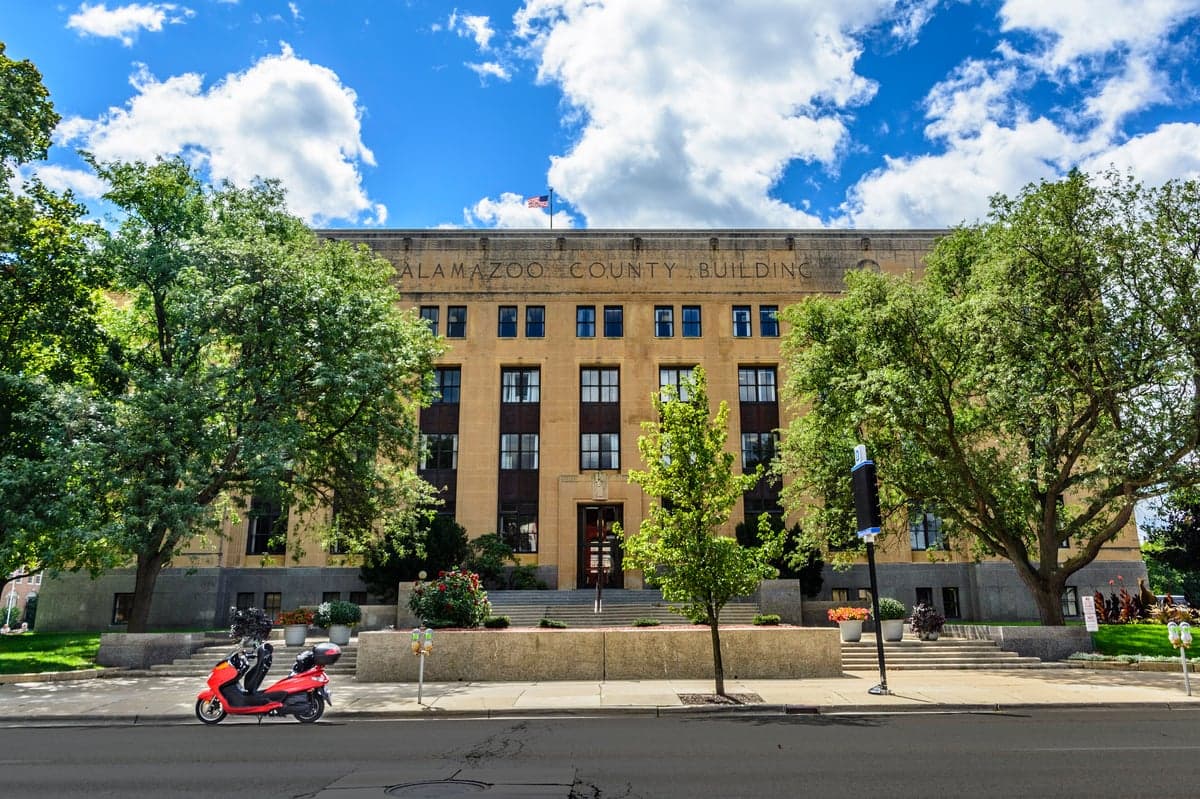
Kalamazoo County today is home to 261,437 residents, a population that is 75.2% white, 10.6% Black, 5.8% Hispanic, 1.4% Indian (subcontinent), and 1.3% East/Southeast Asian, with only 3.3% foreign-born. The county retains a distinctly Midwestern character—rooted in manufacturing, healthcare, and higher education—while its population is older and more settled than the national average, with a college attainment rate of 40.8% that reflects the influence of Western Michigan University and Kalamazoo College. The county’s identity is shaped by a long history of industrial booms, waves of European immigration, and a more recent but modest diversification driven by the Kalamazoo Promise scholarship program and the expansion of the healthcare sector. For a relocation audience, Kalamazoo County offers a stable, family-oriented environment with a slower pace of demographic change than many other parts of the country.
Settlement & growth (pre-1960)
Before American settlement, the area now known as Kalamazoo County was the homeland of the Potawatomi people, who lived in villages along the Kalamazoo River and its tributaries. French fur traders and missionaries passed through the region in the 17th and 18th centuries, but no permanent European settlements were established until after the War of 1812. The 1830s saw the first wave of American settlers, primarily Yankees from New York and New England, who were drawn by the promise of fertile farmland and the opening of the Michigan Territory. These early settlers founded the county seat of Kalamazoo (originally called Bronson) in 1831, and the village of Schoolcraft in 1830, which became an early agricultural hub. The completion of the Michigan Central Railroad through Kalamazoo in 1846 accelerated growth, transforming the county from a frontier outpost into a commercial center for southwestern Michigan.
The second major wave came with German and Dutch immigrants in the 1840s and 1850s, who were attracted by affordable farmland and the region’s growing industrial base. German farmers settled heavily in the townships around Richland and Oshtemo, where their descendants remain a visible presence today. Dutch immigrants, many from the province of Zeeland, concentrated in the northern part of the county, particularly around Parchment and Cooper Township, where they established Reformed churches and tight-knit agricultural communities. The Irish also arrived in significant numbers during this period, many working as laborers on the railroad and in the burgeoning celery and peppermint industries that made Kalamazoo famous in the late 19th century.
The late 19th and early 20th centuries brought a third wave: Polish and Italian immigrants, who came to work in the county’s expanding manufacturing sector. The Kalamazoo Corset Company, the Kalamazoo Stove Company, and the Checker Cab Manufacturing Company were major employers, and immigrant workers settled in working-class neighborhoods on the north side of the city of Kalamazoo. The Polish community established St. Stanislaus Catholic Church in 1903, which became the anchor of a distinct ethnic enclave. Meanwhile, the Great Migration brought Black families from the rural South to Kalamazoo beginning around 1915, drawn by factory jobs and the promise of escaping Jim Crow. The Black population grew steadily through the 1920s and 1930s, settling primarily in the city’s north side and in the neighborhood around East Kalamazoo, where the First Baptist Church became a central institution.
By 1960, Kalamazoo County’s population had reached roughly 170,000, with a demographic profile that was overwhelmingly white (over 95%) and native-born. The county’s economy had shifted from agriculture to manufacturing and education, with Western Michigan University (founded in 1903) and the Upjohn Company (founded in 1886) emerging as the two largest employers. Suburbanization was already underway, with families moving to newer developments in Portage, which incorporated as a city in 1963, and to the villages of Vicksburg and Galesburg.
Modern era (post-1965)
The 1965 Hart-Cellar Act had a modest impact on Kalamazoo County compared to coastal or Sun Belt regions, but it did open the door to new immigrant groups. The most notable post-1965 arrival has been the Indian (subcontinent) community, which now makes up 1.4% of the county’s population. This group is heavily concentrated in the professional and medical sectors, with many working at Western Michigan University, Bronson Methodist Hospital, and the pharmaceutical and life sciences firms that grew out of the Upjohn legacy. Indian families have settled primarily in Portage and the southwest side of the city of Kalamazoo, where good schools and newer housing stock have been strong draws. The East/Southeast Asian community (1.3% of the population) is smaller and more dispersed, with a notable concentration of Vietnamese and Korean families in the Oshtemo and Texas Township areas, many of whom are connected to the university or to medical research.
The Hispanic population, now 5.8% of the county, grew steadily from the 1970s onward, driven by both domestic migration from Texas and the Southwest and by immigration from Mexico and Central America. The Hispanic community is concentrated in the city of Kalamazoo, particularly on the north side and in the Edison neighborhood, where a growing number of Mexican grocery stores, restaurants, and churches have created a visible cultural presence. The Black population, now 10.6%, has remained relatively stable as a share of the county total, though it has become more suburbanized over time, with significant numbers of Black families moving to Portage and Comstock Township in search of better schools and housing.
Domestic migration patterns since 1965 have been shaped by the decline of manufacturing and the rise of healthcare and education as the county’s economic anchors. The Upjohn Company’s merger with Pharmacia in 1995 and subsequent acquisition by Pfizer in 2003 led to job losses, but the region’s healthcare sector—anchored by Bronson Healthcare and Ascension Borgess—has grown steadily, attracting workers from across the Midwest. The Kalamazoo Promise, launched in 2005, has been a significant draw for families with children, offering free college tuition to graduates of Kalamazoo Public Schools and contributing to a modest inflow of middle-class Black and white families from other parts of Michigan and the Rust Belt.
The future
Kalamazoo County is likely to become slightly more diverse over the next 10-20 years, but the pace of change will remain slow compared to the national average. The Hispanic and Indian (subcontinent) populations are expected to grow at the fastest rates, driven by a combination of immigration, higher birth rates, and continued recruitment of medical and tech professionals by local employers. The East/Southeast Asian population is likely to grow more modestly, while the Black and white populations will remain relatively stable in absolute numbers. The county’s foreign-born share, currently 3.3%, will rise but is unlikely to exceed 6-7% by 2040, keeping Kalamazoo County less diverse than the state of Michigan as a whole.
Geographically, new growth will continue to concentrate in Portage, Oshtemo Township, and Texas Township, where land is available for development and schools are highly rated. The city of Kalamazoo itself will see modest population growth, driven by young professionals and students, but its share of the county total will continue to decline as suburbanization persists. The county’s cultural identity—rooted in Midwestern pragmatism, a strong work ethic, and a sense of community—will remain intact, though it will be increasingly shaped by the presence of the Indian and Hispanic communities, whose festivals, restaurants, and religious institutions are becoming more visible.
For someone moving to Kalamazoo County now, the region offers a stable, family-friendly environment with a strong educational infrastructure and a growing but still manageable level of diversity. The population is not undergoing the rapid transformation seen in many Sun Belt or coastal counties, which means the cultural and political character of the area will evolve gradually rather than abruptly. New arrivals will find a community that is welcoming but not yet fully accustomed to significant diversity, and one where the Kalamazoo Promise and the healthcare sector will continue to be the primary drivers of demographic change.

* Values derived from national, state, county, city and local statistics and may differ in a specific area. Last updated: 2026-06-15T23:40:36.000Z
Narrative content on this page is AI-generated and may contain mistakes. Verify any details that matter before acting on them.
ReloMaps may earn a commission from affiliate links at no extra cost to you.

