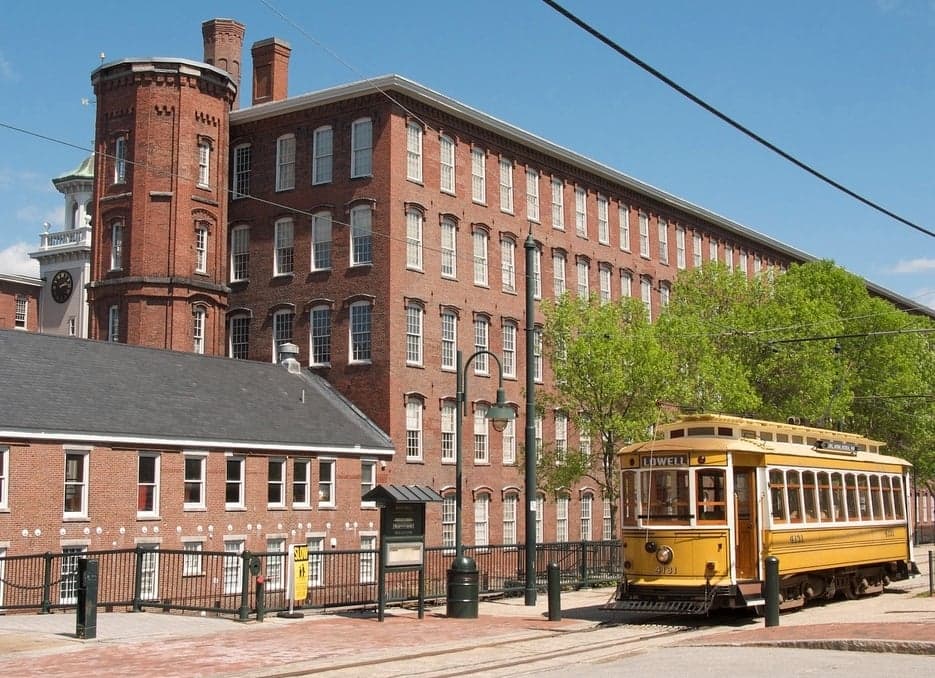
Photo: Wikipedia
Demographics of Middlesex County
Affluence Level in Middlesex County
An upper-middle-class area. Household wealth, education levels, and homeownership run ahead of national benchmarks.
People of Middlesex County
Middlesex County, Massachusetts is a region of deep historical layers and sharp contrasts: a sprawling suburban expanse of 1.6 million people anchored by the university city of Cambridge and the colonial hub of Concord, yet still dotted with working-class mill towns like Lowell and Framingham. Its population is 66.7% white, 9.0% Hispanic, 8.6% East and Southeast Asian, 4.8% Black, and 4.6% Indian (subcontinent), with 59.0% of adults holding a college degree—nearly double the national average. The county’s character is defined by its role as a global center for education, technology, and healthcare, driven by institutions like Harvard and MIT in Cambridge, while its historic industrial cities retain a more diverse, working-class base.
Settlement & growth (pre-1960)
Long before European arrival, the area now known as Middlesex County was home to the Massachusett and Pawtucket peoples, who lived along the Charles, Concord, and Merrimack Rivers. Their villages, such as those near present-day Concord and Lowell, were decimated by disease and war in the 1600s. English Puritans began arriving in the 1630s, establishing the first permanent settlements at Cambridge (1630), Charlestown (now part of Boston, but historically Middlesex), and Concord (1635). These early colonists were primarily farmers, merchants, and clergy from eastern England, and their descendants dominated the county for two centuries.
The next major demographic shift came with the Industrial Revolution in the early 19th century. The region’s rivers—particularly the Merrimack and the Concord—powered massive textile mills in Lowell and Lawrence (the latter in Essex County, but workers spilled into Middlesex). Between 1820 and 1860, tens of thousands of Irish immigrants arrived, fleeing the Great Famine and providing cheap labor for the mills, canals, and railroads. Irish enclaves formed in Lowell, Framingham, and Waltham, where they remained a politically and culturally distinct community for generations.
From the 1880s to the 1920s, a second wave of European immigration transformed the county. French Canadians came in large numbers to work in the textile mills of Lowell and Fitchburg, creating "Little Canadas" that retained French-language newspapers and Catholic parishes for decades. Italians settled in Medford and Somerville, working as laborers and small business owners, while Polish and Lithuanian communities formed in Cambridge and Lowell. Eastern European Jews, fleeing pogroms, arrived in the late 19th and early 20th centuries, establishing a vibrant community in Cambridge and the then-rural Brookline (a Norfolk County enclave adjacent to Middlesex). By 1930, roughly one-third of the county’s population was foreign-born, the vast majority from southern and eastern Europe.
The post-World War II era brought a new kind of migration: the suburbanization of white, middle-class families. Veterans using GI Bill mortgages, combined with new highways like Route 128 (I-95) and the Massachusetts Turnpike, drove explosive growth in towns like Lexington, Weston, Bedford, and Acton between 1950 and 1970. These were nearly all-white communities, and they solidified the county’s reputation as a wealthy, educated suburban corridor centered on science and engineering (the "Route 128 tech belt"). Meanwhile, the older industrial cities of Lowell, Fitchburg, and Malden began to decline as textile mills moved south or closed, and their white ethnic populations started an outward drift.
Modern era (post-1965)
The 1965 Hart-Cellar Immigration Act dramatically reshaped Middlesex County’s population. The most visible change has been the arrival of East and Southeast Asian communities, now numbering about 8.6% of the county’s population. Chinese immigrants, many with graduate degrees, began arriving in the 1970s to work at Harvard, MIT, and the Route 128 tech companies, settling heavily in Cambridge and Lexington. By the 1990s, Lexington’s Chinese-American population reached roughly 15%, and the town’s public schools became famous for their high Asian enrollment. Vietnamese, Korean, and Taiwanese communities also took root, with a notable Vietnamese enclave in Lowell—now home to one of the largest Cambodian communities in the United States, a legacy of the Khmer Rouge era’s refugee resettlement in the 1980s.
Indian (subcontinent) immigration surged after the 1990s tech boom, particularly in Acton, Westford, and Burlington. These communities—largely from India, with smaller numbers from Pakistan, Bangladesh, and Sri Lanka—are among the most educated and affluent in the county, working in IT, engineering, and medicine. The Indian population now stands at 4.6%, a share that continues to grow rapidly. It is important to note that this group is counted separately from the East/Southeast Asian population in the county’s demographics.
Hispanic growth, now 9.0%, has been driven by both domestic migration (Puerto Ricans arriving from the island and from mainland cities) and international immigration from Central America and the Dominican Republic. The largest concentrations are in Lowell, Framingham, and Somerville, where working-class housing remains more affordable. The Black population (4.8%) has a more complex history: a small but historic Black community existed in Cambridge (part of the city’s African-American heritage dating to the 19th century), but the growth since 1990 has come from African immigrants—Nigerians, Ghanaians, and Ethiopians—and from Caribbean immigrants, particularly in Malden and Everett.
Domestically, the county has experienced a steady outflow of white families to more rural areas (New Hampshire, southern Maine) and the Sun Belt, offset by an influx of highly educated young professionals and immigrants. The college-educated share—59.0%—is the key driver: the region’s economy is built on the innovation economy, and newcomers disproportionately hold advanced degrees. Suburbanization has continued, with towns like Woburn and Billerica seeing dense, mixed-use redevelopment near commuter rail stations, while more distant towns like Littleton and Harvard remain largely white and rural.
The future
Middlesex County is likely to become more diverse and more educated over the next 10–20 years. The white population share (66.7%) will continue to decline due to both out-migration and lower birth rates, while the Indian and East/Southeast Asian shares will increase, driven by continued immigration and high birth rates among established families. The Hispanic population is also projected to grow, particularly in the inner suburbs, though at a slower pace than Asian groups. The Black population will likely see modest growth through African and Caribbean immigration.
Geographic dispersion is the trend: while Cambridge and Lowell remain the primary immigrant gateways, second-generation families are moving to outer suburbs like Westford, Andover (Essex), and Acton, where good schools and larger homes attract upwardly mobile families. This dispersal is gradually making wealthier towns like Lexington and Newton (the latter in Middlesex) among the most diverse high-income communities in America. The county’s cultural identity—once defined by its Yankee Protestant roots and Irish and Italian Catholic working class—is shifting toward a pluralistic, globally oriented society where a mixed-race, polyglot middle class is the norm.
For someone moving in now, Middlesex County offers a high-density, high-opportunity environment where the population is increasingly young, well-educated, and ethnically complex. The biggest challenge is housing costs—the county is among the least affordable in the U.S.—which is reshaping who can afford to live here. The future is one of growing diversity tethered to the knowledge economy, with the character of the county’s towns and cities diverging: the core suburbs will become denser and more diverse, while the exurban fringe remains whiter and more traditional. It is no longer a region of single-ethnic enclaves, but a tapestry of overlapping, mobile communities where your neighbor is as likely to be a Chinese biotech researcher, an Indian software manager, a Salvadoran contractor, or a sixth-generation Yankee selectman.

* Values derived from national, state, county, city and local statistics and may differ in a specific area. Last updated: 2026-07-03T03:30:06.000Z
Narrative content on this page is AI-generated and may contain mistakes. Verify any details that matter before acting on them.
ReloMaps may earn a commission from affiliate links at no extra cost to you.

