Photo: Wikipedia
Political ClimatePolitical Climate in Middlesex County
Showing district-level results — no local-only data available.
Local Political AnalysisPolitical Analysis of Middlesex County
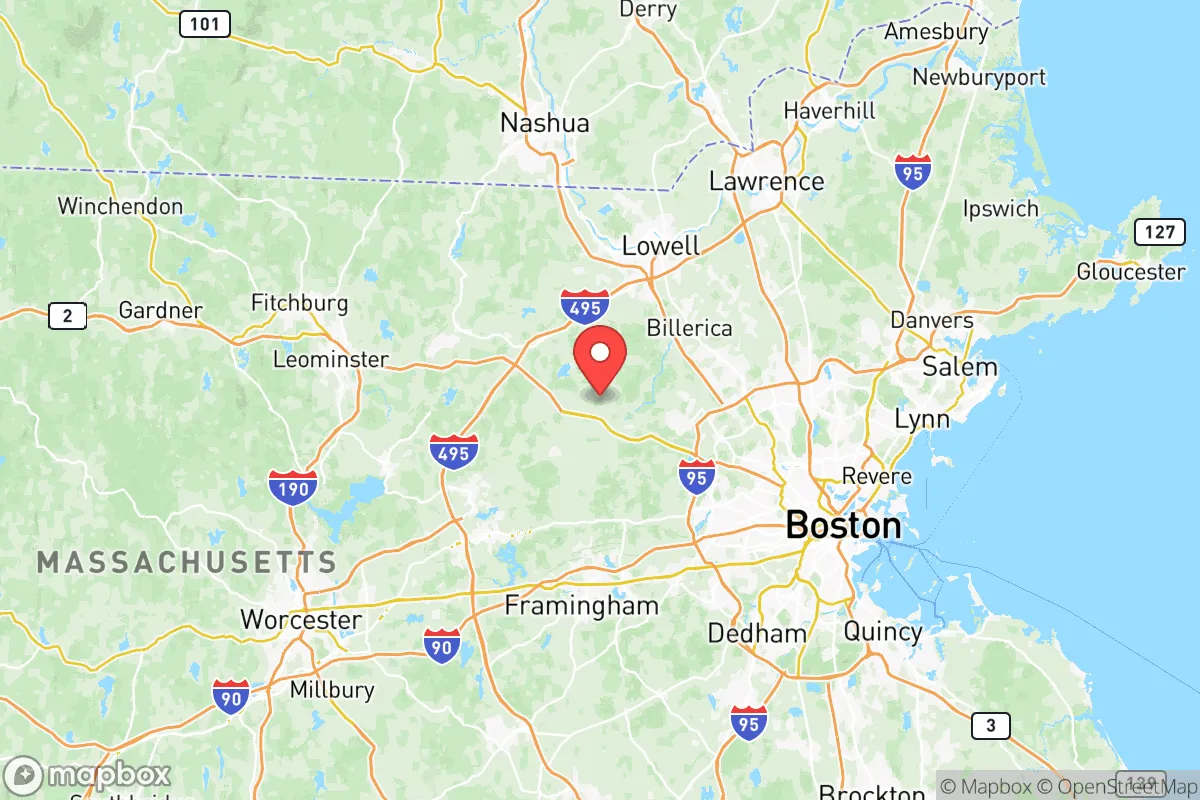
Middlesex County is a deep blue stronghold, with a Cook PVI of D+11, though it's slightly less Democratic than Massachusetts as a whole (D+15). The county's political trajectory has been steadily moving leftward over the past two decades, driven by rapid suburbanization and an influx of younger, college-educated professionals, particularly along the I-95 and Route 2 corridors. This shift has transformed once-moderate towns into reliably Democratic precincts, while the county's few remaining conservative pockets have become smaller and more isolated.
How it compares
The D+11 rating means Middlesex County is about 4 points more Republican-leaning than the state average, but that gap is deceptive. The county's political geography is a patchwork: Cambridge, Somerville, and Arlington are among the most liberal jurisdictions in the entire country, routinely voting 80-90% Democratic. Meanwhile, Wilmington, Tewksbury, and parts of Billerica still show competitive races, often splitting tickets between Democratic state legislators and Republican candidates for local office. The real swing precincts are in Burlington, Woburn, and Stoneham — older inner-ring suburbs where working-class families and municipal employees have historically leaned more moderate. In 2024, these towns voted about 55-60% Democratic, down from 60-65% a decade ago, reflecting a slight rightward drift among non-college voters. By contrast, the western exurbs like Acton, Boxborough, and Littleton have flipped from purple to solid blue since 2016, as tech workers from Route 128 and I-495 moved in.
What this means for residents
For liberal residents, the county's lean means their values are broadly reflected in local policy — Middlesex County towns were among the first in the state to adopt sanctuary city ordinances, implement rent control measures, and mandate paid family leave beyond state requirements. Conservative residents, however, aren't entirely marginalized. In towns like Pepperell, Townsend, and Ashby (the county's northwestern corner), you'll find active Republican town committees, gun rights advocacy groups, and churches that host conservative speakers. The practical effect is that local school boards and planning boards in these towns often have 3-2 or 4-3 splits, meaning conservative voices can still influence zoning, curriculum, and budget decisions. The real tension plays out in housing policy: liberal towns push for dense, transit-oriented development, while more conservative areas resist zoning changes, leading to a patchwork of affordability and growth patterns across the county.
Culturally, Middlesex County is defined by its deep institutional ties to higher education and biotech, which shapes everything from local news coverage to civic priorities. The Boston Globe and WBUR dominate the media landscape, and town meetings often feature debates about climate resilience, public transit expansion, and affordable housing — issues that resonate more with the county's educated, professional class than with its shrinking blue-collar base. One notable distinction from the rest of Massachusetts: Middlesex County has a higher concentration of Asian-American voters (about 12% of the population) than the state average (7%), particularly in Lexington, Acton, and Westford, which has made local politics more attentive to issues like language access in schools and small business support for immigrant entrepreneurs. The county's political future likely hinges on whether its growing liberal suburbs can absorb the moderate-to-conservative holdouts, or whether those holdouts will consolidate into a more organized minority that shapes local elections through low-turnout primaries and zoning board races.

State Political ClimatePolitical Climate in Massachusetts
State Political AnalysisPolitical Environment in the State
Massachusetts is one of the most reliably Democratic states in the country, with a Cook Partisan Voting Index of D+15, meaning it votes about 15 points more Democratic than the national average in presidential elections. The state hasn’t voted for a Republican presidential candidate since Ronald Reagan in 1984, and the Democratic Party holds every statewide office, a supermajority in both legislative chambers, and all 11 U.S. House seats. Over the last 20 years, the shift has been toward the left, driven by the growing dominance of the Boston metro area and the collapse of the old moderate Republican brand that once produced governors like William Weld and Mitt Romney. For a conservative relocator, this means you’re moving into a state where your vote will almost certainly be in the minority, but where local politics can vary dramatically depending on which town you choose.
Urban vs. rural divide
The political map of Massachusetts is a classic urban-rural split, but with a twist: the urban core is so dominant that it overwhelms the rest of the state. Greater Boston, including Cambridge, Somerville, and Brookline, is the engine of the state’s Democratic vote, with precincts routinely hitting 80-90% Democratic. The western part of the state, including Springfield and Pittsfield, also leans blue, but less intensely. The real Republican strongholds are in the central and southeastern regions, particularly in towns like Wrentham, Norfolk, and Plymouth, where Trump won 55-60% of the vote in 2024. The Cape and Islands (Barnstable, Nantucket, Martha’s Vineyard) are a mixed bag: the Vineyard is deep blue, while the outer Cape and parts of Plymouth County lean Republican. The most notable recent shift has been in the Merrimack Valley (Lawrence, Lowell, Haverhill), where growing Hispanic and Asian populations have pushed the region leftward, even as surrounding rural towns like Dracut and Tewksbury have held steady for the GOP. If you’re a conservative looking for a like-minded community, the suburbs south and west of Boston—places like Franklin, Medway, and Bridgewater—are your best bets, though even there, you’ll be in a purple-to-red island in a blue sea.
Policy environment
Massachusetts has a high-tax, high-service policy environment that is unlikely to change anytime soon. The state income tax is a flat 5% (down from 5.15% after a 2022 ballot measure), and the sales tax is 6.25%. Property taxes are locally set and can be steep—expect $12-15 per $1,000 of assessed value in most suburbs, with no statewide cap. The regulatory posture is business-friendly in some sectors (biotech, clean energy) but heavily restrictive in others (housing, firearms, energy extraction). Education policy is a top priority: Massachusetts consistently ranks #1 in K-12 outcomes nationally, but that comes with high per-pupil spending and a rigorous MCAS graduation requirement. Healthcare is near-universal, thanks to the 2006 Romneycare law that preceded the ACA, and the state runs its own health insurance exchange. Election laws are among the most accessible in the country: no-excuse mail-in voting, same-day registration, and early voting are all permanent fixtures. For a conservative, the policy environment means you’ll pay more in taxes and deal with more regulations, but you’ll also get top-tier schools and infrastructure—if you can afford the housing.
Recent policy direction
The last five years have seen a clear leftward push on several fronts. On gun and self-defense law, the 2024 Massachusetts Gun Safety Act (H.4885) expanded the state’s assault weapons ban, required serialization of homemade firearms, and created a new licensing system for ammunition sales. It also banned carrying firearms in most government buildings and on public transit. The state already had some of the strictest gun laws in the country, including a “may-issue” concealed carry regime that was partially liberalized by the 2022 Bruen decision, but the new law tightens things further. On parental and education rights, the state has moved in the opposite direction from many red states: a 2023 law (Chapter 28 of the Acts of 2023) requires all public schools to adopt policies supporting transgender students, including allowing them to use facilities matching their gender identity without parental notification. The state also mandates LGBTQ-inclusive curriculum in health classes. On speech and privacy, Massachusetts has a strong public records law and a 2023 data privacy act that limits how companies can collect and sell personal data, but there’s no state-level shield law for journalists. On medical and bodily autonomy, abortion is protected up to 24 weeks (and later for health reasons) under a 2020 law (Chapter 260), and the state has a “buffer zone” law protecting access to clinics. On property rights, the state’s 2021 MBTA Communities Act requires towns near transit to rezone for multi-family housing, which has sparked fierce local resistance in suburbs like Milton and Arlington. On taxation, a 2022 ballot measure added a 4% surtax on income over $1 million (the “millionaire’s tax”), which has already generated over $2 billion for education and transportation. On voting and ballot access, the 2022 VOTES Act made mail-in voting permanent and expanded early voting. For a conservative, the direction is clear: the state is becoming more restrictive on guns and more progressive on social issues, while taxes and housing regulations continue to tighten.
Civil unrest & political movements
Massachusetts has a long history of activism, but the flashpoints in recent years have been around race, policing, and housing. The 2020 George Floyd protests in Boston were large and mostly peaceful, but led to the removal of a statue of Christopher Columbus in the North End and a push to rename Faneuil Hall (which hasn’t happened). The state’s sanctuary policy is among the strongest in the country: a 2017 law (Chapter 125) prohibits state and local law enforcement from detaining people based solely on federal immigration holds, and Boston, Cambridge, and Somerville have all declared themselves “sanctuary cities.” Immigration politics are a live issue, especially in gateway cities like Lawrence and Lowell, where migrant arrivals have strained school and housing resources. On the right, the Massachusetts Republican Party is small but active, with a strong libertarian streak—groups like the Massachusetts Fiscal Alliance and the Pioneer Institute push for tax cuts and school choice. Election integrity controversies have been minimal, though the 2020 and 2024 elections saw some Republican activists challenge mail-in ballot procedures; no major fraud was found. The most visible flashpoint for a new resident would be the housing crisis: you’ll see “No on the MBTA Communities Act” signs in suburban yards, and you’ll hear heated debates at town meetings about zoning changes. The state’s political culture is one of organized, vocal activism on both sides, but the left has the institutional power.
Projection
Over the next 5-10 years, Massachusetts will likely become even more Democratic, driven by three trends. First, the Boston metro area is growing faster than the rest of the state, thanks to the biotech and tech sectors, and those new residents are overwhelmingly young and liberal. Second, the state’s Hispanic and Asian populations are growing, and they vote Democratic by wide margins. Third, the Republican Party in Massachusetts has become more conservative and less competitive, losing the moderate wing that once won statewide races. The 2024 election saw Trump win just 33% of the vote in Massachusetts, down from 35% in 2020, suggesting the state is moving left even as the national GOP shifts. For a conservative moving in now, expect to see continued Democratic supermajorities, more progressive legislation on guns, housing, and taxes, and a political environment where your voice will be heard at the local level but not at the state level. The suburbs south and west of Boston will remain the most conservative areas, but even there, the demographic tide is slowly turning blue. If you’re looking for a place where your vote might matter in a statewide race, this isn’t it—but if you’re looking for a high-quality public school system and a stable economy, Massachusetts delivers.
For a new resident, the bottom line is this: Massachusetts is a blue state that works well for people who value strong public services, high educational standards, and a predictable regulatory environment, but it comes with a high price tag and a political culture that can feel stifling if you’re on the right. If you’re a conservative, you’ll find your people in the suburbs and rural towns, but you’ll need to be comfortable being in the minority at the state level. The state’s trajectory is toward more progressive policies, not less, so don’t expect a political shift anytime soon. Your best bet is to pick a town that matches your values—Franklin for a red-leaning suburb with good schools, Plymouth for a more conservative coastal town, or Wrentham for a rural feel with easy access to Boston—and engage at the local level, where your vote still counts. Just know that the state as a whole is moving in a direction that may not align with your politics, and that’s unlikely to change.
* Values derived from national, state, county, city and local statistics and may differ in a specific area. Last updated: 2026-07-03T03:30:06.000Z
Narrative content on this page is AI-generated and may contain mistakes. Verify any details that matter before acting on them.
ReloMaps may earn a commission from affiliate links at no extra cost to you.

