
Photo: Wikipedia
Political ClimatePolitical Climate in Sumter County
Showing county-level results — no local-only data available.
Lean and PVI are calculated from this county’s 2020 and 2024 presidential results, Cook-style.
Political rankings in Georgia
- Most Conservative Cities in Georgia
- Most Liberal Cities in Georgia
- Best Liberal-Leaning Towns in the South
- Best Liberal-Leaning Towns in the Deep South
- Safest Liberal-Leaning Towns in the South
- Safest Conservative-Leaning Towns in the South
- Safest Conservative-Leaning Towns on the East Coast
- Affordable Small Towns for Conservatives
- Most Conservative Counties in Georgia
- Most Liberal Counties in Georgia
Local Political AnalysisPolitical Analysis of Sumter County
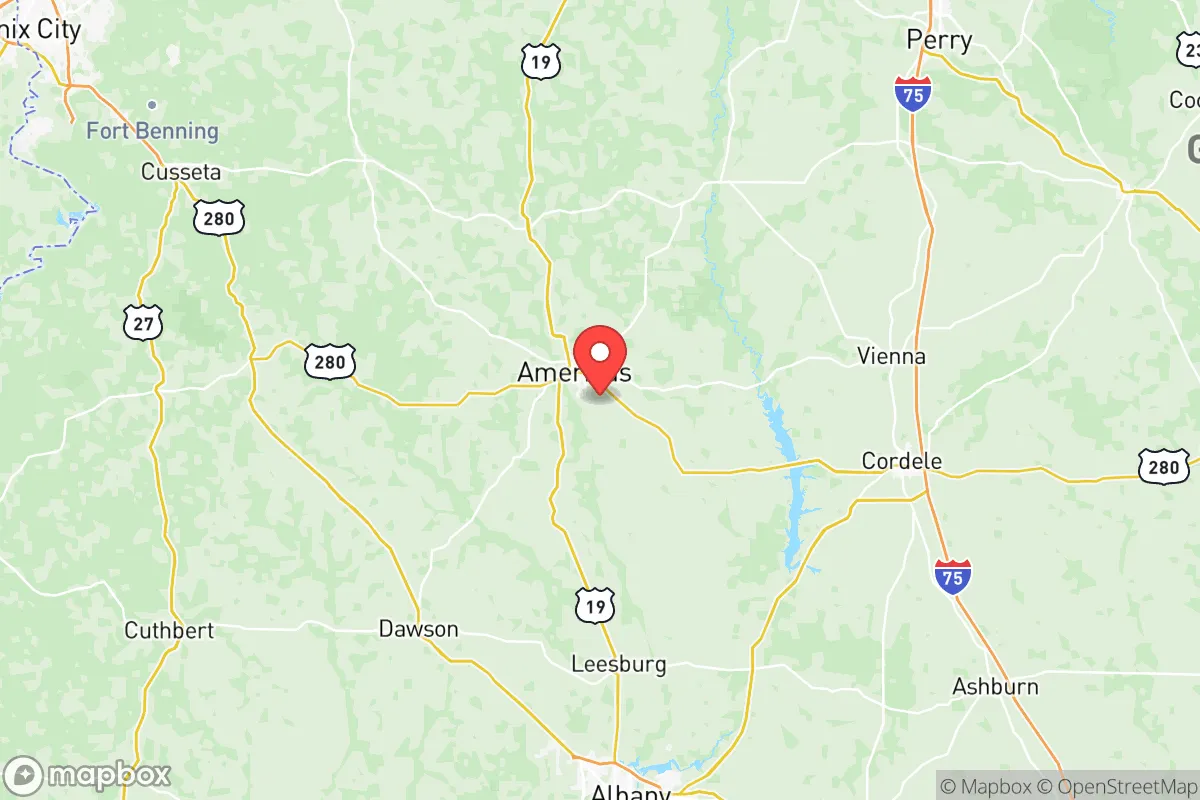
Sumter County, Georgia, leans Democratic with a Cook PVI of D+4, a shift that reflects both its rural Black Belt heritage and the growing influence of Americus and Leslie as organizing hubs. The county has trended bluer over the past decade, driven by increased turnout in majority-Black precincts and a steady influx of younger, more progressive residents tied to Georgia Southwestern State University and the Jimmy Carter National Historical Park. But don’t mistake that D+4 for a monolith—Sumter’s politics are more layered than the countywide number suggests, with sharp divides between the urban core and the outlying farm communities.
How it compares
Compared to Georgia as a whole, Sumter County is notably more Democratic. The state’s Cook PVI is unknown, but recent statewide elections have been razor-thin—Georgia flipped blue for Biden in 2020 by less than 0.3 points, then swung back to Trump in 2024 by roughly 2 points. Sumter, by contrast, gave Biden a comfortable 8-point win in 2020 and held steady for Harris in 2024. That gap is driven by the county’s demographics: roughly 55% Black population, concentrated in Americus and the rural southern precincts around Cobb and De Soto. The white-majority precincts in the northern part of the county—places like Plains and the unincorporated areas near Andersonville—vote reliably Republican, often by 20-30 points. The swing precincts are in the mixed-income neighborhoods just outside downtown Americus, where Georgia Southwestern’s faculty and staff tend to vote blue while longtime white retirees lean red. Leslie, a small town of about 400, is a microcosm: its precinct split 52-48 for Biden in 2020, but flipped to 53-47 for Trump in 2024, reflecting the national trend of rural white voters drifting right even as the county overall held.
What this means for residents
For conservative residents, the D+4 lean means they’re often outvoted in county commission and school board races, but they hold sway in the northern precincts and in Plains, where Jimmy Carter’s hometown still votes red despite his legacy. Local Republican candidates can win if they run as moderates on economic issues—like supporting the Sumter County Development Authority’s push for agribusiness and logistics jobs—while avoiding national culture-war rhetoric. For liberal residents, the county’s Democratic tilt provides a sense of alignment with local governance, but it doesn’t translate to progressive policy dominance. The county commission is split 3-2 Democratic, and the school board leans conservative on issues like curriculum and library books, reflecting the influence of rural white voters who turn out reliably in low-turnout local elections. Both sides find common ground on practical matters: keeping property taxes low (the county millage rate is 10.5, below the state average) and supporting the local hospital, Phoebe Sumter, which is the largest employer outside of education.
Culturally, Sumter County wears its history on its sleeve. The Jimmy Carter connection is a source of pride across the political spectrum—his Sunday school classes at Maranatha Baptist Church draw visitors from both parties. But the county also carries the weight of its civil rights past, including the 1965 Americus movement and the legacy of the Sumter County Freedom Singers. That history shapes local discourse: Confederate monument debates flare up every few years, and the county’s decision to keep the Americus city flag unchanged (it includes a Confederate battle emblem) remains a flashpoint. Policy-wise, the county has resisted statewide trends like the 2024 law restricting absentee ballot drop boxes, with the local elections board voting 3-2 to keep two drop boxes open in Americus. For residents, the political climate means living with a constant, low-grade tension—but also with a neighborly pragmatism that keeps the county from boiling over. It’s a place where you can disagree on politics at the Piggly Wiggly and still help each other haul hay.

State Political ClimatePolitical Climate in Georgia
State Political AnalysisPolitical Environment in the State
Georgia has transformed from a reliably Republican stronghold into the nation’s most competitive swing state over the past two decades, a shift driven by explosive growth in the Atlanta metro and the political mobilization of its diverse suburban and urban populations. In 2020, Joe Biden became the first Democratic presidential candidate to win Georgia since Bill Clinton in 1992, flipping it by a razor-thin 0.2% margin, and the state has only tightened since—Donald Trump lost it again in 2024 by roughly 1.2 points. The old coalition of white rural and exurban voters that powered GOP dominance since 2002 is now being matched by a coalition of Black voters, college-educated white suburbanites, and a rapidly growing Asian and Hispanic electorate, making Georgia a genuine 50-50 state where control of the legislature and governor’s mansion remains Republican but every statewide race is a toss-up.
Urban vs. rural divide
The political map of Georgia is a story of two Georgias: the booming, diverse Atlanta metro and the rest of the state. Metro Atlanta—encompassing Fulton, DeKalb, Cobb, Gwinnett, and Clayton counties—accounts for roughly 60% of the state’s population and is the engine of Democratic growth. Fulton County (Atlanta) and DeKalb County gave Biden over 80% of their votes in 2020, while Gwinnett and Cobb, once GOP bastions, have flipped blue as Asian and Hispanic populations surged and college-educated whites moved in. Outside the metro, the state is deeply red: rural south Georgia counties like Brooks, Colquitt, and Tift routinely vote 70-80% Republican, while the exurban and small-town north Georgia counties—Cherokee, Forsyth, Hall, and Pickens—are among the most conservative in the nation. The key battlegrounds are the “collar counties” like Henry, Newton, and Rockdale, which are rapidly diversifying and trending Democratic, and the coastal areas around Savannah (Chatham County), which have become competitive. The result is a state where a Republican can win the governor’s mansion by 5 points (Brian Kemp in 2022) while losing the presidential vote, because the GOP’s rural base is shrinking relative to the metro’s growth.
Policy environment
Georgia’s policy environment reflects its divided politics: a Republican-controlled legislature and governor’s office that push conservative priorities, but with a pragmatic, business-friendly bent that sometimes moderates the sharpest edges. The state’s income tax is a flat 5.39% (down from 5.75% in 2024, with a path to 4.99% by 2029), and there is no state tax on Social Security income, which appeals to retirees. Property taxes are relatively low, with a median effective rate of 0.87%, but vary widely by county—Fulton County’s rates are nearly double those of rural Brooks County. Education policy is a flashpoint: Georgia has a robust school voucher program (the Georgia Promise Scholarship Act, passed in 2024) that gives $6,500 per student for private school or homeschooling expenses, but it’s means-tested and limited to low-performing public school zones. The state also has a “Parents’ Bill of Rights” (SB 449, 2022) that requires schools to notify parents of any changes to a student’s health or well-being, including gender identity, and prohibits instruction on sexual orientation or gender identity in K-3 classrooms. Healthcare is a mixed bag: Georgia did not expand Medicaid under the Affordable Care Act, leaving roughly 300,000 low-income adults in a coverage gap, but the state has a limited “Georgia Pathways” work requirement program that has enrolled only a few thousand people. Election laws have been a national flashpoint: the 2021 Election Integrity Act (SB 202) added a voter ID requirement for absentee ballots, limited drop boxes, and made it a crime to hand out food or water to voters in line, drawing fierce criticism from Democrats and civil rights groups. Gun laws are among the most permissive in the country: Georgia is a permitless carry state (since 2022), with no waiting periods, no magazine capacity limits, and no red flag law, though a background check is required for purchases from licensed dealers.
Recent policy direction
Over the past three years, Georgia has moved decisively toward a conservative-libertarian posture on gun rights, education, and taxation, while maintaining a cautious, business-friendly stance on social issues. The 2022 permitless carry law (HB 218) was a top priority for the NRA and state gun rights groups, and it passed with strong Republican support. On education, the 2024 Georgia Promise Scholarship Act and the 2022 Parents’ Bill of Rights reflect a national trend toward school choice and parental oversight, but they have not triggered the kind of mass exodus from public schools seen in some other states. On medical and bodily autonomy, Georgia’s 2019 “Heartbeat Bill” (HB 481) bans abortion after a fetal heartbeat is detected (around six weeks), with exceptions for rape, incest, and the life of the mother; it was blocked in court for years but took effect after the Dobbs decision in 2022. There is no ballot initiative process in Georgia, so voters cannot directly overturn the law, and the legislature has shown no appetite for loosening it. On privacy and surveillance, Georgia has no comprehensive data privacy law, but it does have a biometric privacy law (the Georgia Biometric Information Privacy Act) that has led to class-action lawsuits against companies like Facebook. Property rights are strong: Georgia is a “right-to-farm” state with strong protections for agricultural operations against nuisance lawsuits, and it has no statewide rent control or rent stabilization laws. Voting and ballot access remain contentious: early voting is robust (three weeks of early in-person voting, including two Saturdays), but the 2021 law reduced the number of drop boxes and made it harder to vote by mail, which disproportionately affects urban and Democratic-leaning voters. The overall direction is toward a state that is conservative on social issues and taxes, but with enough moderation on economic and business policy to keep the Fortune 500 companies (like Coca-Cola, Delta, and Home Depot) that call Atlanta home from fleeing.
Civil unrest & political movements
Georgia has been a focal point for political activism on both sides, with the 2020 election aftermath and the 2021 voting law sparking sustained protests and legal battles. The “Stop the Steal” movement had a significant presence in Georgia, with Trump allies like Sidney Powell and Lin Wood filing lawsuits challenging the election results, and a controversial call between Trump and Secretary of State Brad Raffensperger in January 2021. On the left, the 2020 protests over the killing of George Floyd and the 2021 voting law protests drew tens of thousands of people to the Georgia State Capitol, and groups like Fair Fight Action (founded by Stacey Abrams) and the New Georgia Project have built a permanent grassroots infrastructure for voter registration and mobilization. Immigration politics are less volatile than in border states, but Georgia has a strict 2011 law (HB 87) that allows police to check immigration status during lawful stops and penalizes those who transport or harbor undocumented immigrants; it has been partially upheld in court. There is no sanctuary city policy in Georgia—state law explicitly prohibits local governments from adopting such policies—and the Atlanta metro’s immigrant communities (especially in Gwinnett and DeKalb) have been a target of occasional ICE enforcement actions. Election integrity controversies remain a live issue: the 2024 election saw Trump allies again challenging absentee ballot procedures in Fulton County, and the State Election Board (now controlled by a 3-2 Republican majority) has passed new rules requiring hand-counting of ballots, which critics say could delay results. A new resident would notice the political energy most visibly in the Atlanta metro, where yard signs, campaign canvassers, and political ads are ubiquitous during election season, and where the state capitol is a frequent site of rallies on both sides.
Projection
Over the next 5-10 years, Georgia is likely to remain a 50-50 state, but the demographic trends favor a slow, steady shift toward the left, driven by continued in-migration to the Atlanta metro from other states and abroad. The Atlanta Regional Commission projects that the metro area will add 1.8 million people by 2050, with most growth coming from Asian and Hispanic populations, who lean Democratic, and from college-educated whites, who have been trending away from the GOP. The rural and exurban counties that anchor the Republican base are either stagnant or losing population, meaning the GOP will need to either win back suburban voters or turn out its base at record levels to stay competitive. The state legislature is likely to remain under Republican control for the near term due to gerrymandering (the 2021 redistricting maps were drawn to protect GOP incumbents), but the margin is shrinking—Democrats picked up two state House seats in 2024 and are within striking distance of a majority by 2030. The biggest wildcard is the 2026 gubernatorial election, where a strong Democratic candidate could break the GOP’s hold on the governor’s mansion, which would shift the policy environment significantly on issues like Medicaid expansion, abortion, and voting access. A relocator moving to Georgia now should expect a state that will continue to be a political battleground, with close elections, intense activism, and a policy environment that could swing either way depending on who wins the next few cycles.
For a new resident, the bottom line is that Georgia offers a low-tax, business-friendly environment with strong gun rights and conservative social policies, but it is not a safe bet for either side—the politics are fluid and the outcome of every election is uncertain. If you’re a conservative, you’ll find a state that has delivered on tax cuts, school choice, and permitless carry, but you’ll also live in a state where your vote for president may not count for much if the metro continues to grow. If you’re a liberal, you’ll find a state with a vibrant, diverse metro area and a growing political infrastructure, but you’ll also face a six-week abortion ban, no Medicaid expansion, and a legislature that is hostile to your priorities. The practical takeaway is that Georgia rewards political engagement—your vote matters more here than in almost any other state, and the policy direction will be shaped by who shows up. If you’re moving to the Atlanta suburbs, you’ll be in the middle of the fight; if you’re moving to rural south Georgia or the north Georgia mountains, you’ll be in a solidly conservative area where the politics are more predictable. Either way, Georgia is a state where the national political conversation plays out in real time, and that’s unlikely to change anytime soon.
* Values derived from national, state, county, city and local statistics and may differ in a specific area. Last updated: 2026-10-31T14:22:52.000Z
Narrative content on this page is AI-generated and may contain mistakes. Verify any details that matter before acting on them.
ReloMaps may earn a commission from affiliate links at no extra cost to you.

