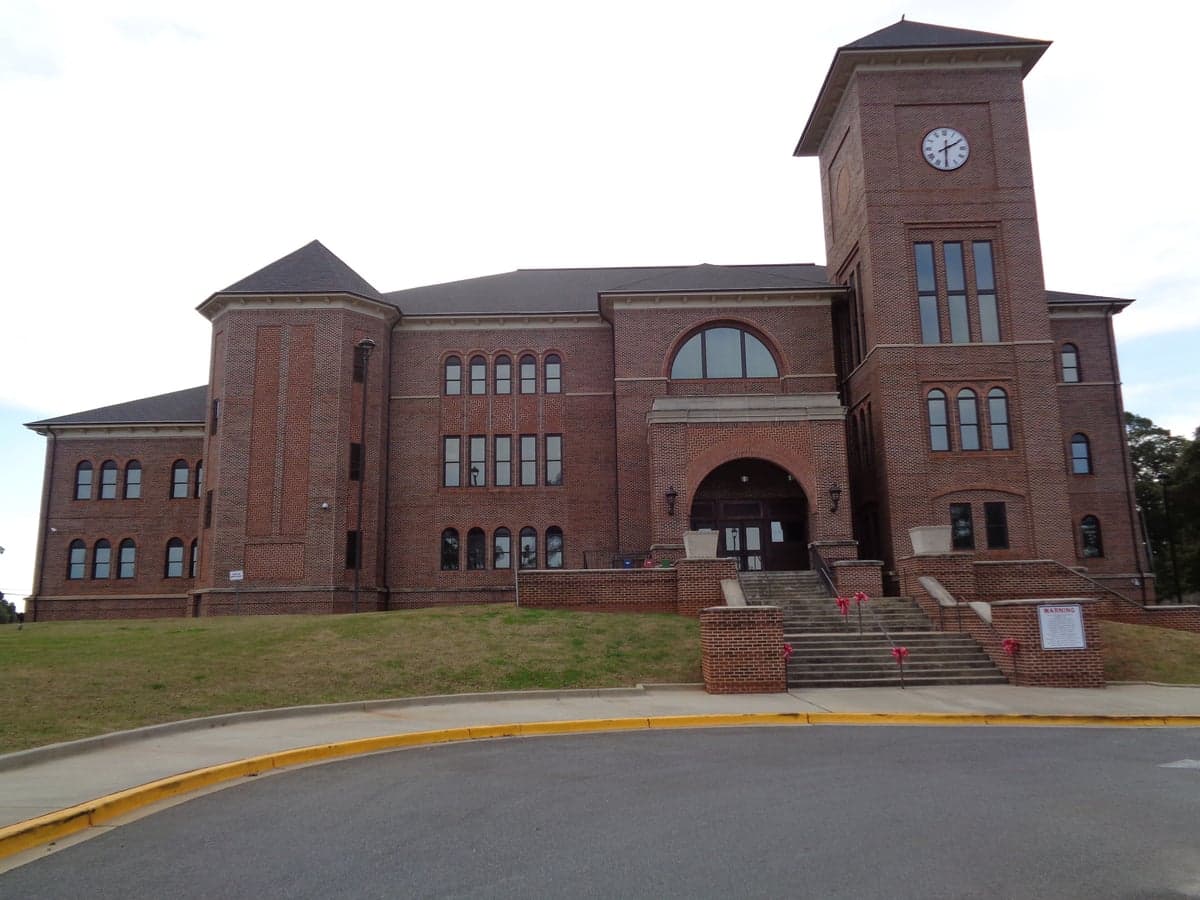
Photo: Wikipedia
Demographics of Sumter County
Affluence Level in Sumter County
A below-average socioeconomic profile. Incomes, home values, and educational attainment trail the U.S., with higher poverty and unemployment.
People of Sumter County
Sumter County, Georgia, is a predominantly Black-majority community of roughly 29,000 residents, anchored by the city of Americus and shaped by a deep agricultural heritage and the legacy of the Civil Rights Movement. The county’s population is 49.8% Black or African American, 38.6% White, and 6.2% Hispanic, with a very small foreign-born share of 2.2% and a college attainment rate of 21.3%. This is a place where rural Southern identity, HBCU influence from Georgia Southwestern State University, and a strong sense of local history converge, creating a community that is both traditional and quietly evolving.
Settlement & growth (pre-1960)
The land that became Sumter County was originally inhabited by the Creek and Cherokee nations, who were forcibly removed through treaties and land cessions in the 1820s and 1830s, opening the area to white settlement. The county was created in 1831 from parts of Lee County, and its earliest non-Native settlers were primarily Anglo-American planters from Virginia, the Carolinas, and other parts of Georgia, drawn by the fertile black soil ideal for cotton cultivation. These families established the county seat of Americus in 1832, along with smaller communities like Plains and Leslie, which became centers of the plantation economy.
The forced migration of enslaved Black people was the defining demographic event of the 19th century. By 1860, enslaved African Americans made up a majority of Sumter County’s population, working the cotton fields that dominated the landscape. After emancipation, many freed people remained in the area as sharecroppers and tenant farmers, forming the foundation of the county’s Black community. The post-Reconstruction era saw the establishment of distinct Black neighborhoods within Americus, such as East Americus and the area around Staley Park, as well as rural settlements like Doverel and Miona Springs.
The early 20th century brought little new immigration to Sumter County, which remained overwhelmingly native-born and rural. The boll weevil infestation of the 1910s and 1920s devastated the cotton economy, prompting many Black residents to leave for northern cities during the Great Migration. This outmigration continued through the 1940s and 1950s, reducing the county’s Black population share temporarily, though it remained substantial. The county’s white population, meanwhile, remained concentrated in Americus and the farming communities of Cobb and DeSoto.
Modern era (post-1965)
The 1965 Hart-Cellar Act had minimal direct impact on Sumter County, as the area attracted very few international immigrants. The county’s foreign-born population today is just 2.2%, far below the national average. The small Hispanic population of 6.2% is a relatively recent development, with most growth occurring since the 1990s as Latino families moved into the region for work in agriculture, poultry processing, and construction. These families are dispersed across the county, with small clusters in Americus and around the farming areas of Plains and Andersonville.
The most significant demographic shift since 1965 has been the return migration of Black families to the South, a trend that began in the 1970s and accelerated in the 2000s. Sumter County’s Black population has remained stable as a majority, with many families maintaining deep generational roots. The county’s white population has declined in relative terms, from a majority in the 1960s to 38.6% today, driven by outmigration of younger whites to urban areas and a lower birth rate. The Asian and Indian populations are negligible, at 0.7% and 0.6% respectively, and are concentrated almost entirely in Americus, often associated with Georgia Southwestern State University or local healthcare.
Suburbanization has been limited in Sumter County, which remains predominantly rural. Americus has seen some outward growth along the US-19 and GA-27 corridors, but the county lacks the commuter-driven sprawl common in metro Atlanta. The town of Plains, best known as the home of President Jimmy Carter, has retained its small-town character and remains a predominantly white community of about 700 residents. The historic village of Andersonville, site of the infamous Civil War prison, draws tourists but has a population of fewer than 250.
The future
Sumter County’s population is projected to remain stable or decline slightly over the next decade, as it has since peaking at around 33,000 in the 1980s. The county is not becoming more diverse in the way that urban Georgia is; rather, it is becoming slightly more Hispanic as a small but steady influx of Latino families settles in for agricultural work, while the Black and white populations remain relatively static. The foreign-born share is expected to remain very low, as the area lacks the job diversity and immigrant networks that drive growth in larger cities.
The county’s cultural identity is likely to remain rooted in its Black-majority heritage, with Americus serving as a regional hub for African American history and civic life. The presence of Georgia Southwestern State University and the Jimmy Carter National Historical Park in Plains will continue to anchor the local economy and attract a modest number of newcomers, but large-scale demographic change is unlikely. Younger residents, particularly those with college degrees, will continue to leave for job opportunities in Atlanta, Columbus, and Macon, reinforcing the county’s older age profile.
For someone moving in now, Sumter County offers a deeply traditional, slow-paced Southern environment with a strong sense of place and community. The population is overwhelmingly native-born and long-established, with little of the ethnic churn seen in faster-growing parts of Georgia. The county’s future is one of stability rather than transformation — a place where the past remains visible in the landscape and the people, and where change comes gradually, if at all.

* Values derived from national, state, county, city and local statistics and may differ in a specific area. Last updated: 2026-10-31T14:22:52.000Z
Narrative content on this page is AI-generated and may contain mistakes. Verify any details that matter before acting on them.
ReloMaps may earn a commission from affiliate links at no extra cost to you.

