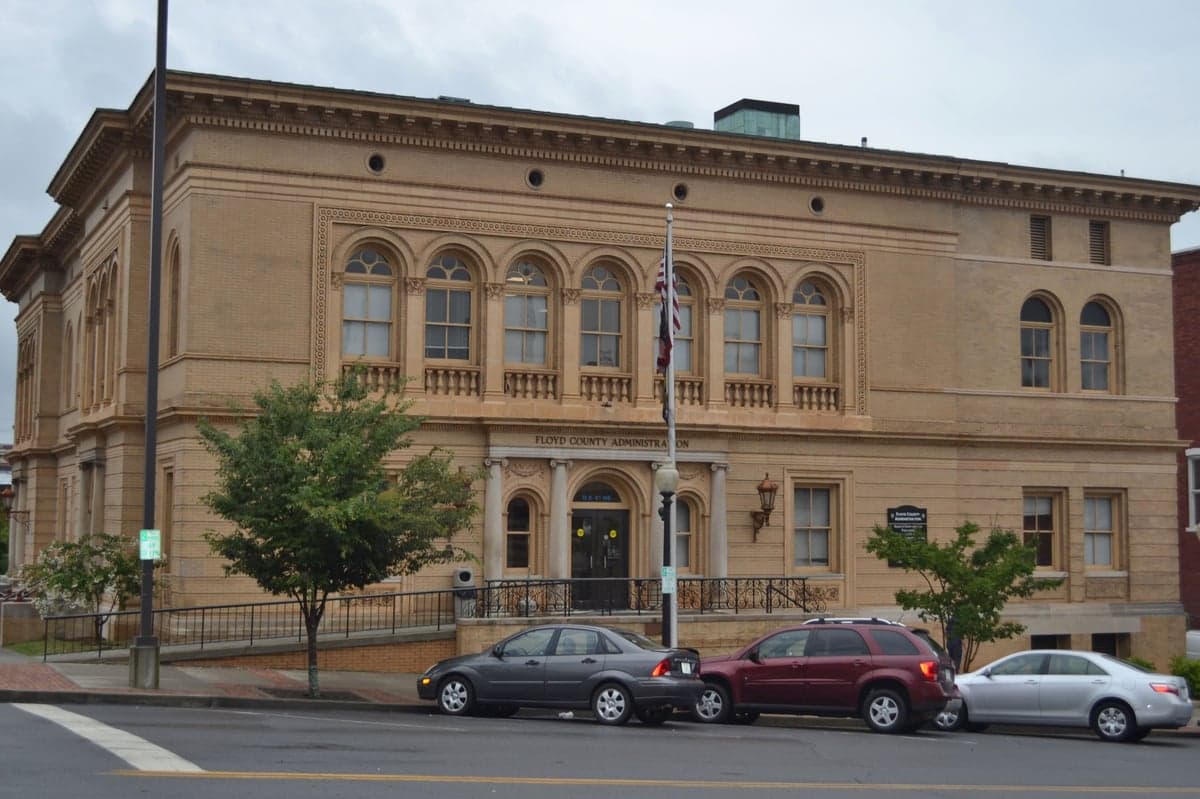
Photo: Wikipedia
Political ClimatePolitical Climate in Floyd County
Showing district-level results — no local-only data available.
Local Political AnalysisPolitical Analysis of Floyd County
Floyd County, Georgia, is a reliably Republican stronghold with a Cook Partisan Voting Index (PVI) of R+19, meaning it votes about 19 points more Republican than the national average. This isn't a recent shift; the county has been solidly red for decades, though the margins have tightened slightly in the last two presidential cycles as suburban Atlanta's influence creeps northwest. The real story here isn't a dramatic flip, but a slow, steady drift—Rome, the county seat and largest city, has become a quiet battleground between its conservative rural roots and a growing cohort of younger, more moderate professionals.
How it compares
Compared to the state of Georgia as a whole, Floyd County is significantly more conservative. Georgia itself is a competitive swing state (Cook PVI unknown, but widely considered a toss-up in 2024), while Floyd County is a deep-red anchor in the northwest corner. The political geography inside the county tells the tale: Rome's downtown and historic districts, especially around Broad Street and the Berry College area, lean blue in local elections, driven by college faculty, artists, and young families. Meanwhile, the rural precincts in Lindale, Coosa, and the unincorporated areas around Cave Spring vote overwhelmingly red, often by 70% or more. The swing precincts are in the suburban ring around Rome—places like the Garden Lakes area and the outskirts near the Floyd Medical Center—where moderate voters decide county commission races. In 2020, Trump won Floyd County with 68% of the vote, but Biden pulled 31%, a slight improvement over Hillary Clinton's 27% in 2016. That 4-point shift is small but real, driven almost entirely by Rome's precincts.
What this means for residents
For conservative residents, Floyd County feels like home. The county commission, school board, and most municipal offices are reliably Republican. Tax policy is consistently low—the county's millage rate has stayed flat for years, and there's little appetite for new bond referendums. Gun rights are broadly supported, and the local sheriff's office is vocal about Second Amendment protections. For liberal residents, life is more nuanced. You'll find like-minded neighbors in Rome's downtown coffee shops or at Berry College events, but you'll also encounter a lot of "Trump 2024" signs on rural highways. Local Democratic candidates rarely win countywide races, but they can and do win city council seats in Rome's wards 1 and 3, where turnout is higher. The practical effect is that progressive policy ideas—like affordable housing initiatives or public transit expansions—tend to stall at the county level but get a fair hearing in city hall. The biggest cultural distinction is the strong influence of Berry College and the local faith community. Berry, a private liberal arts school with a conservative Christian heritage, anchors a lot of the county's civic life, while the many Baptist and Methodist churches shape social norms. You won't see a lot of overt political activism on either side; most folks here just want to keep the county clean, the schools decent, and the traffic manageable.
Looking ahead, the trajectory is toward a slow purple shift in Rome proper, but the rural precincts will keep Floyd County red for the foreseeable future. The real action is in the county commission races, where moderate Republicans are starting to edge out hardline conservatives, especially on issues like zoning and economic development. If you're moving here, expect a place where politics is a background hum, not a daily shout—unless you're at a city council meeting debating a new apartment complex. Then it gets loud.

State Political ClimatePolitical Climate in Georgia
State Political AnalysisPolitical Environment in the State
Georgia has transformed from a reliably Republican stronghold into the nation’s premier political battleground, flipping blue for Joe Biden in 2020 by a razor-thin 0.23%, then re-electing both Democratic Senator Raphael Warnock in a 2022 runoff and handing Republicans a 2024 win for Donald Trump by roughly 2 points—a whiplash-inducing cycle that shows no single coalition has settled into dominance. The state’s long arc over the past 20 years has been a steady march from solid red to purple: in 2004, George W. Bush won Georgia by 17 points; by 2016, Trump won it by 5; by 2020, Biden won it by less than 12,000 votes. That trajectory is driven by the explosive growth of metro Atlanta, which now casts nearly 60% of the state’s vote, and the simultaneous hardening of rural and exurban conservatism everywhere else. The result is a state where both parties can credibly compete, and where a relocator’s experience will differ dramatically depending on whether they land in Alpharetta, Augusta, or Albany.
Urban vs. rural divide
The political map of Georgia is a story of two Georgias that barely recognize each other. Metro Atlanta—including Atlanta proper, Cobb, Gwinnett, DeKalb, Fulton, and Clayton counties—is the engine of Democratic strength. Gwinnett County, a once reliably red suburban bastion, voted for Biden by 14 points in 2020 after backing Romney by 12 points in 2012, a 26-point flip in eight years driven by diversifying suburbs and professional-class transplants from other states. DeKalb and Fulton are deep blue (Biden won them by 60+ points), while Cobb County, once the heart of Republican suburbia, now leans blue by a consistent 2-3 points in statewide races. Outside of Atlanta, the picture flips hard. Rural south Georgia, the coastal plains, and the Appalachian foothills are uniformly deep red—counties like Echols, Towns, and Brantley regularly give Republicans 80-85% of the vote. The mid-sized cities tell a mixed story: Savannah and Athens are Democratic-leaning college towns, while Columbus and Macon are more competitive but lean slightly red. Augusta, anchored by Fort Eisenhower and the medical district, tilts Republican but with a strong Democratic minority in the city proper. The exurban ring beyond the I-285 perimeter—places like Forsyth County, Cherokee County, and Paulding County—remains overwhelmingly Republican, often by 30+ point margins, and has only gotten redder as Atlanta liberals have sorted into the inner suburbs. If you live in Buckhead, you’re in a blue bubble; if you live in Cumming, you’re in a red fortress.
Policy environment
Georgia’s policy posture reflects its divided nature: it tilts conservative on taxes and business regulation, but with real-world limits that a relocator should understand. The state has a flat income tax rate of 5.39% (down from 5.75% in 2024, with further cuts tied to revenue triggers), and no estate or inheritance tax. Property taxes are locally set and vary widely; a $400,000 home in Fulton County might carry a tax bill of ~$4,000, while the same home in Harris County (near Columbus) might be under $2,500. The state’s regulatory climate is broadly pro-business, with a right-to-work law and no local minimum wage ordinances. Education policy is conservative but contested: Georgia has a school voucher program (the Georgia Promise Scholarship Act, passed in 2024) for students in low-performing districts, but also a robust system of charter schools and a growing home-school community. Public school funding is around $11,000 per student, slightly below the national average. Healthcare policy is mixed: the state has not expanded Medicaid, leaving roughly 300,000 adults in the coverage gap, but it does have a robust telehealth infrastructure and a certificate-of-need law that limits hospital competition. Election laws were overhauled via SB 202 in 2021, which added ID requirements for absentee ballots, limited drop boxes, and shortened runoff windows—a response to the 2020 controversies that has drawn both praise for security and criticism for accessibility. For a libertarian-leaning relocator, the tax and regulatory environment is a plus; for a liberal one, the Medicaid gap and voting restrictions are significant downsides.
Recent policy direction
Georgia’s recent legislative direction is a microcosm of national fights, with a governor who is conservative but pragmatic. On guns and self-defense, Georgia has permitless carry (HB 218, signed in 2022), allowing any legal gun owner to carry a concealed handgun without a license, and strong castle doctrine and stand-your-ground laws. Parental and education rights saw a big push in 2025 with the passage of SB 88, which requires school districts to notify parents of any curriculum involving “sexually explicit” material and allows parents to opt their children out. Speech and free expression have been tested: the state passed a campus free speech law (HB 1, 2023) that prohibits public universities from disinviting speakers based on viewpoint, though some critics note enforcement is uneven. Privacy and surveillance are less locked down: Georgia has no comprehensive data privacy law, though a 2024 bill (HB 138) to create a consumer privacy framework stalled. Medical and bodily autonomy saw a major shift with the 2019 heartbeat abortion law (HB 481), which bans most abortions after about six weeks—the law took effect in 2022 after the Dobbs decision and remains in place, though it’s a perennial legislative battleground. Property rights are strong: Georgia is a “Dillon’s Rule” state, meaning local governments have only powers expressly granted by the state, but property taxes are relatively low and there’s no state-level rent control. Voting and ballot access: beyond SB 202, the state has no same-day voter registration, no automatic voter registration, and requires a photo ID to vote in person. The direction is clearly one of a state that is culturally conservative on social issues and moderately conservative on fiscal ones, but with enough swing-district pressure to keep the GOP from going full throttle on culture-war legislation.
Civil unrest & political movements
Georgia has seen significant political flashpoints in recent years that a newcomer should be aware of. The 2020 election aftermath was the biggest: protests over the presidential result were relatively small in Georgia compared to national scenes, but there were sustained demonstrations outside the state capitol in Atlanta following the 2020 election, led by groups like Fair Fight Action and the Georgia NAACP. The January 5, 2021 Senate runoff election brought massive national attention and money, with both sides treating Georgia as the center of the political universe. Immigration politics are sharp: Georgia is not a sanctuary state, and HB 87 (2011) cracked down on sanctuary cities, though it was partially struck down by courts. The current GOP-led legislature has debated tougher E-Verify requirements and limited in-state tuition for undocumented students. Election integrity remains a hot-button topic: a 2023 investigation found no widespread fraud in the 2020 election, but many rural counties are still pushing for hand-count audits and ballot security measures. Notable protest movements include the “Stop Cop City” campaign against the Atlanta Public Safety Training Center, which saw extensive protests and legal battles in 2022-2023, and periodic right-to-life rallies at the capitol. On the right, groups like the Georgia Republican Assembly and various tea party factions remain active, pushing for school board takeovers and anti-CRT legislation. The practical effect for a new resident: you won’t see daily street protests outside of downtown Atlanta, but political tension is baked into local life—your neighbor’s yard sign, your church’s sermon, and your kid’s school board meeting all carry political weight.
Projection
Georgia’s trajectory over the next decade is toward becoming a permanent swing state, not a red or blue one. The demographic forces are inexorable: metro Atlanta continues to grow by 100,000 people annually, and the migrants are younger, more diverse, and more suburban than the national average. Cobb, Gwinnett, and North Fulton—the old bedrock of GOP support—are now blue-leaning or trending blue, and that migration belt is pushing outward into exurbs like Buford, Braselton, and Newnan. But at the same time, rural Georgia is not depopulating as fast as in other states; it's holding steady and actually turning out at higher rates in midterm years. The 2024 election showed that even in a state that Biden won in 2020, Trump could still win by a small margin, and the state’s electoral votes are now reliably within 2-3 points. Projecting forward: by 2030, expect Georgia’s state legislature to still be under GOP control (due to gerrymandered maps and rural overrepresentation), but the governor’s race and Senate races will be toss-ups every cycle. The state will likely remain socially conservative on most issues—abortion restrictions and gun rights are probably locked in—but fiscal and regulatory policy could move slightly left if Democrats ever control the statehouse, which is a real possibility if Atlanta’s growth continues. For someone moving in now, the realistic expectation is: you will live in a state where every election is a national story, where your vote actually counts, and where policy will swing back and forth based on which party wins the next close race.
For a relocator, the practical bottom line is this: Georgia’s politics give you what you look for. If you’re a conservative, you get low taxes, strong gun rights, a business-friendly environment, and a state government that is reliably center-right on culture issues, even if the Atlanta metro makes life more complicated for statewide candidates. If you’re a liberal, you get a competitive electoral landscape where your vote actually moves the needle, a vibrant and growing urban heartland in Atlanta, and the ability to live in a blue bubble in Decatur or East Atlanta while paying relatively low state taxes. The key is picking the right town: a family looking for a conservative, family-oriented suburb should look at Kennesaw, Woodstock, or Peachtree City; a single professional looking for progressive, walkable urban life should focus on Atlanta’s intown neighborhoods, or Athens. The state’s political divide is hard, but it’s also a check on extreme policy from either side—no one party can ignore the other for long. If you’re okay with that tension, Georgia is a great place to put down roots.
* Values derived from national, state, county, city and local statistics and may differ in a specific area. Last updated: 2026-07-03T03:04:53.000Z
Narrative content on this page is AI-generated and may contain mistakes. Verify any details that matter before acting on them.
ReloMaps may earn a commission from affiliate links at no extra cost to you.

