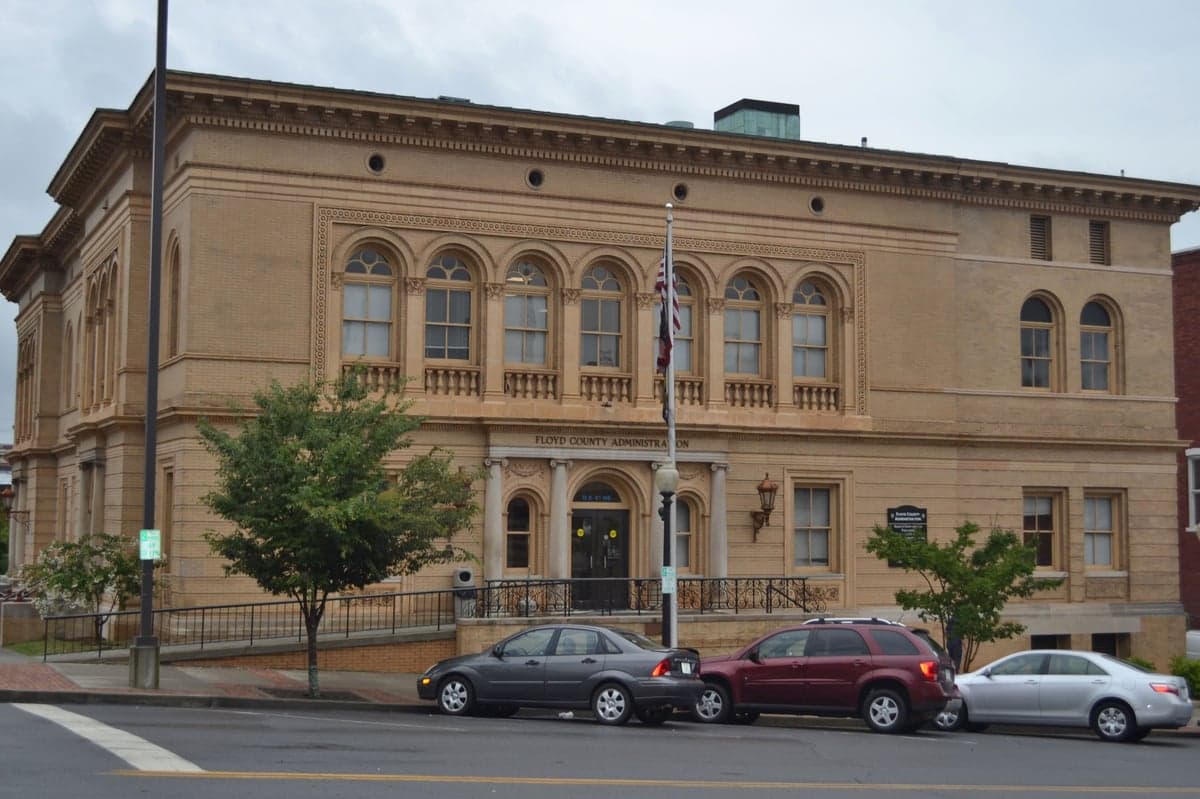
Photo: Wikipedia
Demographics of Floyd County
Affluence Level in Floyd County
A middle-class area roughly in line with national averages across income, home values, education, and employment.
People of Floyd County
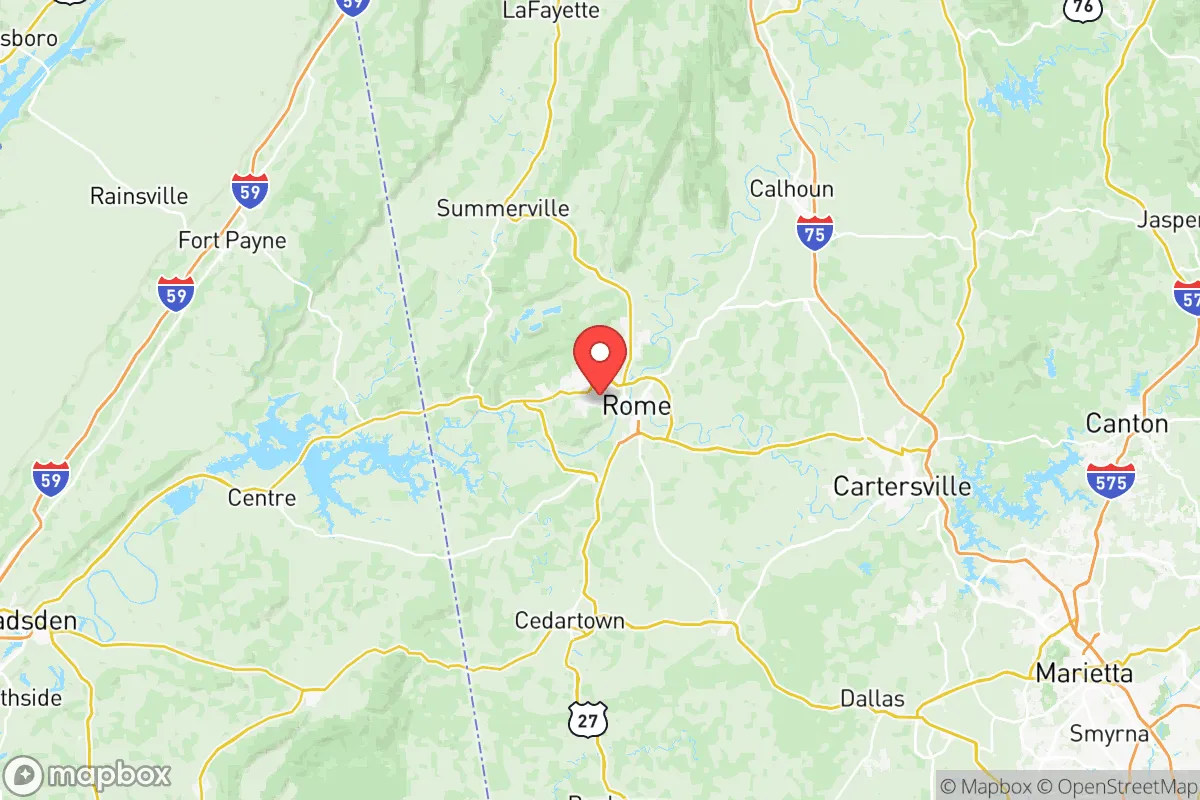
Floyd County, Georgia, with a population of 98,985, is a predominantly white (69.4%) and historically Southern community with a noticeable and growing Hispanic (12.0%) and Black (13.5%) presence. Its population is concentrated in the county seat of Rome, along with smaller towns like Cave Spring, Lindale, and Shannon, and is characterized by a lower-than-average foreign-born rate (4.3%) and a modest college attainment level (24.9%). The county’s identity is rooted in a blend of Old South agricultural heritage, 19th-century industrial ambition, and a steady, if slow, diversification driven by manufacturing and service-sector jobs.
Settlement & growth (pre-1960)
Before American settlement, the area now known as Floyd County was the heart of the Cherokee Nation. Major Cherokee towns, including Chiaha (near modern Rome) and others along the Coosa River, thrived here. The Cherokee developed a sophisticated agricultural society and, by the early 1800s, had adopted many Anglo-American practices, including plantation slavery. This era ended with the forced removal of the Cherokee on the Trail of Tears following the 1830 Indian Removal Act. The county was created in 1832 from Cherokee land, named after General John Floyd, a veteran of the Creek War.
White settlers, overwhelmingly of Scots-Irish and English stock, poured into the fertile valleys after the Cherokee expulsion. These early families, many from the Piedmont regions of Virginia and the Carolinas, established subsistence farms and later cotton plantations. The city of Rome, founded in 1834 at the confluence of the Etowah and Oostanaula rivers, quickly became the county’s economic and political hub, leveraging its river access for trade. A distinctive small community, Cave Spring, was settled in the 1830s around its namesake limestone spring, becoming a resort destination and later home to a school for the blind.
The post-Civil War period brought profound change. The collapse of the plantation economy led to a system of sharecropping and tenant farming for both newly freed Black families and poor whites, with rural communities like Coosa and Floyd Springs hosting many of these households. The county seat of Rome remained the main population center. Industrialization arrived in earnest around 1880, with the establishment of textile mills, most notably in Lindale (starting in 1895) and Shannon. These mills drew rural white families from throughout Northwest Georgia, creating distinct company towns and a working-class, largely Southern-born population. A smaller wave of Irish and Italian immigrants also came to work on railroad construction and in the mines in the late 19th century, though their numbers stayed small and they largely assimilated into the white population. The county’s Black population, which had been a substantial minority in the early 1900s, began a slow decline during the Great Migration (roughly 1910–1970) as families left for industrial jobs in the North and Midwest. By 1960, Floyd County’s population was overwhelmingly white, native-born, and Southern in character.
Modern era (post-1965)
The 1965 Hart-Cellar Act had a muted direct impact on Floyd County compared to larger metropolitan areas, as its foreign-born population (4.3%) remains low. However, the legal changes did trigger two significant shifts. First, a small but steady stream of immigrants from Mexico and Central America began arriving from the 1970s onward, drawn by agricultural work on poultry farms and nurseries, as well as construction and light manufacturing jobs. Hispanic residents, now 12.0% of the county, are the fastest-growing demographic group. While initially concentrated in older neighborhoods within Rome (notably the area around South Rome and East Rome), many have since moved into newer subdivisions throughout the county, including around Rome’s expanding industrial parks.
Second, the end of explicit racial segregation, slowly enforced through the 1970s, began to reshape Black population patterns. Many Black families moved out of historically Black neighborhoods in Rome (like the Old East Rome and South Rome districts) into more integrated areas, including West Rome and suburban subdivisions near the US 27 corridor. The county’s Black population stands at 13.5%, a share that has remained relatively stable since the 2000 census, as losses from out-migration have slowed.
Domestic migration has been the primary driver of recent demographic change. Beginning in the 1990s, Floyd County began attracting white-collar workers from metro Atlanta who sought lower housing costs and a slower pace of life. These new residents tend to settle in newer subdivisions on the outskirts of Rome, as well as in unincorporated areas like the Mount Alto and Johns Mountain communities. Meanwhile, the mill towns of Lindale and Shannon have seen a decline in population as textile jobs have moved overseas, leading some working-class families to leave the county. The county is also a net destination for retirees from other parts of Georgia and neighboring states, drawn to the rural scenery and lower cost of living. The result is a county that is moderately more diverse than it was in 1960, but still retains a solidly Southern, and politically conservative, core identity.
The future
Floyd County is projected to grow modestly over the next 10–20 years, with the biggest demographic shift being the continued expansion of the Hispanic population, which is likely to become the county’s largest minority group, potentially reaching 15–18% by 2040. This growth will be driven by both new immigration and natural increase, as Hispanic families are, on average, younger than the white non-Hispanic population. White non-Hispanic residents will likely continue to be a large majority but will decline gradually in percentage share. The Black population is expected to hold steady or grow slowly. The county’s low foreign-born rate (4.3%) will probably inch upward, mainly from Latin American immigration, with smaller contributions from Asia and the Indian subcontinent (currently 0.8% East/Southeast Asian and 0.5% Indian).
Geographically, new residential development is concentrated along the US 411 corridor north of Rome toward the Floyd-Bartow county line, and along the GA 140 corridor west of Rome. These areas are seeing the construction of single-family homes aimed at Atlanta commuters and retirees. Older neighborhoods in the city of Rome, particularly near the riverfront and downtown, are undergoing slow revitalization and attracting younger professionals, while the former mill villages of Lindale and Shannon face stagnation or decline. Culturally, the county will likely see a gradual, but limited, liberalization among its younger and more educated residents, especially in Rome, while the rural and exurban areas will remain deeply conservative. For a newcomer, Floyd County in the late 2020s and 2030s will feel like a slowly diversifying, predominantly white Southern community where change is steady but not fast enough to challenge its fundamental character.
What this means for someone moving in now: Floyd County offers a slower, quieter alternative to metro Atlanta with a lower cost of living and a strong sense of local identity, but it remains a place where traditional Southern values dominate public life. The demographic trends are toward greater Hispanic inclusion and a modest increase in college-educated residents, but the county is not becoming a diverse, cosmopolitan environment. It is a good fit for those seeking affordable single-family housing, good access to outdoor recreation (notably the Coosa River and the nearby Appalachian foothills), and a community where neighbors know each other, but it may feel insular to those accustomed to more racial and cultural diversity.

* Values derived from national, state, county, city and local statistics and may differ in a specific area. Last updated: 2026-07-03T03:04:53.000Z
Narrative content on this page is AI-generated and may contain mistakes. Verify any details that matter before acting on them.
ReloMaps may earn a commission from affiliate links at no extra cost to you.

