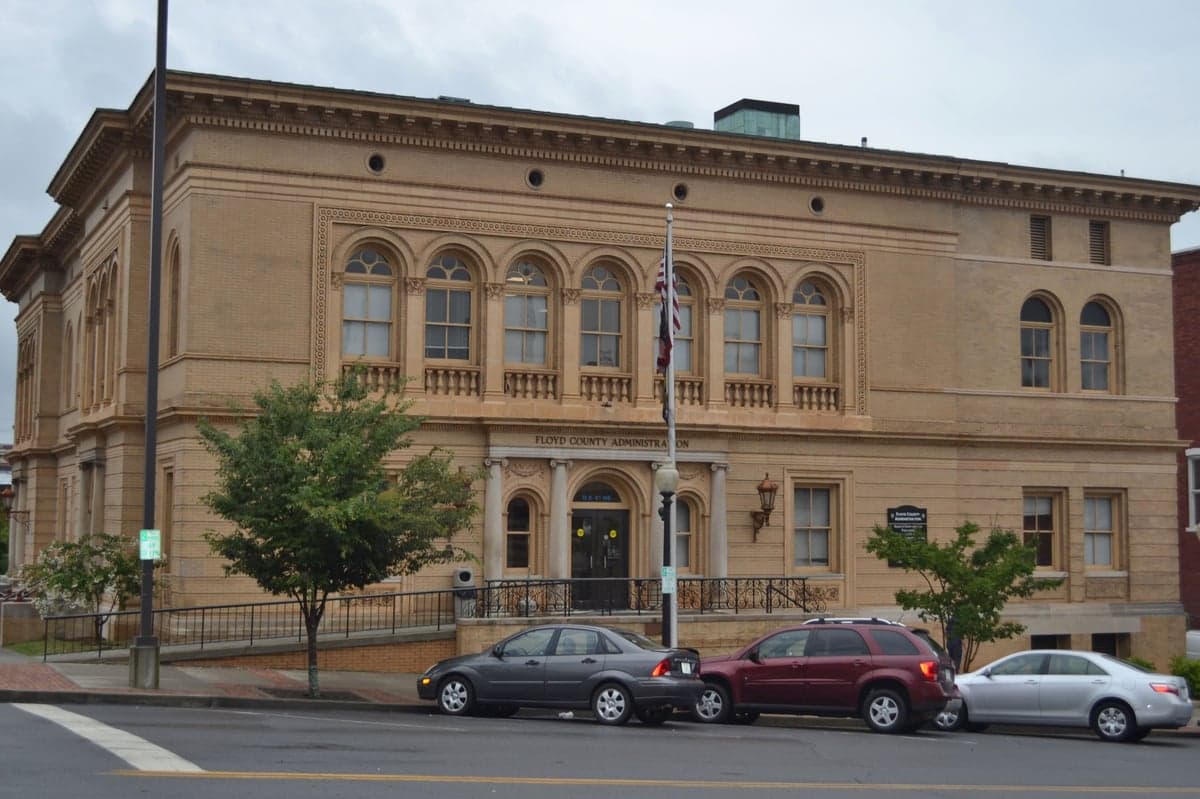
Photo: Wikipedia
Personal Sovereignty in Floyd County
Viable for self-reliance. Generally workable, though some barriers may limit total independence.
What does Personal Sovereignty tell us?
Personal Sovereignty measures your capacity for self-reliance and independence with minimal government friction. Higher scores mean fewer barriers between you and the way you want to live... but it assumes you have the space you need and good neighbors.
What does this tell us?
Personal Sovereignty measures your capacity for self-reliance and independence with minimal government friction. Higher scores mean fewer barriers between you and the way you want to live... but it assumes you have the space you need and good neighbors.
State Policy
Energy independence: Importer (12% of energy produced in-state)
Personal Liberty
Homesteading

Personal Liberty Analysis
Floyd County, Georgia, anchored by the city of Rome, offers a notably high degree of personal sovereignty compared to metro Atlanta or coastal Georgia, with a regulatory environment that leans toward light-touch governance and a culture that values self-reliance. The county's political character is broadly conservative, with Rome and the unincorporated areas consistently voting Republican in local and national elections, which translates into a governing philosophy that generally prioritizes individual choice over collective mandates. For a single individual or family seeking to maximize personal freedom—whether in financial decisions, self-defense, or lifestyle—Floyd County presents a balanced environment where state-level preemptions and local customs create a wide berth for autonomy, though with some practical constraints tied to its position within Georgia's broader legal framework.
Tax burden and regulatory posture in Floyd County
Georgia's state-level tax structure is relatively favorable for personal sovereignty, with a flat income tax rate of 5.49% in 2026 and no state-level estate or inheritance tax. Floyd County's local tax burden is moderate: the combined county and city property tax millage rate in Rome hovers around 28 mills, while unincorporated areas like Lindale and Silver Creek see slightly lower rates near 25 mills, reflecting the absence of city services. Sales tax in Floyd County totals 8% (4% state, 4% local), which is standard for Northwest Georgia. The regulatory posture is notably light on occupational licensing and business formation: starting a sole proprietorship or LLC requires no county-level approval beyond a basic business license, and home-based businesses are permitted by right in most residential zones, including in Coosa and Armuchee. Zoning is minimal outside Rome's city limits—unincorporated areas have no countywide zoning code, only subdivision regulations and health department rules for septic systems. This means a resident in Shannon can operate a small welding shop or run a daycare from their home without navigating a thicket of permits, a sharp contrast to the more regulated environments of Cobb or Fulton counties.
Self-defense and gun law specifics in Floyd County
Georgia is a constitutional carry state, meaning no permit is required to carry a handgun openly or concealed for anyone 21 or older who is legally allowed to possess a firearm. Floyd County fully aligns with this posture: the Floyd County Sheriff's Office issues weapons carry licenses (WCLs) for reciprocity purposes, but there is no local ordinance that restricts carry in county parks, government buildings (beyond state-mandated courthouse security), or public streets. The county's gun culture is robust, with multiple indoor and outdoor ranges, including the Rome Gun Club and the Floyd County Police Department's public range in Lindale. Stand-your-ground law applies statewide, with no duty to retreat in any place where a person is lawfully present. For home defense, Georgia law provides a strong castle doctrine presumption. The practical effect in Floyd County is that a resident in Mount Berry or Coosa can keep a firearm in their vehicle, carry on their person while hiking at John's Mountain Wildlife Management Area, and defend their home without fear of prosecution, provided the use of force is reasonable. No local ammunition taxes, magazine capacity bans, or waiting periods exist—the county defers entirely to state preemption on firearm regulation.
Self-reliance and homesteading viability in Floyd County
Homesteading and off-grid living are viable in Floyd County, particularly in the northern and western unincorporated areas where lot sizes are larger and zoning is absent. Minimum lot sizes for a single-family home with a septic system are 1 acre in most of the county, but in the Armuchee and Silver Creek areas, parcels of 5 to 20 acres are common, and many are sold with no HOA restrictions. Off-grid feasibility is high: Georgia has no state law prohibiting rainwater collection, and Floyd County does not require a permit for a private well on parcels over 1 acre, though a well must be drilled by a licensed contractor and tested for potability. Solar panels are permitted by right in unincorporated areas, and net metering is available through Georgia Power, though the utility's buyback rate is low (around 3 cents per kWh). Raising livestock—chickens, goats, sheep, and even cattle—is allowed without a permit on parcels of 2 acres or more in unincorporated zones; Lindale and Coosa are particularly popular for small-scale hobby farms. The county's agricultural extension office in Rome offers soil testing and livestock workshops, supporting a self-reliant lifestyle. However, within Rome city limits, lot sizes shrink to 0.25 acres or less, and the city enforces a ban on keeping roosters and limits the number of chickens to six, so homesteaders should target the outlying communities for maximum freedom.
Personal liberties in Floyd County: parental rights, medical autonomy, speech, and property
Floyd County's approach to personal liberties is shaped by Georgia's broader legal landscape, which leans toward individual rights in several key areas. Parental rights are strong: Georgia law grants parents the fundamental right to direct their children's education, medical care, and upbringing, and Floyd County's school board—covering Rome City Schools and Floyd County Schools—has not adopted any controversial curriculum mandates beyond state standards. Homeschooling is straightforward, requiring only a declaration of intent and annual standardized testing, with no home visits or curriculum approval from the county. Medical autonomy is more constrained: Georgia has not expanded Medicaid, and the state's abortion law bans the procedure after six weeks, with limited exceptions. However, Floyd County has no local health ordinances that restrict access to over-the-counter supplements, alternative medicine, or religious exemptions for vaccination—the county health department follows state guidelines but does not enforce additional mandates. Free speech is robust, with no local noise ordinances that restrict political signage or public assembly beyond standard time-place-manner rules; the Rome Forum and Floyd County Courthouse steps are common sites for protest and speech. Property rights are well-protected: eminent domain is rarely used for private development, and the county's tax assessor uses a mass appraisal system that is transparent and appealable. The only notable constraint is that Floyd County, like all Georgia counties, enforces a statewide ban on fireworks after 11:59 PM and during drought conditions, but this is a minor limitation on an otherwise permissive property-rights environment.
Overall, Floyd County ranks as one of the more sovereignty-friendly areas in Northwest Georgia, offering a lighter regulatory touch than metro Atlanta or even neighboring Bartow County, which has stricter zoning in its unincorporated areas. The combination of constitutional carry, minimal zoning, low property taxes relative to the region, and strong parental rights creates a environment where a self-reliant individual or family can operate with significant autonomy. For a reader prioritizing personal freedom, the key trade-off is between the convenience of Rome's amenities and the greater liberty found in the outlying communities of Armuchee, Silver Creek, and Coosa, where lot sizes are larger, regulations are fewer, and the culture of self-reliance is most deeply embedded. Compared to states like California or New York, Floyd County offers a dramatically higher degree of personal sovereignty; compared to more libertarian-leaning counties in Idaho or Montana, it is slightly more constrained by state-level health and environmental regulations, but remains a strong choice for those seeking a balanced, freedom-oriented lifestyle in the Southeast.

* Values derived from national, state, county, city and local statistics and may differ in a specific area. Last updated: 2026-07-03T03:04:53.000Z
Narrative content on this page is AI-generated and may contain mistakes. Verify any details that matter before acting on them.
ReloMaps may earn a commission from affiliate links at no extra cost to you.

