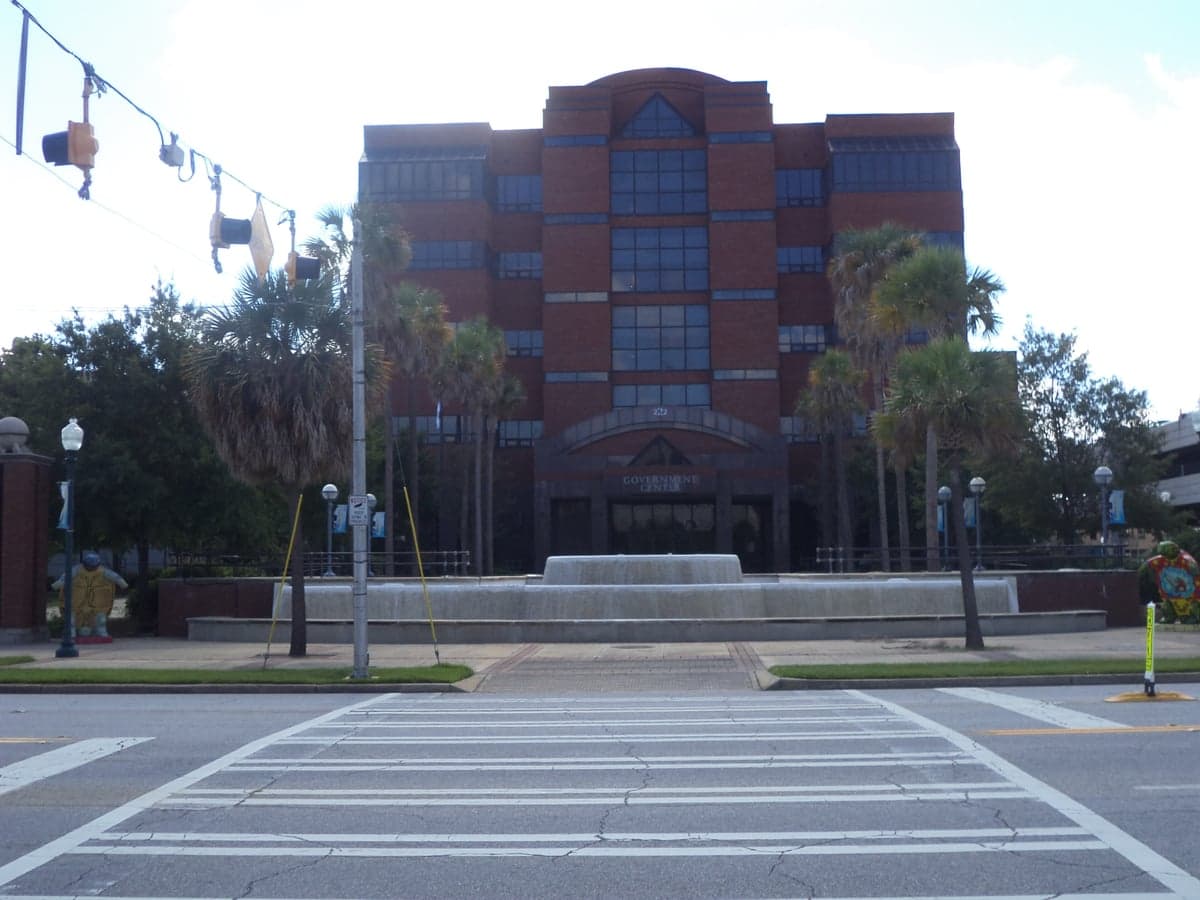
Photo: Wikipedia
Political ClimatePolitical Climate in Dougherty County
Showing district-level results — no local-only data available.
Local Political AnalysisPolitical Analysis of Dougherty County
Dougherty County, anchored by Albany, has been a reliable Democratic stronghold in southwest Georgia for decades, carrying a Cook PVI of D+4 that reflects a consistent but not overwhelming blue lean. The county voted for Joe Biden by about 10 points in 2020, a margin that has narrowed slightly from previous cycles as the broader region trends rightward. The real story, though, is the sharp urban-rural divide within the county itself: Albany’s core precincts, particularly around the historic downtown and near Albany State University, vote overwhelmingly Democratic—often by 70-80%—while the more rural, outlying communities like Putney and Leesburg (which is actually in Lee County but borders Dougherty) lean heavily Republican. The swing precincts are the suburban fringes of Albany, like those around the Radium Springs area and the newer subdivisions off Ledo Road, where ticket-splitting is common and local races can flip on turnout.
How it compares
Compared to Georgia as a whole, Dougherty County is significantly more Democratic. The state’s Cook PVI is unknown, but Georgia has become a true battleground—flipping blue for Biden in 2020 by less than 12,000 votes, then swinging back toward Republicans in 2022 with Governor Brian Kemp’s landslide reelection. Dougherty, by contrast, has not voted for a Republican presidential candidate since 1988, when George H.W. Bush carried it. The county’s Democratic lean is driven by its majority-Black population (roughly 68% Black, per recent estimates) and the organizing power of Albany State University, a historically Black institution. In state-level races, Dougherty often provides a reliable 10-15 point margin for Democrats, but that’s increasingly offset by the deep-red rural counties surrounding it—Lee, Worth, and Terrell—which vote 70%+ Republican. This creates a political island effect: Dougherty is a blue dot in a sea of red, making its influence in statewide elections real but limited to offsetting GOP margins elsewhere.
What this means for residents
For liberal residents, especially in Albany, the local political climate is comfortable. The city council and county commission are reliably Democratic, and progressive priorities like expanding Medicaid, funding public schools, and supporting Albany State get consistent airtime. Conservative residents, particularly those in the county’s unincorporated areas or the smaller towns like Sasser and Dawson (the latter technically in Terrell County but part of the same media market), often feel out of step with local governance. They tend to organize through the Dougherty County Republican Party, which is active but outmatched in voter registration. The practical effect is that local policy debates—over zoning, tax rates, and law enforcement funding—tend to reflect moderate Democratic priorities, with Republicans often playing a vocal but minority role. The county’s trajectory is toward a slow, slight reddening at the margins, driven by an influx of retirees from the Atlanta area and military families connected to nearby Marine Corps Logistics Base Albany, but the core Democratic base remains stable due to high Black voter turnout and the university’s influence.
Culturally, Dougherty County stands apart from much of southwest Georgia in its embrace of Albany’s role as a regional hub for civil rights history and higher education. The Albany Civil Rights Institute and the legacy of the 1961-62 Albany Movement give the county a distinct progressive identity that you don’t find in, say, nearby Sylvester or Camilla. Policy-wise, this translates into a more visible commitment to equity initiatives and historic preservation, though the county still grapples with the same economic challenges—poverty, infrastructure, and healthcare access—that define the broader region. For both conservatives and liberals, the political climate here is less about partisan fireworks and more about the daily work of governing a mid-sized Southern city that’s trying to hold its own in a rapidly changing state.

State Political ClimatePolitical Climate in Georgia
State Political AnalysisPolitical Environment in the State
Georgia has transformed from a reliably Republican stronghold into the nation’s most competitive swing state over the past two decades, a shift driven by explosive growth in the Atlanta metro and a diversifying electorate. The state voted for Joe Biden in 2020 by a razor-thin 0.2% margin and saw both Senate seats flip to Democrats in 2021, yet Republicans still control the governorship, legislature, and all other statewide offices. This split reality means Georgia’s political climate is a high-stakes tug-of-war, with the conservative-leaning interior and rural south pulling against the increasingly blue, diverse Atlanta suburbs and urban core. For a relocator, this translates into a state where conservative policy is still the baseline, but the trajectory is unmistakably toward a purple, contested future.
Urban vs. rural divide
The political map of Georgia is a study in stark contrasts. The Atlanta metro—encompassing Fulton, DeKalb, Cobb, Gwinnett, and Clayton counties—now accounts for roughly 60% of the state’s vote and leans decisively Democratic. Fulton County alone delivered Biden a 300,000-vote margin in 2020, while DeKalb and Clayton are among the most reliably blue counties in the South. Meanwhile, the rural and exurban counties that ring the metro—like Forsyth, Cherokee, and Paulding—have become Republican strongholds, often voting 70-80% for GOP candidates. Outside Atlanta, the state’s second-largest city, Columbus (Muscogee County), is a Democratic-leaning military and manufacturing hub, while Augusta (Richmond County) and Savannah (Chatham County) are blue-leaning but surrounded by deep-red rural territory. The classic example of the rural-urban split is Macon (Bibb County), which votes Democratic, while the surrounding Middle Georgia counties like Houston and Peach are reliably Republican. The key battlegrounds are the fast-growing, diverse suburbs of Atlanta—Gwinnett, Cobb, and Henry counties—which flipped from red to blue between 2016 and 2020, driven by an influx of college-educated professionals and Asian-American and Latino voters. A relocator moving to Milton or Alpharetta (north Fulton) will find a more conservative, affluent suburb, while Decatur or Smyrna (inside the Perimeter) are solidly liberal.
Policy environment
Georgia’s policy environment reflects its divided government: a Republican legislature and governor with a Democratic-leaning electorate that can occasionally force compromise. The state has a flat income tax rate of 5.39% (scheduled to drop to 4.99% by 2029), a relatively low property tax burden (median effective rate around 0.87%), and a robust right-to-work law that keeps unionization low. On education, Georgia has a robust charter school system and a school choice program (the Georgia Promise Scholarship Act, passed in 2024) that provides $6,500 vouchers for students in low-performing districts. However, the state also has a controversial “divisive concepts” law (HB 1084, 2022) that restricts teaching about race and gender in schools, which has drawn legal challenges. Healthcare policy is a flashpoint: Georgia is one of ten states that has not expanded Medicaid under the ACA, leaving roughly 300,000 low-income adults in a coverage gap. The state’s election laws have been a national focus: the 2021 Election Integrity Act (SB 202) added voter ID requirements for absentee ballots, limited drop boxes, and restricted out-of-precinct provisional voting, while also expanding early voting hours in most counties. Gun laws are among the most permissive in the nation: Georgia has permitless carry (HB 218, 2022), no red flag law, and no waiting period for long guns. On abortion, the state enacted a six-week “heartbeat” ban (HB 481) in 2019, which was blocked by courts but reinstated after the Dobbs decision in 2022; it remains in effect with exceptions for rape, incest, and medical emergencies.
Recent policy direction
Georgia’s recent legislative sessions have pushed a distinctly conservative agenda, but with notable limits. The 2023-2024 sessions saw the passage of a parental rights bill (HB 1178) that requires schools to notify parents of any “material change” in a student’s health or well-being, effectively targeting transgender student policies. A privacy and surveillance law (SB 441, 2024) restricts local governments from collecting biometric data without a warrant, a response to concerns about facial recognition. On property rights, the state passed a “squatter’s rights” reform (HB 1017, 2024) making it easier for homeowners to remove unauthorized occupants. The medical and bodily autonomy landscape is sharply divided: the six-week abortion ban remains, but the state also has a medical cannabis program (limited to low-THC oil) and a 2024 law (HB 133) that protects access to contraception. On voting and ballot access, the trend is toward restriction: SB 202 also criminalized handing out food and water to voters waiting in line (a provision later struck down by a federal judge), and the state has purged over 1.8 million voter registrations since 2012 under a “use it or lose it” law. Taxation is trending downward: the 2024 budget included a $1 billion income tax cut, accelerating the rate reduction. For a relocator, the practical takeaway is that Georgia is a state where conservative policy wins most battles, but the margins are thin enough that national attention and legal challenges are constant.
Civil unrest & political movements
Georgia has been a focal point for political activism on both sides. The 2020-2021 election cycle saw massive protests in Atlanta after the murder of George Floyd, with the city becoming a hub for the Black Lives Matter movement. The “Stop the Steal” movement was also active, with then-President Trump pressuring Georgia Secretary of State Brad Raffensperger to “find 11,780 votes” in a recorded phone call that became a national scandal. In 2022, the “Cop City” protests in DeKalb County—opposing a planned police training facility in a forest—turned violent, with activists firebombing construction equipment and the state designating the site as a “domestic terrorism” target. Immigration politics are tense: Georgia passed a strict anti-sanctuary city law (HB 452, 2024) that allows the state to withhold funding from local governments that refuse to cooperate with ICE, though no major city has formally declared sanctuary status. The election integrity controversy remains live: the Georgia State Election Board, now controlled by Trump-aligned Republicans, has passed new rules in 2024 that critics say could delay certification of results, leading to legal battles. A relocator moving to Atlanta’s intown neighborhoods (like Virginia-Highland or East Atlanta) will see frequent protest activity, while a move to Gainesville or Warner Robins will find a quieter, more conservative environment with occasional pro-Trump rallies.
Projection
Over the next 5-10 years, Georgia’s political trajectory points toward continued competitiveness, with a slight Democratic lean at the presidential level but persistent Republican control of state government. The key demographic driver is in-migration from blue states: Georgia gained over 300,000 new residents between 2020 and 2024, many from California, New York, and Illinois, who tend to be college-educated and moderate-to-liberal. These newcomers are concentrating in the Atlanta suburbs, particularly Gwinnett, Cobb, and Forsyth counties, which are becoming more diverse and Democratic. However, the rural and exurban counties are also growing, and the state’s Republican legislature has shown a willingness to gerrymander congressional and state legislative districts to maintain power even as the popular vote tightens. The 2026 gubernatorial election will be a bellwether: if Democrats can win the governor’s mansion, the state’s policy direction could shift significantly on Medicaid expansion, abortion, and voting access. If Republicans hold it, expect continued conservative policy with incremental moderation on economic issues. A relocator moving to Savannah or Athens (both blue-leaning college towns) should expect their local politics to become more progressive, while a move to Dalton or Valdosta (rural manufacturing hubs) will remain deeply conservative. The wildcard is the 2028 presidential election: Georgia is likely to be a top-tier battleground, meaning the state will see intense national attention, campaign spending, and political polarization.
For a new resident, the bottom line is that Georgia offers a politically divided but functional environment where your experience depends heavily on where you live. If you’re a conservative, you’ll find a state government that largely aligns with your values on taxes, guns, and education, but you’ll live in a state that votes for Democratic presidents. If you’re a liberal, you’ll find vibrant, progressive communities in Atlanta, Athens, and Savannah, but you’ll be governed by a Republican legislature that restricts abortion access and voting rights. The practical takeaway: choose your county carefully. Moving to Forsyth County (north of Atlanta) gives you a reliably conservative, affluent community with top-rated schools; moving to DeKalb County gives you a diverse, liberal environment with strong Democratic representation. Georgia is no longer a deep-red state—it’s a purple state with a red legislature, and that tension is likely to define life here for the next decade.
* Values derived from national, state, county, city and local statistics and may differ in a specific area. Last updated: 2026-07-03T02:20:28.000Z
Narrative content on this page is AI-generated and may contain mistakes. Verify any details that matter before acting on them.
ReloMaps may earn a commission from affiliate links at no extra cost to you.

