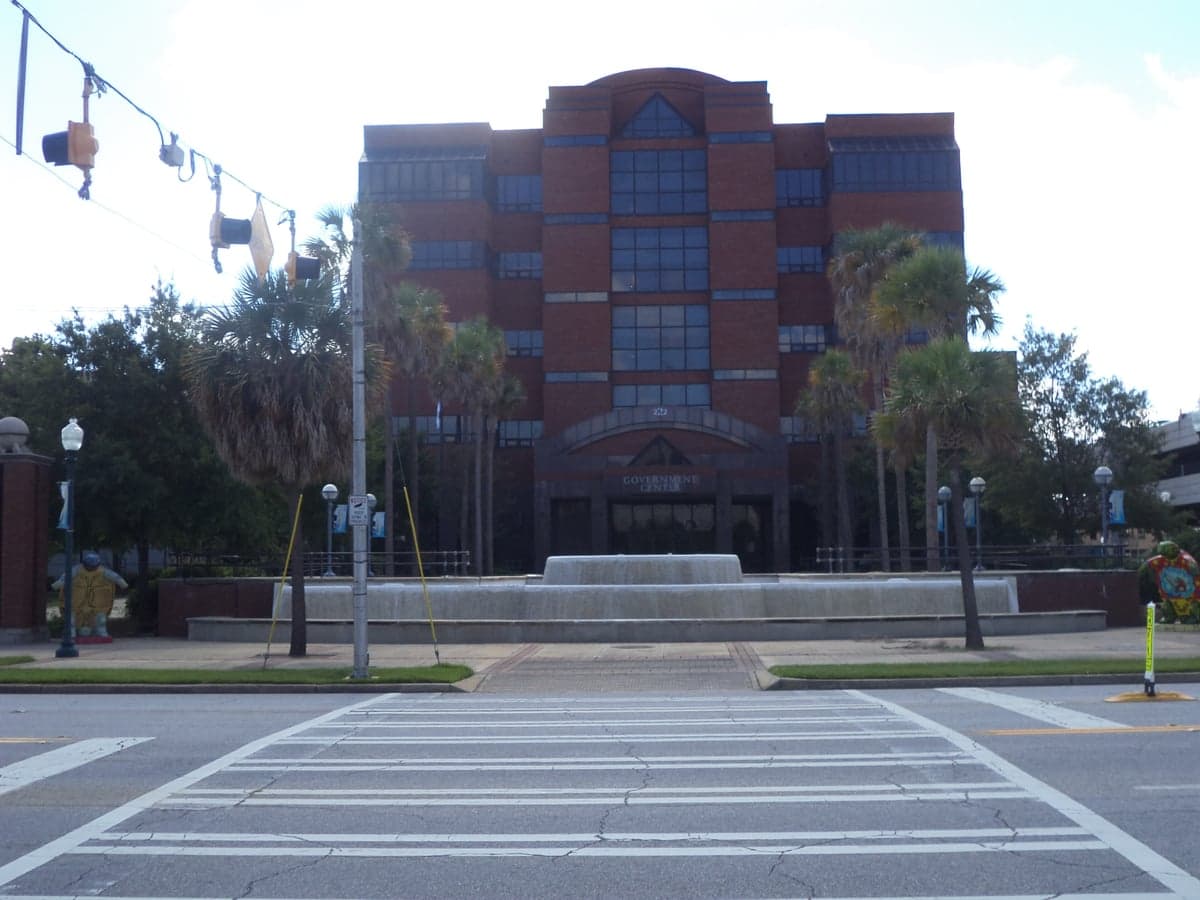
Photo: Wikipedia
Demographics of Dougherty County
Affluence Level in Dougherty County
A low-income area with significant economic hardship. Household wealth and educational attainment are well below national averages.
People of Dougherty County
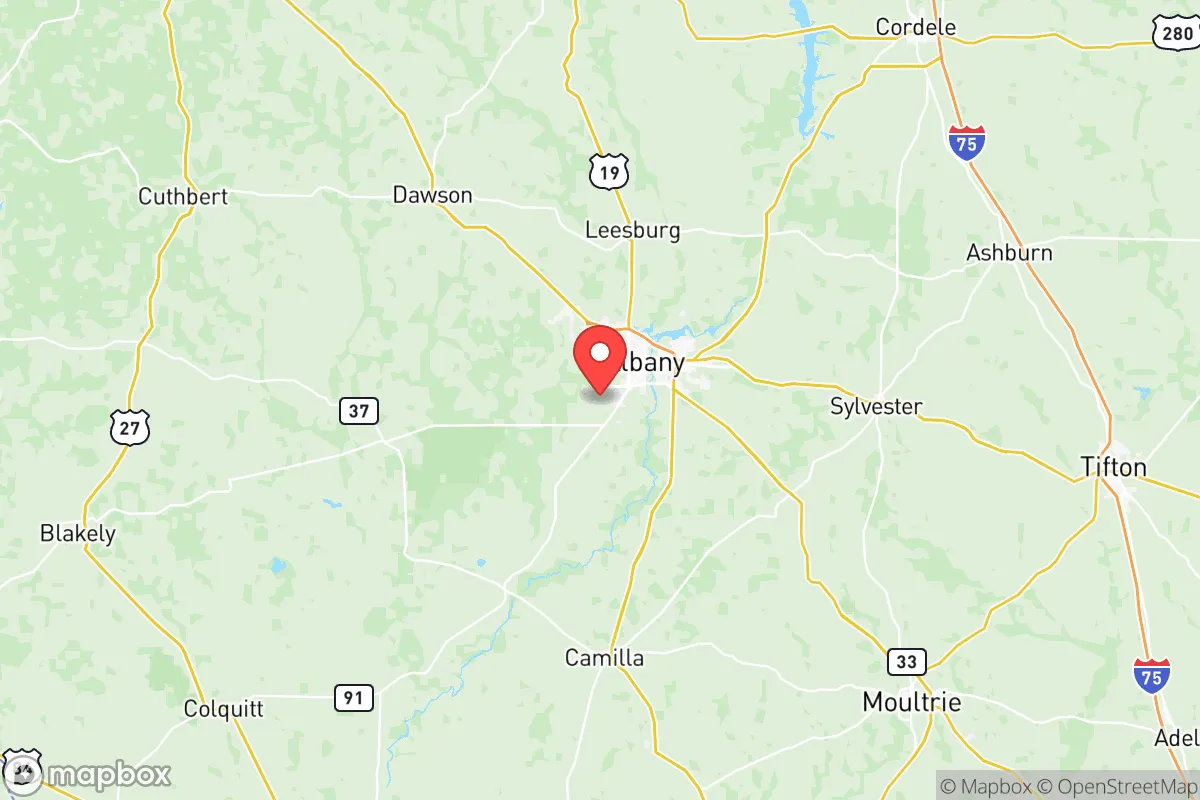
Today, Dougherty County is home to roughly 83,915 residents, a predominantly Black community (70.2%) with a significantly smaller White population (23.3%) and a modest Hispanic presence (3.1%). The county is anchored by the city of Albany, which serves as the economic and cultural hub of southwest Georgia, giving the area a distinctly Southern, historically rooted character. With a foreign-born population of just 1.2% and a college attainment rate of 23.2%, Dougherty County remains one of the least ethnically diverse and most insular communities in Georgia, shaped by a legacy of agriculture, segregation, and the Civil Rights Movement.
Settlement & growth (pre-1960)
Long before European settlement, the land that is now Dougherty County was inhabited by the Creek (Muscogee) people, who lived in scattered villages along the Flint River and its tributaries. The Creeks were forcibly removed in the 1820s and 1830s under the Indian Removal Act, clearing the way for white settlers from the Carolinas, Virginia, and Georgia's coastal counties. Dougherty County was formally created in 1853 from a portion of Baker County, with Albany established as the county seat the same year. The region's early economy was built on cotton, and the fertile black soil of the Flint River valley attracted planters who brought enslaved African Americans to work the vast plantations. By 1860, enslaved people already made up a majority of the county's population, a demographic pattern that would persist for generations.
After the Civil War and Emancipation, many freedmen remained in Dougherty County as sharecroppers and tenant farmers, settling in rural communities like Putney, Pretoria, and Oakfield. The post-Reconstruction era saw the imposition of Jim Crow laws, which rigidly enforced racial segregation and disenfranchised Black voters. The early 20th century brought the boll weevil infestation and the collapse of the cotton economy, prompting many Black residents to leave the county during the Great Migration (roughly 1915–1970), heading north to cities like Detroit, Chicago, and New York. Meanwhile, the county's white population remained small but politically and economically dominant, concentrated in Albany and the smaller towns of Leesburg (now in Lee County) and Dawson (now in Terrell County). The arrival of the U.S. Marine Corps Logistics Base in Albany in 1952 provided a stable source of non-agricultural employment, but the county's racial hierarchy remained largely unchanged through the 1950s.
Modern era (post-1965)
The 1965 Hart-Cellar Act had minimal direct impact on Dougherty County, as the area attracted very few international immigrants. The foreign-born share remains at just 1.2%, far below the national average. Instead, the county's modern demographic story is one of domestic migration and suburbanization. The Civil Rights Movement of the 1960s, including the Albany Movement (1961–1962), brought national attention to the county's entrenched segregation. While the movement achieved legal desegregation, it also accelerated white flight. Many white families moved to the surrounding counties of Lee, Worth, and Terrell, leaving Albany's city limits increasingly Black. By 1980, Albany was a majority-Black city, and Dougherty County as a whole followed suit by the 1990s.
The decline of manufacturing and agriculture in the late 20th century hit Dougherty County hard. The closure of several textile mills and food-processing plants led to population loss and economic stagnation. The county's population peaked at around 96,000 in 2000 and has since declined to 83,915. The Black population share has grown steadily, from roughly 55% in 1990 to 70.2% today, while the White share has fallen from 42% to 23.3% over the same period. The Hispanic population, though small at 3.1%, has grown from near zero in 1990, driven by a small number of Mexican and Central American immigrants working in agriculture and poultry processing in communities like Putney and East Albany. The East/Southeast Asian population (0.7%) is tiny and largely consists of Vietnamese and Filipino families connected to the Marine Corps base. There is no measurable Indian-subcontinent population (0.0%).
Suburbanization within the county has been limited. Unlike many Sun Belt counties, Dougherty has not seen significant new housing developments or population growth in its unincorporated areas. The city of Albany remains the overwhelming population center, with smaller settlements like Riverside and Turner City functioning as residential neighborhoods rather than independent towns. The county's population is aging, with a median age of 36.7, and the college-educated share (23.2%) is below the state average, reflecting the limited white-collar job base.
The future
Dougherty County's population is projected to continue its slow decline, driven by out-migration of younger residents seeking better economic opportunities in Atlanta, Savannah, and other faster-growing parts of Georgia. The county is becoming slightly more diverse in the sense that the small Hispanic and Asian populations are growing from a very low base, but the overall trend is toward an even higher Black majority. The White population is likely to continue shrinking as older residents age out and few new white families move in. The county's cultural identity remains deeply rooted in the Black Southern experience, with Albany's churches, historically Black colleges (Albany State University), and civil rights landmarks serving as touchstones. The area is not becoming a destination for international immigrants or domestic migrants from other regions, so its demographic trajectory is one of gradual homogenization rather than diversification.
For someone moving in now, Dougherty County offers a low cost of living and a strong sense of community history, but also limited economic opportunity and a population that is both aging and shrinking. The county is not experiencing the rapid change seen in metro Atlanta or coastal Georgia; instead, it remains a stable, predominantly Black, rural-Southern community with a quiet, insular character. New residents should expect a place where the past — both its struggles and its resilience — continues to shape daily life.

* Values derived from national, state, county, city and local statistics and may differ in a specific area. Last updated: 2026-07-03T02:20:28.000Z
Narrative content on this page is AI-generated and may contain mistakes. Verify any details that matter before acting on them.
ReloMaps may earn a commission from affiliate links at no extra cost to you.

