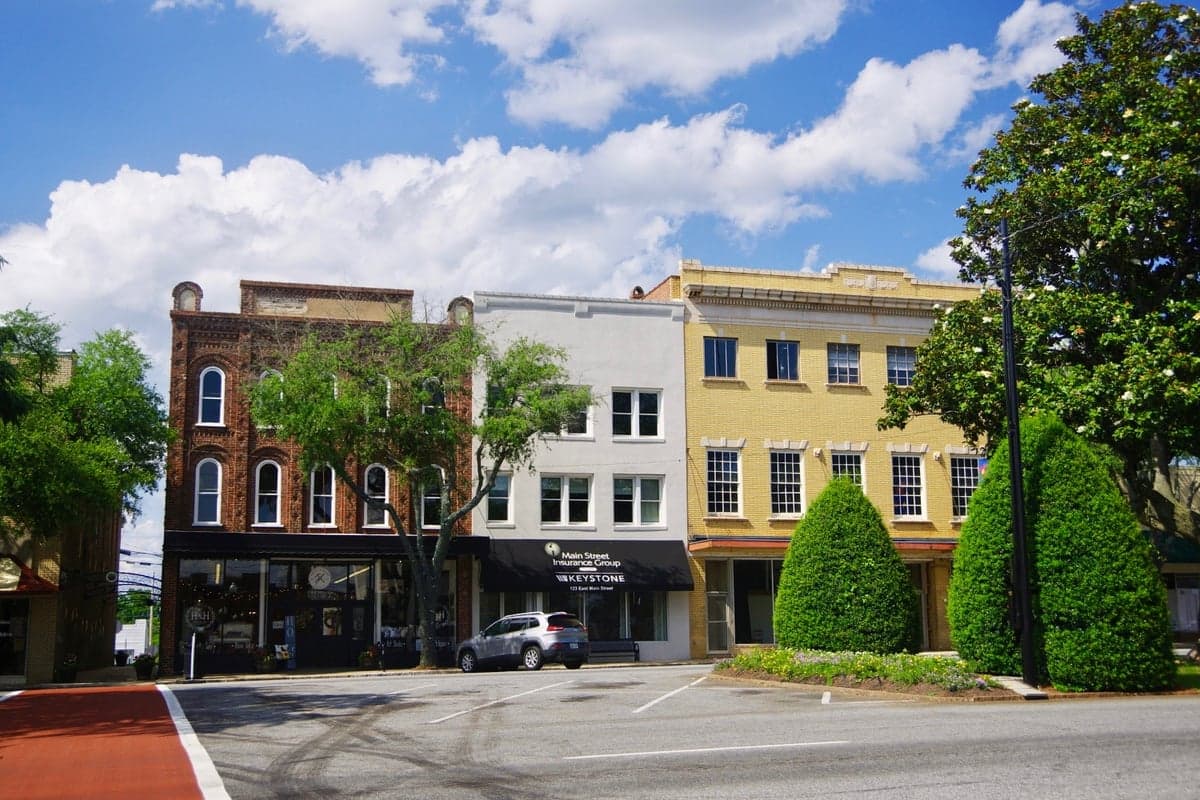
Photo: Wikipedia
Political ClimatePolitical Climate in Forest City, NC
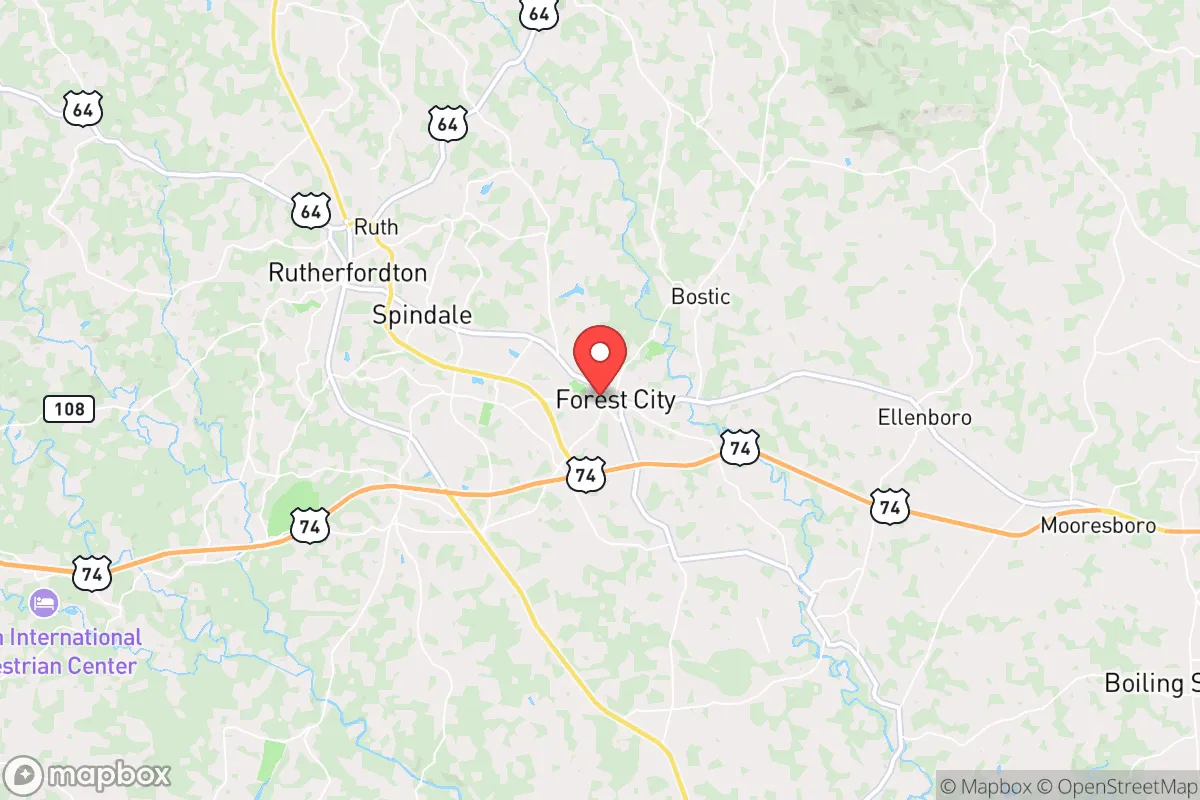
District shown is the primary district for this city’s centroid. Cities may span multiple districts.
Local Political AnalysisPolitical Analysis of Forest City, NC
Forest City leans solidly Republican, with a Cook Partisan Voting Index of R+8, making it significantly more conservative than North Carolina as a whole, which sits at R+1. This isn’t a recent shift—the area has been reliably red for decades, driven by a mix of rural values, manufacturing roots, and a older, white demographic base. If you look at election results since 2000, Rutherford County (where Forest City sits) has voted for the GOP presidential candidate by margins of 15 to 25 points, even when the state was competitive. The trajectory is stable: no signs of flipping blue, but also no dramatic lurch further right, as the local economy and population growth remain modest compared to the booming Charlotte metro just 70 miles east.
How it compares
Statewide, North Carolina is a classic purple battleground, with urban centers like Charlotte, Raleigh, and Asheville pulling left, while rural and exurban areas like Forest City anchor the right. The R+8 rating here is about 7 points more conservative than the state average. For context, nearby towns like Shelby (R+12) and Spindale (R+10) are even redder, while Asheville (D+18) and Charlotte (D+9) are stark contrasts. Forest City sits in the middle of a conservative corridor along the I-26 and US-74 corridors, where gun rights, low taxes, and traditional social values dominate local politics. The county commission and school board are uniformly Republican, and Democratic candidates rarely break 40% in local races. This isn’t a place where political signs for both parties are common—you’ll see a lot more Trump and Budd signs than Harris or Biden ones.
What this means for residents
For conservative residents, the political climate is comfortable and affirming. Local government is responsive to their priorities: property taxes are low (Rutherford County’s rate is around 0.55 per $100 valuation), zoning is minimal, and the sheriff’s office is vocal about Second Amendment support. Churches and civic clubs are deeply woven into community life, and conservative candidates rarely face serious primary challenges. For liberal residents, the reality is more isolating. You’ll find few like-minded neighbors, and local political discussions can feel one-sided. That said, Forest City isn’t hostile—people are generally polite, and there’s no organized pushback against the few progressive voices. The nearest active Democratic groups are in Asheville or Charlotte, so if you want to canvass or attend a rally, you’ll be driving an hour or more. Policy-wise, this means the area has resisted Medicaid expansion (though the state finally adopted it in 2023), kept abortion access limited, and maintained a “right-to-work” labor environment that keeps unions weak.
Culturally, Forest City’s politics show up in everyday life. The local paper, the Daily Courier, leans conservative in its editorial stance, and the annual “Blue Ridge BBQ Festival” is more about community than politics. There’s a strong sense of self-reliance—people here don’t expect much from government beyond basic services. The biggest distinction from the state as a whole is the lack of political friction: in Forest City, you don’t get the constant partisan bickering you see in Raleigh or Charlotte. It’s a place where politics is less a daily obsession and more a background assumption. If you’re moving here, know that your vote will likely not change the outcome, but your neighborly relationships won’t hinge on it either. The long-term outlook is steady: as long as the textile and manufacturing base holds, and as long as retirees from the North don’t flood in (which they haven’t), Forest City will stay R+8, quietly and reliably red.

State Political ClimatePolitical Climate in North Carolina
State Political AnalysisPolitical Environment in the State
North Carolina is a classic swing state with a slight Republican lean, carrying a Cook PVI of R+1, but the real story is how that lean has tightened and fractured over the past two decades. For most of the 2000s, the state was reliably red in presidential elections, but by 2008 it flipped blue for Obama, then swung back to Trump in 2016 and 2020 before narrowly going for Trump again in 2024. The dominant coalitions are a fast-growing, diverse urban-suburban axis centered on the Research Triangle, Charlotte, and the Triad, pushing left, versus a deeply entrenched rural and exurban base that keeps the state competitive. What this means for a relocator is that your experience of North Carolina’s politics will depend almost entirely on which county you land in — and the state is currently a laboratory for how these two Americas coexist under one capitol dome.
Urban vs. rural divide
The political map of North Carolina is a textbook case of the urban-rural chasm. The state’s three major metro engines — Charlotte-Mecklenburg, the Raleigh-Durham-Chapel Hill Research Triangle, and the Greensboro-Winston-Salem Triad — are solidly Democratic and growing fast. Mecklenburg County alone delivered a 30-point margin for Biden in 2020, while Wake County (Raleigh) gave a 25-point margin. These metros are powered by transplants from the Northeast and Midwest, major universities, and a booming tech and finance sector. In contrast, the rural east — places like Robeson County, Duplin County, and the northeastern coastal plain — vote heavily Republican, often by 30 to 40 points. The western mountain counties, like Watauga (Boone) and Buncombe (Asheville), are blue outliers in an otherwise red region, driven by college towns and tourism. The real battlegrounds are the fast-growing exurban counties like Union (south of Charlotte) and Johnston (southeast of Raleigh), which are trending redder as they fill with families fleeing urban school districts and taxes. If you move to Charlotte or Raleigh, you’ll live in a blue bubble; if you settle in a small town like Lumberton or Hendersonville, you’ll be in deep red territory.
Policy environment
North Carolina’s state-level policy is shaped by a Republican-controlled General Assembly that has held supermajorities for most of the last decade, though Democratic Governor Roy Cooper (2017-2025) was able to veto some of their agenda until the GOP finally secured a veto-proof majority in 2024. The tax structure is relatively low: the flat personal income tax rate was cut to 4.5% in 2024 and is scheduled to drop to 3.99% by 2027, with no state tax on Social Security benefits. The corporate tax rate is a flat 2.5%, among the lowest in the nation. Education policy has been a flashpoint: the state funds a private school voucher program (the Opportunity Scholarship Program) that has expanded dramatically, while public school funding per pupil remains below the national average. Healthcare is a mixed bag — the state finally expanded Medicaid in 2023 under a bipartisan deal, adding 600,000 low-income adults, but certificate-of-need laws still restrict new hospital and clinic construction. Election laws are moderately restrictive: voter ID is required (passed in 2018, implemented in 2023), early voting is generous (17 days), and same-day registration is available during early voting. The state is also notorious for aggressive gerrymandering of both congressional and legislative districts, which has been repeatedly struck down by courts but just as repeatedly reinstated in new forms.
Recent policy direction
The last five years have seen North Carolina move decisively right on several fronts, though with some notable exceptions. On gun and self-defense law, the state enacted permitless carry (constitutional carry) in 2023, allowing any adult who can legally possess a firearm to carry it concealed without a permit. On parental and education rights, the General Assembly passed the Parents’ Bill of Rights in 2023, requiring schools to notify parents about instructional materials involving sexuality and to obtain parental consent before changing a student’s gender designation. On speech and privacy, the state has no broad privacy law, but it did pass a ban on TikTok on government devices in 2023. On medical and bodily autonomy, abortion is currently banned after 12 weeks of pregnancy (with exceptions for rape, incest, and fetal anomalies), enacted in 2023 after the Dobbs decision; a 20-week ban existed previously. On property rights, the state has strong protections against eminent domain abuse, and there is no state-level rent control preemption. On taxation, the trajectory is clearly downward: the income tax is being phased to a flat 3.99% by 2027, and the corporate rate is already at 2.5%. On voting and ballot access, the state has tightened rules: voter ID is now enforced, absentee ballot drop boxes were restricted in 2023, and the period for curing absentee ballots was shortened. The overall direction is toward lower taxes, expanded gun rights, restricted abortion access, and increased parental control over education — a package that appeals to conservative relocators but frustrates progressive ones.
Civil unrest & political movements
North Carolina has a history of visible political activism on both sides. The Moral Monday protests of 2013, led by the NAACP, drew thousands to the state capitol to protest Republican policies on voting rights, education, and healthcare. More recently, the 2020 protests over George Floyd’s murder in Charlotte and Raleigh saw significant property damage and National Guard deployments. On the right, the state has a strong gun-rights movement, with annual “2nd Amendment Rally” events at the capitol drawing thousands. Immigration politics are relatively muted compared to border states, but Charlotte and Durham have declared themselves sanctuary cities, while the state legislature has repeatedly tried to ban such policies (HB 10 in 2024 would have required local law enforcement to cooperate with ICE, but it stalled). Election integrity has been a persistent flashpoint: the 2020 election in North Carolina was closely contested, with Trump winning by 1.3 points, and the state’s elections board was the subject of partisan battles over absentee ballot rules. There is no serious secession or nullification movement, but rural counties have occasionally floated the idea of forming a new state (the “State of Franklin” concept in the west). A new resident will notice that political yard signs and bumper stickers are common, and that local news covers state politics intensely — this is not a place where people are shy about their views.
Projection
Over the next 5-10 years, North Carolina is likely to become more competitive at the presidential level, not less. The state is growing fast — it added 400,000 people between 2020 and 2024 — and most of that growth is in the blue-leaning metros of Charlotte, Raleigh, and the Triad. However, the exurban and rural areas are also growing, and the Republican General Assembly has shown no interest in making the state’s political map more reflective of its actual partisan balance. The most likely scenario is that the state remains R+1 to R+2 for the next decade, with close presidential races and continued Republican control of the legislature. The wild card is the 2025 gubernatorial election: if a Republican wins the governor’s mansion for the first time since 2013, the state could see a more aggressive conservative agenda on abortion, education, and taxes. If a Democrat wins, expect continued veto battles and gridlock. For a relocator, the key takeaway is that North Carolina’s politics will remain a tug-of-war, with the state’s direction depending on which party turns out its base in any given cycle. The in-migration from blue states is real, but it’s not yet enough to flip the state blue — and the legislature’s gerrymandering ensures that Republican power will persist even if the popular vote tightens.
For someone moving to North Carolina, the practical takeaway is that your day-to-day experience of politics will depend heavily on where you live. If you settle in Charlotte or Raleigh, you’ll find a diverse, progressive-leaning environment with strong job growth, good schools in some districts, and a vibrant cultural scene — but you’ll also pay higher property taxes and deal with traffic. If you choose a smaller town like Wilmington or Asheville, you’ll get a more distinct local flavor (coastal or mountain) with a political culture that leans left in Asheville and right in Wilmington. If you’re looking for a conservative-friendly environment with low taxes, strong gun rights, and a focus on parental control in schools, the exurbs of Union County or Johnston County are your best bet. The bottom line: North Carolina offers a genuine choice of political ecosystems within one state, but the state-level policy direction is clearly conservative, and that’s unlikely to change dramatically in the next decade. Plan accordingly.
* Values derived from national, state, county, city and local statistics and may differ in a specific area. Last updated: 2026-09-30T19:36:50.000Z
Narrative content on this page is AI-generated and may contain mistakes. Verify any details that matter before acting on them.
ReloMaps may earn a commission from affiliate links at no extra cost to you.

