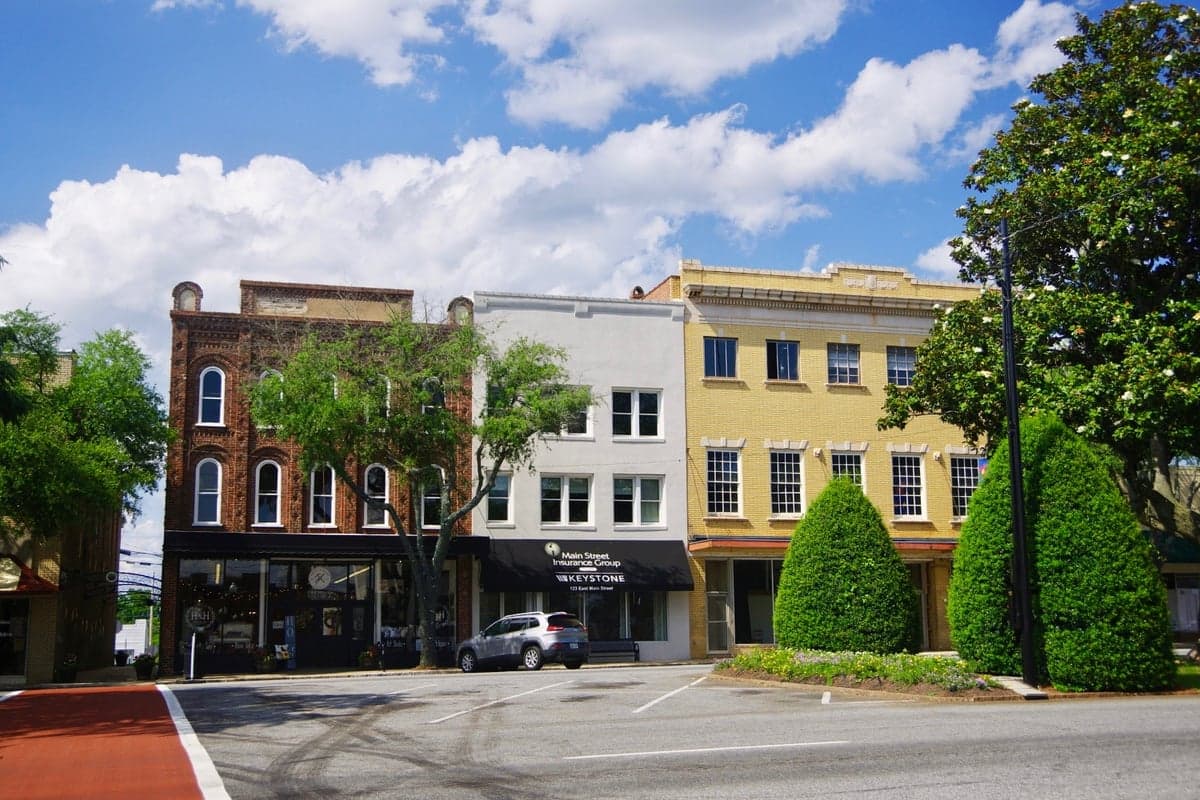
Photo: Wikipedia
Personal Sovereignty in Forest City, NC
Viable for self-reliance. Generally workable, though some barriers may limit total independence.
What does Personal Sovereignty tell us?
Personal Sovereignty measures your capacity for self-reliance and independence with minimal government friction. Higher scores mean fewer barriers between you and the way you want to live... but it assumes you have the space you need and good neighbors.
What does this tell us?
Personal Sovereignty measures your capacity for self-reliance and independence with minimal government friction. Higher scores mean fewer barriers between you and the way you want to live... but it assumes you have the space you need and good neighbors.
State Policy
Energy independence: Importer (15% of energy produced in-state)
Personal Liberty
Homesteading

Personal Liberty Analysis
Forest City, North Carolina, offers a notably high degree of personal sovereignty, rooted in North Carolina’s strong preemption laws, a relatively low state and local tax burden, and a regulatory environment that generally favors individual decision-making over government oversight. For a resident prioritizing autonomy, the town provides a legal and economic framework where self-reliance is not just possible but structurally encouraged, particularly when compared to more heavily regulated states in the Northeast or on the West Coast. The key trade-offs involve access to services and infrastructure density, but for those seeking to minimize external control over their daily lives, Forest City represents a solid, middle-ground option within the broader Southern autonomy landscape.
Tax burden and regulatory posture for individuals and small businesses
North Carolina’s tax structure is a significant draw for those seeking to keep more of their earnings. The state levies a flat individual income tax rate of 4.5% as of 2026, with a scheduled reduction to 3.99% by 2027, and a corporate income tax rate that has already been phased down to 2.5%. There is no state-level tax on Social Security benefits, and the standard deduction is generous. Rutherford County, where Forest City is the largest municipality, adds a local sales tax rate of 2.25%, bringing the total to 7% in most areas—competitive for the region. Property taxes are the primary local revenue source, with Rutherford County’s rate at approximately $0.58 per $100 of assessed value, and Forest City adds a municipal rate of roughly $0.45, for a combined effective rate around $1.03 per $100. This is moderate for North Carolina and significantly lower than states like New York or Illinois. The regulatory posture for small businesses is light-touch: North Carolina is a right-to-work state, has no state-level minimum wage above the federal $7.25, and requires no state-level business license for most sole proprietorships. Zoning in Forest City is present but not overly restrictive, with the town’s Unified Development Ordinance allowing for home-based businesses as a permitted use in most residential districts, subject to basic parking and noise standards. The overall message is clear: the state and local governments aim to keep the cost of compliance low, which directly supports individual economic autonomy.
Self-defense and gun law specifics in North Carolina
For those prioritizing the right to self-defense, North Carolina provides a robust legal framework. The state is a shall-issue jurisdiction for concealed carry permits, meaning that if a resident meets objective criteria—age 21, completion of a firearms safety course, no disqualifying criminal history—the sheriff’s office must issue the permit. There is no discretionary denial. Open carry of handguns and long guns is legal without a permit for anyone who can lawfully possess a firearm. North Carolina also has strong preemption laws: no city or county, including Forest City or Rutherford County, can enact its own gun ordinances stricter than state law. This means local governments cannot ban firearms in parks, impose waiting periods, or require additional registration. Stand-your-ground laws are in effect, with no duty to retreat in any place where the individual is lawfully present. Castle doctrine protections extend to one’s home, vehicle, and workplace. The state also allows the use of deadly force to prevent a forcible felony. For the autonomy-minded resident, the practical result is that carrying a firearm for personal protection is straightforward, legally protected, and not subject to local political whims. The only notable restriction is that concealed carry without a permit is not allowed—a permit is required—but the process is efficient and the cost is low (typically $80 for five years).
Self-reliance and homesteading viability: lot sizes, zoning, and off-grid feasibility
Forest City’s position in the foothills of the Blue Ridge Mountains makes it a viable location for those seeking a degree of self-sufficiency. While the town itself has standard suburban lots (typically 0.25 to 0.5 acres), the surrounding unincorporated areas of Rutherford County offer much more flexibility. Minimum lot sizes in the county’s rural zoning districts are generally 1 to 3 acres, and many parcels available for purchase are 5 to 20 acres, often with existing wells and septic systems. Zoning in these areas is permissive: raising chickens, goats, and even small livestock is typically allowed without special permits, though pigs and cattle may require additional acreage. Off-grid feasibility is high, but with caveats. North Carolina has no state law prohibiting rainwater collection, and many rural homes rely on private wells. Solar panel installation is not restricted by the county, and net metering is available through Duke Energy, the dominant utility. However, the state building code still applies to any new dwelling, meaning a completely off-grid home without any utility connection must still meet structural and safety codes. Composting toilets are legal if they meet NSF standards. The practical reality is that a resident can achieve a high degree of energy and water independence, but must navigate the state’s building code for habitable structures. The county’s agricultural extension office is supportive of small-scale farming, and the local soil is generally good for gardening. For those willing to live outside the town limits, Forest City’s surroundings offer one of the more accessible homesteading environments in the Southeast, with land prices still reasonable—often under $10,000 per acre.
Personal liberties: parental rights, medical autonomy, speech, and property
North Carolina’s legal environment generally supports individual liberties across several key domains. Parental rights are strongly protected by state law, which includes a Parents’ Bill of Rights enacted in 2023. This law requires schools to obtain parental consent before administering any mental health or medical survey, prohibits instruction on gender identity and sexual orientation in K-4 classrooms, and mandates that parents be notified of any changes in a student’s health or well-being. Medical autonomy is more nuanced: the state does not have a broad medical freedom statute, but it does allow for conscientious objection by healthcare providers and has not mandated COVID-19 vaccines for the general public since 2022. There is no state-level vaccine passport requirement. For alternative medicine, the state licenses naturopathic doctors and allows direct primary care agreements. Speech protections are robust, with North Carolina being a strong First Amendment jurisdiction in federal courts. Property rights are reinforced by the state’s right-to-farm law, which protects agricultural operations from nuisance lawsuits if they have been operating for at least one year, provided they follow generally accepted practices. This is a significant protection for anyone engaging in homesteading or small-scale farming near residential areas. The state also has a relatively low rate of eminent domain abuse, with strict requirements for public use justification. Overall, the legal climate in Forest City and North Carolina leans toward individual decision-making in family and medical matters, with the primary limitation being the lack of a comprehensive medical freedom statute that would explicitly protect the right to refuse any treatment.
Compared to other regions of the country, Forest City offers a balanced sovereignty profile. It lacks the extreme low-regulation environment of, say, rural Alaska or parts of Idaho, where no building codes exist and property taxes are near zero. But it also avoids the high-tax, high-regulation environments of the Northeast or West Coast. The town’s position within North Carolina means residents benefit from state-level preemption on guns and parental rights, while local zoning remains moderate and land is affordable. For a single individual or family seeking a place where personal responsibility is the default, where the government is not an active obstacle to self-reliance, and where the cost of freedom—in taxes and compliance—is low, Forest City represents a strong, practical choice in the Southern Piedmont. The key is to choose your specific location carefully: inside town limits for convenience and services, or outside for maximum autonomy and land use flexibility.

* Values derived from national, state, county, city and local statistics and may differ in a specific area. Last updated: 2026-09-30T19:36:50.000Z
Narrative content on this page is AI-generated and may contain mistakes. Verify any details that matter before acting on them.
ReloMaps may earn a commission from affiliate links at no extra cost to you.

