
Photo: Wikipedia
Political ClimatePolitical Climate in Marion County
Showing district-level results — no local-only data available.
Local Political AnalysisPolitical Analysis of Marion County
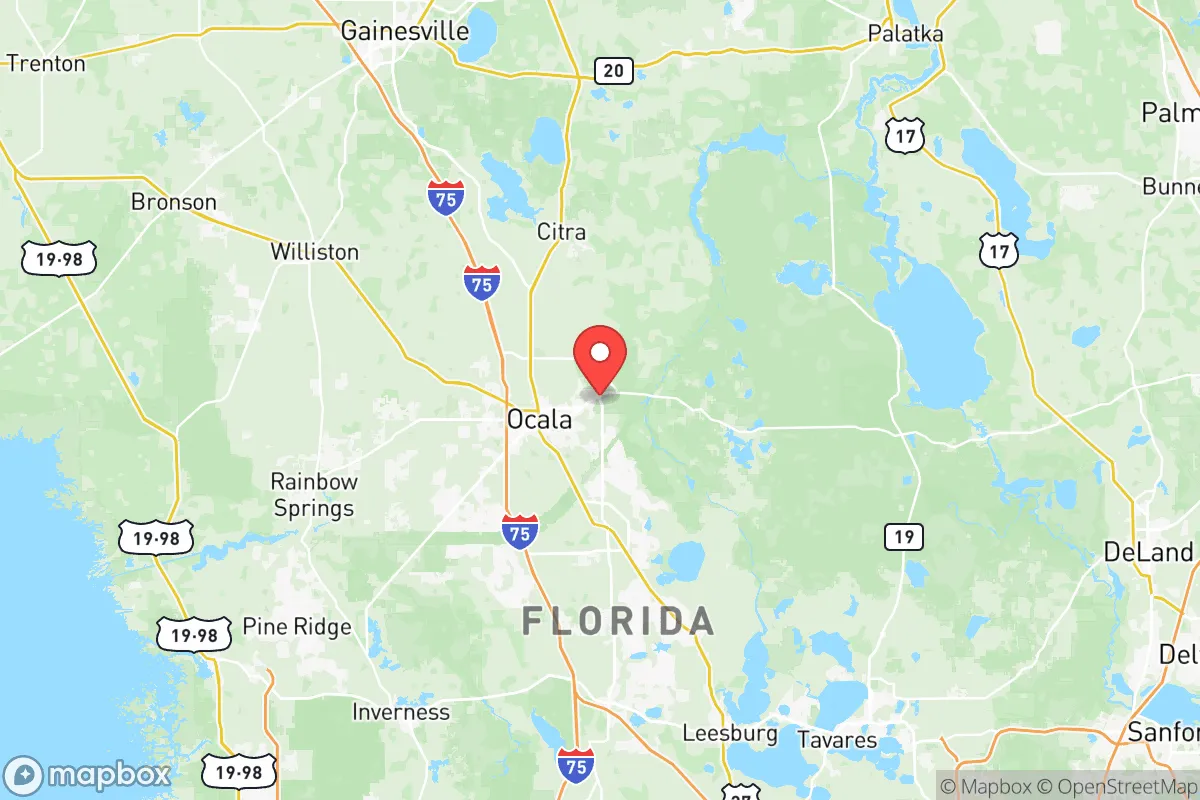
Marion County, Florida, is a reliably Republican stronghold with a Cook Partisan Voting Index (PVI) of R+14, making it significantly more conservative than the state of Florida as a whole, which sits at R+5. This isn't a new development; the county has been trending red for decades, but the shift has accelerated noticeably since the 2016 election. While the county as a whole votes heavily Republican, the internal dynamics are more nuanced than a simple red-blue map suggests, with distinct pockets of political diversity that shape local elections and daily life.
How it compares
The R+14 rating means Marion County is nearly three times more Republican-leaning than the state average. In practice, this translates to Republican candidates routinely winning countywide races by margins of 15 to 25 points. For example, in the 2024 presidential election, Donald Trump carried Marion County with roughly 64% of the vote, compared to about 56% statewide. The most conservative areas are the sprawling rural and suburban communities north and west of Ocala, particularly around Dunnellon and Citrus Springs, where GOP turnout often exceeds 70%. In contrast, the city of Ocala itself is more moderate, with precincts near downtown and the historic district occasionally swinging within 5-10 points of the state average. The most liberal-leaning precincts are concentrated in Silver Springs Shores and parts of southeast Ocala, where a higher proportion of younger and minority voters can push precincts to a 50-50 split or even a slight Democratic lean in low-turnout primaries. The rural Salt Springs and Fort McCoy areas are deeply red, while Belleview and Summerfield are reliably conservative but with a noticeable independent streak that sometimes backs local Democrats in non-partisan races.
What this means for residents
For conservative residents, Marion County is a comfortable environment where their views are the mainstream. Local government, from the county commission to the school board, is dominated by Republicans, and policy debates tend to focus on growth management, property taxes, and Second Amendment rights. Conservative social and religious organizations are well-established and active. For liberal residents, the reality is more about finding community within a minority. While you won't face hostility in most public spaces, political conversations can be tense, and progressive candidates rarely win countywide office. The upside is that local Democratic clubs and activist groups are tight-knit and influential in specific precincts, particularly around Ocala's downtown and the College of Central Florida area. The practical effect is that most residents, regardless of affiliation, learn to navigate a political landscape where compromise is often necessary—especially on non-partisan issues like infrastructure, public safety, and economic development.
Culturally, Marion County's politics are deeply intertwined with its identity as a horse-farming and retirement destination. The county's strong gun rights culture is reflected in the prevalence of shooting ranges and gun shows, and the local Republican Party is heavily influenced by the Tea Party and MAGA factions, which are more vocal than in the state party. A key policy distinction is the county's aggressive approach to growth control—a stance that sometimes puts local Republicans at odds with the state's pro-development tilt. You'll also find a strong local emphasis on veterans' affairs, with the Ocala/Marion County Veterans Memorial Park serving as a frequent rallying point. For anyone moving here, the political climate is straightforward: if you're conservative, you'll feel at home; if you're liberal, you'll find your niche but should expect to be in the minority. The trajectory suggests Marion County will remain R+14 or grow even redder as new residents from blue states continue to arrive, often drawn by the very political stability they find here.

State Political ClimatePolitical Climate in Florida
State Political AnalysisPolitical Environment in the State
Florida is a Republican-leaning state with a Cook PVI of R+5, but calling it simply "red" misses the wild, shifting reality on the ground. Over the past 20 years, the state has lurched from a classic swing state — deciding the 2000 election by 537 votes — to a solidly GOP stronghold in statewide races, while still electing Democrats in local and congressional seats. The dominant coalition is a mix of conservative retirees from the Midwest, Cuban-American and Venezuelan exiles in South Florida, and a growing wave of transplants from blue states who are fleeing taxes and crime but often bring moderate-to-liberal social views. The trajectory is clear: the state has moved about 10 points to the right since 2008, driven by in-migration and a GOP that has locked in structural advantages through redistricting and election laws.
Urban vs. rural divide
The political map of Florida is a tale of three coasts. The I-4 corridor — running from Tampa through Lakeland to Orlando — is the classic battleground, where fast-growing suburbs like Winter Garden and St. Cloud have flipped from blue to red in the last two cycles. Miami-Dade County, once a Democratic firewall, has shifted sharply right: in 2020, Trump improved his margin there by 20 points compared to 2016, and in 2024, Miami and Hialeah voted for the GOP candidate by double digits. Meanwhile, the Panhandle — places like Pensacola and Panama City — is deep red, culturally Southern and military-heavy. The Democratic strongholds are shrinking: Tallahassee (college town and state capital), Gainesville (UF), and the urban cores of Orlando and Tampa still vote blue, but they are islands in a reddening sea. Rural North Florida, from Lake City to Ocala, votes 70-80% Republican, driven by gun rights, agriculture, and evangelical churches.
Policy environment
Florida’s policy environment is defined by low taxes and light regulation. There is no state income tax, which is the single biggest draw for relocators. Property taxes are moderate (averaging 0.83% of home value), and the state caps annual assessment increases at 3% for homesteaded properties via the Save Our Homes amendment. Sales tax is 6%, but local options can push it to 8.5% in places like Miami and Tampa. The regulatory posture is business-friendly: permitting for construction is fast, occupational licensing is minimal, and the state has preempted local governments from enacting their own minimum wages, rent control, or plastic bag bans. Education policy is a national flashpoint: Governor Ron DeSantis pushed through the Parental Rights in Education Act (HB 1557, dubbed "Don't Say Gay" by critics) and the Stop WOKE Act (HB 7), which restrict classroom discussion of sexual orientation and race. School choice is expansive — Florida has one of the largest voucher programs in the country, with over 400,000 students using state funds for private or charter schools. Healthcare policy is mixed: the state did not expand Medicaid under the ACA, leaving roughly 800,000 low-income adults uninsured, but it has a robust network of federally qualified health centers. Election laws have tightened: the 2023 SB 7050 imposed stricter voter ID rules, limited drop boxes, and criminalized third-party ballot collection, while the state purges voter rolls aggressively. For a conservative relocator, this environment is a feature; for a liberal one, it is a source of friction.
Recent policy direction
The last three years have seen a cascade of legislation that signals where Florida is headed. On gun rights, the state enacted permitless carry (HB 543) in 2023, allowing anyone 21 or older to carry a concealed firearm without a license or training — a major shift from the post-Parkland restrictions of 2018. On parental and education rights, the "Don't Say Gay" law was expanded in 2023 to cover all grades, and the state banned DEI programs at public universities. On speech, the Stop WOKE Act restricts workplace and classroom discussions of race, though parts have been blocked by federal courts. On privacy and surveillance, Florida passed a biometric privacy law (SB 616) in 2023 that allows private lawsuits for unauthorized collection of facial recognition data, but it also expanded police use of license plate readers. On medical and bodily autonomy, the state banned abortion after six weeks (HB 5) in 2023, with no exceptions for rape or incest — one of the strictest laws in the country. On property rights, the Live Local Act (SB 102) preempts local zoning to allow affordable housing development on commercial land, a rare pro-density move. On taxation, the state has cut corporate income tax rates and expanded the homestead exemption. On voting, the 2023 law made it a felony for third parties to handle mail-in ballots, and the state now requires a driver's license number or last four digits of a Social Security number to register online. The direction is unmistakably conservative on social issues and libertarian on economics, with a heavy emphasis on executive power concentrated in the governor’s office.
Civil unrest & political movements
Florida has seen its share of political flashpoints. The 2020 racial justice protests in Miami, Tampa, and Orlando were large but largely peaceful, though the state responded with the Combating Public Disorder Act (HB 1) in 2021, which created new penalties for rioting and protected monuments. Immigration politics are intense: the state passed SB 1718 in 2023, which requires hospitals to ask about immigration status, invalidates out-of-state driver's licenses for undocumented immigrants, and funds the relocation of migrants to sanctuary states. Governor DeSantis has flown migrants to Martha's Vineyard and Sacramento as political stunts, drawing both cheers and lawsuits. Sanctuary city policies are banned by state law, and local sheriffs in Polk County and Brevard County have been vocal about cooperating with ICE. Election integrity controversies have been a constant since 2020: the state conducted a high-profile election crime unit that arrested 20 former felons for voting illegally, though many cases were later dismissed. Organized activist movements include the Moms for Liberty chapter network, which has been influential in school board races, and the Florida Rising progressive group, which focuses on voter registration in Black communities. A new resident would notice the intensity of partisan bumper stickers, yard signs, and talk radio — especially in the Panhandle and I-4 corridor — but actual street-level unrest is rare outside of downtown Miami during major protests.
Projection
Over the next 5-10 years, Florida will likely become more Republican, not less. The in-migration pattern — roughly 1,000 new residents per day — is dominated by conservatives from the Northeast and Midwest, plus a steady stream of Latin American exiles who lean right. The Democratic Party in Florida is in disarray, with no clear statewide leader and a shrinking base in rural and suburban areas. The state’s congressional map, drawn by the GOP, is likely to remain gerrymandered. However, the rapid growth of Orlando and Tampa could create new swing districts if younger, more diverse voters turn out. Climate change is the wild card: rising sea levels and hurricane risk could slow growth in coastal areas like Miami Beach and Fort Lauderdale, while inland cities like Ocala and Lakeland boom. A relocator moving in now should expect a state that is culturally conservative, economically libertarian, and politically dominated by a single party for the foreseeable future, with occasional flare-ups over immigration and education policy.
For a new resident, the bottom line is this: if you are a conservative, Florida is a place where your values are reflected in state law and your taxes are low. If you are a liberal, you will find your views represented in the urban cores but increasingly marginalized in statewide policy. The practical takeaway is that Florida rewards those who align with its current direction — low taxes, school choice, gun rights, and strict immigration enforcement — and challenges those who don’t, especially on social issues like abortion and LGBTQ rights. The state is not a swing state anymore; it is a red state with blue cities, and that reality shapes everything from your child’s curriculum to your property tax bill.
* Values derived from national, state, county, city and local statistics and may differ in a specific area. Last updated: 2026-06-18T05:08:24.000Z
Narrative content on this page is AI-generated and may contain mistakes. Verify any details that matter before acting on them.
ReloMaps may earn a commission from affiliate links at no extra cost to you.

