
Photo: Wikipedia
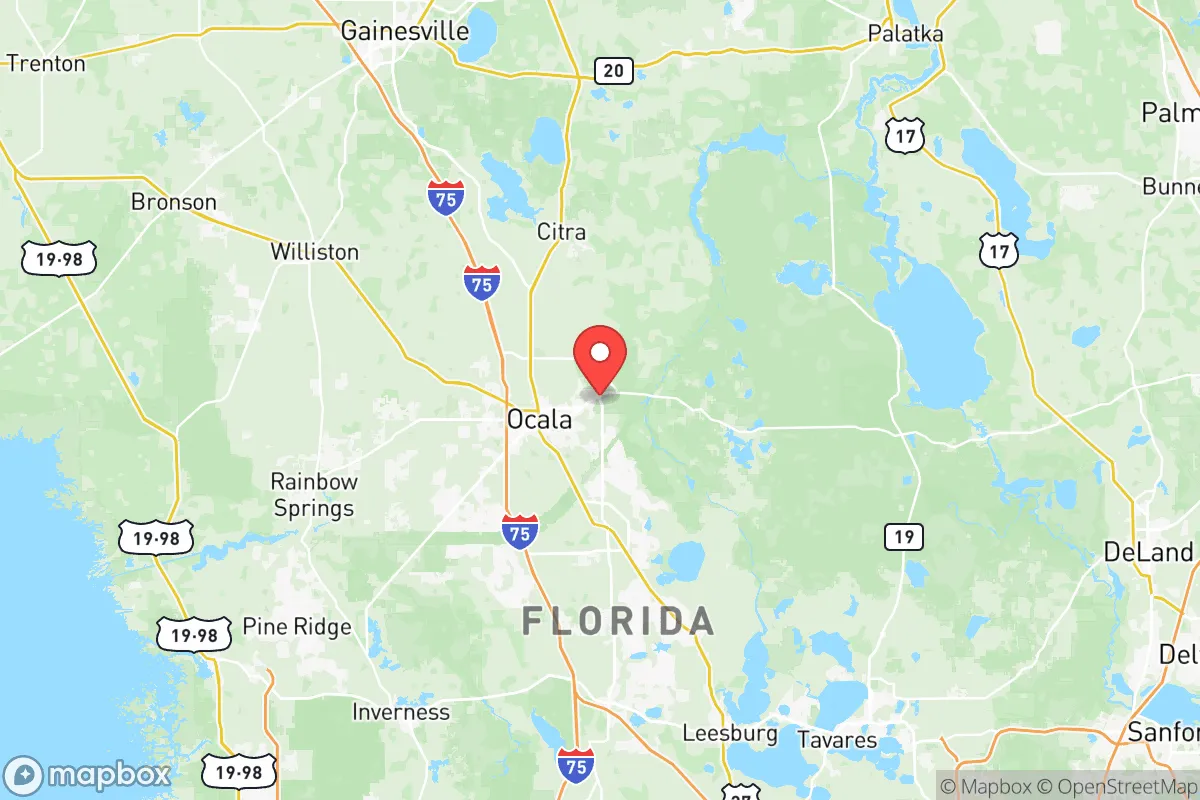
Personal Sovereignty in Marion County
Viable for self-reliance. Generally workable, though some barriers may limit total independence.
What does Personal Sovereignty tell us?
Personal Sovereignty measures your capacity for self-reliance and independence with minimal government friction. Higher scores mean fewer barriers between you and the way you want to live... but it assumes you have the space you need and good neighbors.
What does this tell us?
Personal Sovereignty measures your capacity for self-reliance and independence with minimal government friction. Higher scores mean fewer barriers between you and the way you want to live... but it assumes you have the space you need and good neighbors.
State Policy
Energy independence: Importer (10% of energy produced in-state)
Personal Liberty
Homesteading

Personal Liberty Analysis
Marion County, Florida, offers a notably high degree of personal sovereignty, blending a low-tax, light-regulatory state environment with a deeply rooted culture of self-reliance and individual liberty. For residents prioritizing autonomy over government intervention, the area presents a compelling balance of rural independence and access to essential services, though the level of freedom varies significantly between the unincorporated expanses and the more regulated city limits of Ocala, Belleview, and Dunnellon. The county’s overall posture is one of permissiveness, where the state’s preemption laws and constitutional protections create a broad baseline for personal choice, from firearm ownership to property use.
Tax burden and regulatory posture for residents and businesses
Florida’s absence of a state income tax is the cornerstone of Marion County’s low-tax appeal, directly increasing disposable income for individuals and families. The county’s combined state and local sales tax rate is 7.5%, which is moderate for the state, but the lack of a personal income tax means the effective tax burden on wages and investments is among the lowest in the nation. Property taxes are also restrained; Marion County’s millage rate hovers around 7.5 to 8.0 mills for the unincorporated area, though rates climb within the Ocala city limits (approximately 8.5 mills) and in the town of McIntosh, which has its own municipal services. The regulatory posture is similarly light-touch. Florida’s strong preemption laws prevent counties and cities from enacting their own stricter building codes, occupational licensing requirements, or environmental regulations that exceed state standards. This means a homeowner in Silver Springs Shores or a small business owner in Summerfield faces fewer bureaucratic hurdles than counterparts in states with home-rule authority. However, the city of Ocala does enforce its own zoning and land development codes, which are more restrictive than the county’s, particularly for home-based businesses and accessory dwelling units. For those seeking maximum regulatory freedom, the unincorporated areas—especially the rural tracts near Citra, Fort McCoy, and the Ocala National Forest—offer the least interference.
Self-defense rights and specific gun laws in Marion County
Marion County is a stronghold for Second Amendment rights, operating under Florida’s “shall-issue” concealed carry framework and the state’s preemption law that prohibits local governments from enacting their own firearm ordinances. This means the gun laws are uniform across the county, from the city of Ocala to the most remote parts of the Ocala National Forest. Florida does not require a permit to openly carry a firearm (effective July 2023), and concealed carry permits are issued to any law-abiding resident who completes a training course and passes a background check. The county sheriff’s office, led by Sheriff Billy Woods, is publicly supportive of gun rights and has a reputation for issuing permits efficiently. Stand-your-ground laws apply statewide, meaning there is no duty to retreat before using deadly force in self-defense in any place where a person has a legal right to be. Castle doctrine protections are also in full effect. For residents, this creates a legal environment where personal protection is largely a private matter, with minimal government interference. Gun ranges and firearms retailers are common, particularly along US-441 and SR-40, and the culture in towns like Dunnellon and Belleview is notably firearm-friendly. The only practical limitation is that discharging a firearm is prohibited within most city limits (Ocala, Belleview, Dunnellon) except at approved ranges, so rural property owners in unincorporated areas enjoy the most freedom for recreational shooting on their own land.
Self-reliance and homesteading viability: lot sizes, zoning, and off-grid feasibility
Marion County’s unincorporated areas are a prime destination for homesteaders and those seeking off-grid living, thanks to permissive zoning and large minimum lot sizes in agricultural districts. In the A-1 (General Agriculture) zoning district, which covers much of the northern and western parts of the county, the minimum lot size is one acre, and many parcels are five acres or larger. This allows for keeping livestock, raising poultry, and cultivating substantial gardens without special permits. The county’s land development code explicitly allows for “agricultural uses” as a right, including the keeping of horses, cattle, goats, and bees. Off-grid feasibility is high in areas like Fort McCoy, Citra, and the rural stretches near the Ocklawaha River, where well water and septic systems are standard. Solar panels are permitted without special county approval, and many residents rely on propane or wood for heating. However, the city of Ocala and the town of McIntosh have stricter building codes that require connection to municipal water and sewer where available, making true off-grid living impractical within those limits. The Ocala National Forest, which covers the eastern third of the county, offers federal land for dispersed camping and low-impact living, but permanent residence there is prohibited. For those serious about self-reliance, the unincorporated areas west of I-75, particularly around Dunnellon and Rainbow Springs, offer the best combination of affordable land, permissive zoning, and access to natural water sources.
Personal liberties: parental rights, medical autonomy, speech, and property
Florida’s state-level policies provide a strong foundation for personal liberties in Marion County. Parental rights in education are explicitly protected under the Parental Bill of Rights (Florida Statute 1014), which gives parents the authority to direct their children’s upbringing, education, and healthcare. This has practical effects in Marion County’s school system, where parents have broad access to curriculum materials and can opt their children out of any instruction they find objectionable. Medical autonomy is similarly robust; Florida law prohibits any mandate for vaccines or medical procedures as a condition of employment, education, or travel, and the state has not imposed mask or lockdown mandates since 2021. Marion County’s board of county commissioners has consistently voted against any local public health orders that would restrict individual choice. Free speech is protected under the First Amendment, and the county has no local ordinances that restrict political speech, signage, or assembly beyond state traffic safety rules. Property rights are strongly defended; Florida’s “Private Property Rights Protection Act” requires local governments to compensate property owners if a regulation reduces property value by more than 50%. This makes eminent domain and overly restrictive zoning rare. In practice, a landowner in Silver Springs or Ocklawaha can build a fence, erect a political sign, or operate a small farm without fear of overreach. The only notable limitation is in historic districts within Ocala’s downtown, where the Historic Preservation Board has some say over exterior modifications.
Compared to other regions in Florida and the Southeast, Marion County offers a distinctly high degree of personal sovereignty, particularly for those who choose the unincorporated areas over the city limits. The combination of no state income tax, strong preemption laws, permissive gun laws, and a county government that generally defers to individual choice creates an environment where self-reliance is not just tolerated but encouraged. For a family or individual seeking to maximize autonomy—whether through homesteading, homeschooling, or simply living without excessive regulation—Marion County ranks favorably against more restrictive areas like Alachua County (Gainesville) or Orange County (Orlando). The trade-off is that this freedom comes with fewer public services and a reliance on personal responsibility, which is precisely the appeal for the sovereignty-minded reader.

* Values derived from national, state, county, city and local statistics and may differ in a specific area. Last updated: 2026-06-18T05:08:24.000Z
Narrative content on this page is AI-generated and may contain mistakes. Verify any details that matter before acting on them.
ReloMaps may earn a commission from affiliate links at no extra cost to you.

