
Photo: Wikipedia
Demographics of Marion County
Affluence Level in Marion County
A middle-class area roughly in line with national averages across income, home values, education, and employment.
People of Marion County
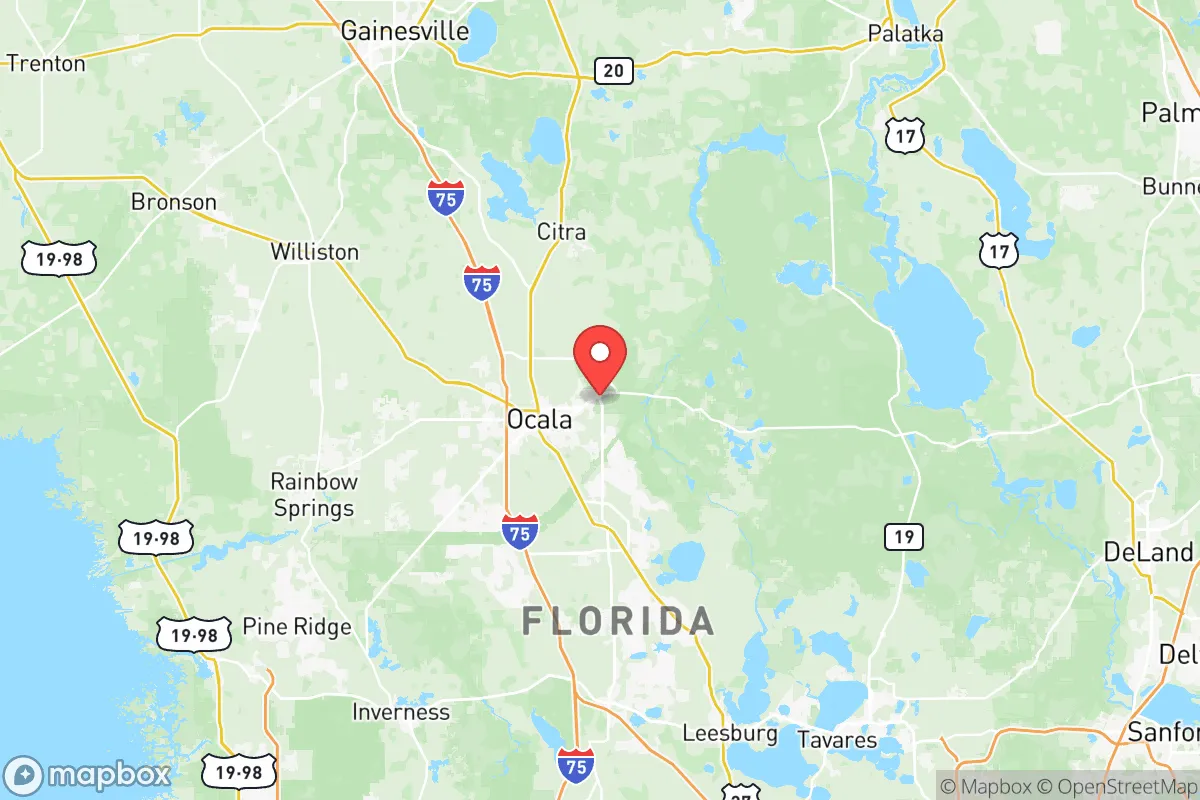
Marion County, Florida, is a region of 387,697 residents defined by a distinctively older, less diverse, and more insular character than the rest of the state. With a foreign-born population of just 3.4%—roughly one-fifth the national average—and a college attainment rate of 22.4%, the county’s identity is rooted in deep Southern heritage, a strong military and agricultural tradition, and a slow-growth ethos that sets it apart from the booming I-4 corridor. The population is 66.8% White, 15.9% Hispanic, 12.2% Black, 0.9% East/Southeast Asian, and 0.6% Indian (subcontinent), reflecting a demographic profile that has shifted only modestly over the past half-century.
Settlement & growth (pre-1960)
Long before European contact, the area now known as Marion County was home to the Timucua people, a loose confederation of chiefdoms that lived in villages along the Ocklawaha and Silver Rivers. Spanish explorers, including Hernando de Soto in 1539, encountered these groups, but sustained colonization did not begin until the late 18th century, when the British and later the Spanish granted land to settlers. The Timucua were largely wiped out by disease and conflict by the early 1700s, and the region became a sparsely populated frontier.
After Florida became a U.S. territory in 1821, the first major wave of American settlers arrived—primarily Scots-Irish and English families from Georgia, South Carolina, and Alabama. They were drawn by the promise of cheap, fertile land for cotton and cattle. The Second Seminole War (1835–1842) slowed settlement, but after the war, the U.S. Army established Fort King (near present-day Ocala) as a key outpost. The fort attracted traders, farmers, and craftsmen, and Ocala was formally incorporated in 1869. By the 1850s, the county’s population was overwhelmingly white and Southern, with enslaved African Americans making up roughly 40% of the total.
After the Civil War and emancipation, many freed Black families remained in the county, establishing small farming communities such as Reddick and McIntosh. These settlements became centers of Black landownership and community life, with churches, schools, and mutual-aid societies. The arrival of the railroad in the 1880s—first the Florida Central and later the Seaboard Air Line—transformed the economy. Citrus groves, timber, and phosphate mining boomed, drawing a modest wave of European immigrants, mostly from Germany and Italy, who settled in Dunnellon (a phosphate boomtown) and Silver Springs (a tourist destination). However, the foreign-born share never exceeded 5% in this period, as the county’s agricultural economy did not attract the large industrial immigrant populations seen in northern cities.
The Great Depression and the New Deal brought the Civilian Conservation Corps to the Ocala National Forest, but the county remained rural and poor through the 1940s. World War II introduced a new element: the U.S. Army established the Ocala Army Air Base (later Ocala International Airport), and the nearby town of Belleview saw an influx of military personnel and support workers. After the war, many veterans returned to the area, drawn by the low cost of living and the promise of a slower pace. The 1950s saw the first wave of Northern retirees—mostly from the Midwest and Northeast—who settled in mobile-home parks and subdivisions around Ocala and Silver Springs Shores. By 1960, the county’s population had reached 103,000, still overwhelmingly white and native-born.
Modern era (post-1965)
The 1965 Hart-Cellar Act had a muted effect on Marion County compared to coastal Florida. The county’s foreign-born population today is just 3.4%, and the largest immigrant groups are Hispanic (15.9% of the total population) and Black (12.2%). The Hispanic community is predominantly of Mexican and Puerto Rican origin, with smaller numbers from Cuba and Central America. They began arriving in significant numbers in the 1990s, drawn by work in construction, landscaping, and agriculture—especially the horse farms and nurseries around Ocala and Summerfield. Today, the Hispanic population is dispersed throughout the county, with notable concentrations in the Ocala city limits and in the unincorporated areas west of Silver Springs.
The Black population, which was 11.8% in 1970, has remained relatively stable at 12.2% today. However, its geographic distribution has shifted. Historically Black communities like Reddick and McIntosh have seen population decline as younger generations moved to Ocala or left the county entirely. Meanwhile, the Black population in Ocala itself has grown, particularly in the northwest and southeast quadrants of the city. The East/Southeast Asian population (0.9%) and Indian subcontinent population (0.6%) are small but growing, concentrated in Ocala’s medical and professional sectors, with a small cluster of Filipino and Vietnamese families in Belleview.
The most transformative demographic force since 1965 has been domestic migration—specifically, the influx of retirees and second-home buyers from the Northeast, Midwest, and Canada. The development of The Villages, a massive age-restricted retirement community that straddles the Marion-Lake-Sumter county line, began in the 1970s and exploded in the 2000s. While the majority of The Villages lies in Sumter and Lake counties, its northern edge extends into Marion, bringing tens of thousands of mostly white, affluent, and politically conservative retirees. This wave has made Marion County one of the oldest counties in Florida, with a median age of 47.2 (compared to the state median of 42.2). Suburbanization has also spread along the I-75 corridor, with new subdivisions in Ocala, Belleview, and Dunnellon attracting families from the Tampa-Orlando metro areas seeking cheaper housing.
The future
Marion County is becoming slightly more diverse, but at a slower pace than the rest of Florida. The Hispanic share is projected to rise from 15.9% to roughly 20% by 2040, driven by natural increase and continued migration from Puerto Rico and Mexico. The Black share is expected to remain near 12%, while the White share will decline gradually as older cohorts pass away and younger, more diverse families move in. The East/Southeast Asian and Indian populations will likely grow from their current small bases, particularly as Ocala’s healthcare and logistics sectors expand—the World Equestrian Center and the Ocala International Airport are attracting a more professional workforce.
Geographically, growth will concentrate in the I-75 corridor and the Ocala city limits, with new subdivisions spreading south toward Belleview and west toward Dunnellon. The Villages will continue to draw retirees, but the county’s overall age structure may begin to balance as younger families are priced out of the Tampa and Orlando markets. The cultural identity of the county is likely to remain conservative and rooted in Southern traditions, but with an increasing Hispanic influence in food, festivals, and small business. The foreign-born share will remain low by national standards, likely not exceeding 6% by 2040.
For someone moving in now, Marion County offers a stable, slow-growing community where the population is older, less diverse, and more politically conservative than the Florida average. The dominant culture is white, Southern, and retiree-oriented, with a growing Hispanic presence that is largely integrated rather than concentrated in enclaves. The county is not becoming a melting pot—it is becoming a slightly more varied version of what it has always been: a quiet, affordable, and insular place where change comes gradually, and where the past still shapes the present.

* Values derived from national, state, county, city and local statistics and may differ in a specific area. Last updated: 2026-06-18T05:08:24.000Z
Narrative content on this page is AI-generated and may contain mistakes. Verify any details that matter before acting on them.
ReloMaps may earn a commission from affiliate links at no extra cost to you.

