Photo: Wikipedia
Political ClimatePolitical Climate in Crown Heights, NY
District shown is the primary district for this city’s centroid. Cities may span multiple districts.
Political rankings in New York
- Most Conservative Cities in New York
- Most Liberal Cities in New York
- Best Conservative-Leaning Towns in the Northeast
- Best Conservative-Leaning Towns in the Mid-Atlantic
- Safest Liberal-Leaning Towns on the East Coast
- Safest Conservative-Leaning Towns on the East Coast
- Most Affordable Liberal-Leaning Small Towns in the U.S.
- Safest Liberal-Leaning Cities in the U.S.
- Most Conservative Counties in New York
- Most Liberal Counties in New York
Local Political AnalysisPolitical Analysis of Crown Heights, NY
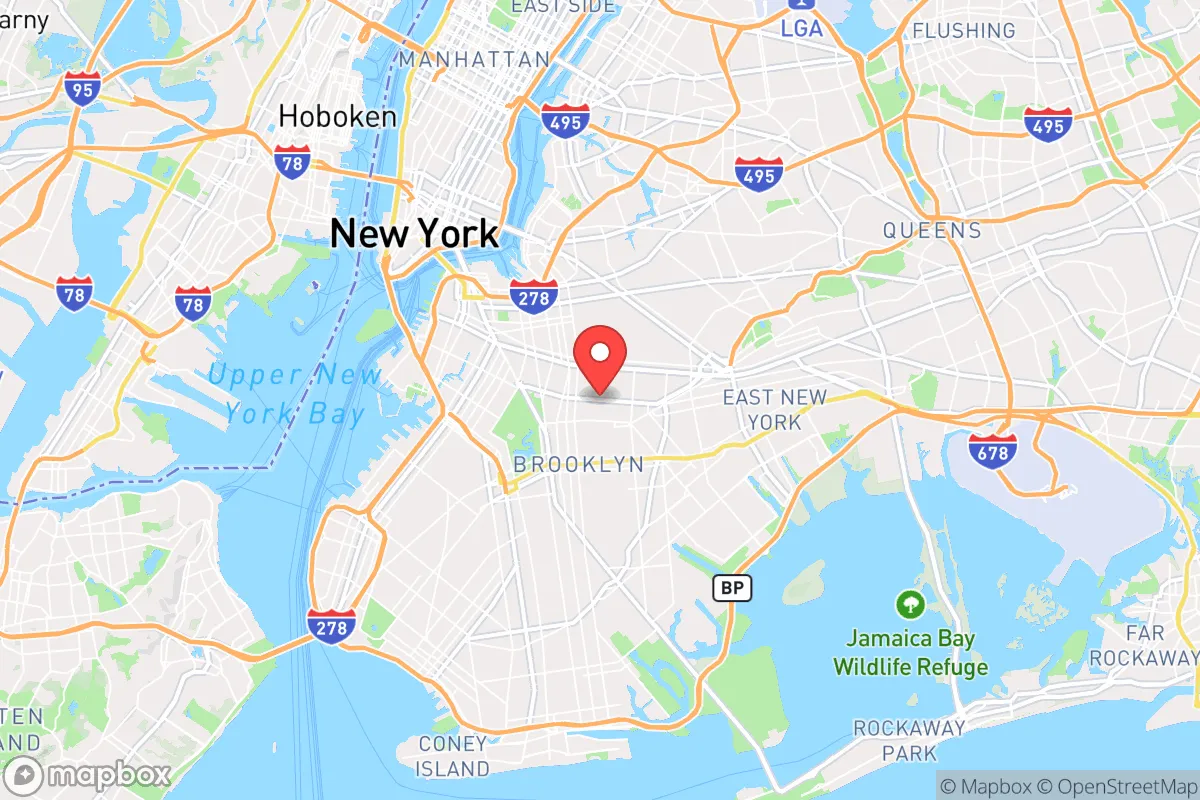
Crown Heights is one of the most reliably Democratic strongholds in all of New York City, with a Cook Partisan Voting Index of D+22 — meaning it votes about 22 points more Democratic than the national average. That’s not just a blue dot on the map; it’s a deep blue anchor. The neighborhood has been trending steadily leftward for decades, driven by a coalition of Black, Caribbean, and increasingly Orthodox Jewish voters who, while culturally distinct, overwhelmingly back Democratic candidates in general elections. You won’t find much swing here: in 2024, the area’s precincts gave Democratic presidential candidates margins north of 75%, and local City Council races are effectively decided in the primary.
How it compares
Compared to New York City as a whole, Crown Heights is noticeably more progressive on economic issues but more moderate on certain cultural flashpoints. Manhattan’s Upper East Side, for instance, has a similar Democratic lean but a much higher concentration of moderate, fiscally conservative Democrats. In contrast, Crown Heights’ politics are shaped by its large Hasidic Jewish community — concentrated around Kingston Avenue — and its long-established Black and Caribbean populations. These groups often diverge on school policy and housing development: the Hasidic community tends to favor private religious schooling and opposes rezoning for density, while many Black and Caribbean residents push for more public school funding and affordable housing. This creates a local political landscape that’s less uniformly progressive than the D+22 number suggests. Nearby neighborhoods like Park Slope (D+30) are more uniformly liberal on social issues, while Staten Island’s South Shore (R+10) offers a stark contrast — a reminder that even within the same city, political realities can feel like different countries.
What this means for residents
For liberal residents, Crown Heights is a comfortable place to live politically: you’ll rarely encounter overt opposition to Democratic policies, and local elected officials — like Assemblymember Brian Cunningham and Council Member Crystal Hudson — are reliably progressive on housing, policing, and tenant rights. Conservative residents, however, aren’t invisible. The Orthodox Jewish community often votes as a bloc for candidates who prioritize school choice, religious accommodation, and public safety — positions that can put them at odds with the broader progressive agenda. If you’re a conservative-leaning person here, you’ll find your voice in local synagogue associations and community boards, but you won’t see many Republican yard signs. The practical effect is that policy debates in Crown Heights are less about left vs. right and more about which faction of the Democratic coalition wins the day. On issues like congestion pricing or police reform, the neighborhood’s representatives tend to split along community lines rather than party lines.
Culturally, Crown Heights stands out for its intense localism. Unlike Manhattan’s hyper-transient neighborhoods, Crown Heights has deep roots: block associations, tenant unions, and religious institutions carry real weight. The annual West Indian American Day Parade on Labor Day is a massive political and cultural event where every local candidate campaigns. Policy-wise, the neighborhood has been a battleground over the Brooklyn-Queens streetcar proposal and the fate of the old Bedford-Union Armory — both fights that pitted pro-development forces against preservationists. If you move here, you’ll quickly learn that local politics isn’t abstract; it’s about who gets to build what on your block. The D+22 label tells you the team, but the real game is the internal scrimmage.

State Political ClimatePolitical Climate in New York
State Political AnalysisPolitical Environment in the State
New York State has long been a Democratic stronghold, but the reality on the ground is far more nuanced than its statewide electoral results suggest. Since the early 2000s, the state has shifted from a purple-ish blue to a deep blue, driven overwhelmingly by New York City and its immediate suburbs. In the 2024 presidential election, Kamala Harris won the state by roughly 12 points, a margin that has narrowed slightly from Joe Biden’s 23-point win in 2020, but still reflects a durable Democratic advantage. The real story, however, is the growing chasm between the five boroughs and the rest of the state—a divide that shapes every policy debate and relocation decision.
Urban vs. rural divide
The political map of New York is a tale of two states. New York City—Manhattan, Brooklyn, Queens, the Bronx, and Staten Island—accounts for over 40% of the state’s population and delivers landslide Democratic margins. In 2024, Manhattan voted 84% for Harris, while Staten Island, the most conservative borough, still went 57% for Trump. The immediate suburbs—Nassau and Suffolk on Long Island, and Westchester just north of the city—are battlegrounds that have trended rightward. Nassau County flipped from Biden +8 in 2020 to Trump +2 in 2024, a swing driven by crime and education concerns. Upstate, the picture is starkly different. Buffalo, Rochester, Syracuse, and Albany are Democratic islands in a sea of red; Erie County (Buffalo) went for Harris by 15 points, but surrounding rural counties like Wyoming and Orleans voted 70%+ for Trump. The Southern Tier, from Chautauqua County to the Catskills, is solidly Republican, while the North Country—Plattsburgh, Watertown, and the Adirondacks—leans red but with a libertarian streak. The Hudson Valley is a microcosm: Dutchess County is purple, Ulster County is blue, and Columbia County is deep blue, while Greene and Delaware counties are reliably red.
Policy environment
New York’s policy environment is defined by high taxes and heavy regulation. The state has a progressive income tax with rates up to 10.9% for top earners, and property taxes are among the highest in the nation—averaging 1.7% of home value, with Long Island and Westchester often exceeding 2%. The regulatory posture is aggressive: the state has strict rent control laws in NYC and some suburbs, a $15 minimum wage that adjusts annually, and a paid family leave program funded by payroll deductions. Education policy is centralized; the state controls curriculum standards and administers Regents exams, and school funding is heavily skewed toward NYC and high-needs districts. Healthcare is dominated by the state’s Medicaid program, which covers roughly one in three New Yorkers, and the state-run NY State of Health exchange. Election laws are among the most liberal in the country: no-excuse absentee voting, early voting (10 days), automatic voter registration at the DMV, and same-day registration. Gun laws are strict: a 2023 law requires a license to purchase any firearm, bans "assault weapons" and high-capacity magazines, and mandates safe storage. The state also has a "red flag" law allowing courts to temporarily remove firearms from individuals deemed a threat.
Recent policy direction
Over the past five years, New York has moved decisively left on nearly every front. The 2022 "Clean Slate Act" automatically seals most criminal records after a set period, while the 2019 bail reform law eliminated cash bail for most non-violent offenses—though it was partially rolled back in 2023 after a crime spike. On guns, the 2023 "Concealed Carry Improvement Act" (passed after the Supreme Court’s Bruen decision) requires "good moral character" for permits and bans guns in "sensitive locations" like Times Square and subways. Parental and education rights have been a flashpoint: the state mandates LGBTQ-inclusive curriculum and has resisted parental opt-out policies for sex ed. Speech is broadly protected, but the state has cracked down on "hate speech" in schools and online under a 2022 law that critics say chills free expression. Privacy and surveillance are mixed: the state has strong data breach notification laws but also allows warrantless surveillance of license plates via the statewide "E-ZPass" system. Medical autonomy is expansive: New York codified abortion rights in 2019 and passed a 2022 law protecting providers who treat out-of-state patients. Property rights are constrained by rent control and a 2019 law that eliminated vacancy decontrol, effectively locking in below-market rents for life. On voting, the state expanded mail-in voting and enacted automatic voter registration, but has not moved to ranked-choice voting or open primaries.
Civil unrest & political movements
New York has been a stage for both left- and right-wing activism. The 2020 Black Lives Matter protests in NYC were among the largest in the country, with sustained demonstrations in Manhattan and Brooklyn. In response, the state passed the "Eric Garner Act" banning chokeholds and the "Police Reform and Reinvention Collaborative" requiring every locality to review use-of-force policies. On the right, the "Second Amendment" movement is active upstate, with gun rights rallies in Albany and at the state capitol. Immigration politics are heated: New York City’s "sanctuary city" policy, which limits cooperation with ICE, has been a flashpoint, especially after the 2022-2023 migrant surge that saw over 100,000 asylum seekers arrive. The state has a "right to shelter" law that mandates housing for anyone who requests it, straining resources. Election integrity controversies have been minimal compared to swing states, but some upstate counties have passed resolutions calling for a "convention of states" to amend the U.S. Constitution. Secession rhetoric is mostly confined to fringe groups; a 2021 proposal to split the state into "New York City" and "Upstate" went nowhere. Visible flashpoints include the annual "Taxpayer March on Albany" and the ongoing battle over the state’s "Green New Deal" (the Climate Leadership and Community Protection Act), which mandates 100% zero-emission electricity by 2040 and has drawn lawsuits from upstate towns worried about wind turbine siting.
Projection
Over the next 5-10 years, New York’s political trajectory is likely to continue its current drift: deeper blue in the NYC metro, redder in the exurbs and rural areas, and a shrinking middle. Demographic trends are working against the state: New York lost a net 500,000 residents between 2020 and 2024, mostly to Florida, Texas, and the Carolinas. Those leaving tend to be higher-income, more conservative-leaning families, while the state’s growth is driven by international immigration into NYC. This will likely make the state’s politics even more polarized, with the legislature in Albany becoming more progressive and the upstate congressional seats becoming more Republican. The state’s fiscal situation is a wild card: a $10 billion budget deficit projected for 2026 could force tax increases or service cuts, accelerating out-migration. For a new resident, expect the policy environment to remain liberal on social issues (abortion, LGBTQ rights, gun control) and high-tax, but with potential for modest moderation on crime and education if the suburban swing continues. The upstate-downstate divide will only widen, meaning your experience will depend heavily on where you land.
For a conservative-leaning relocator, the bottom line is that New York is a state of stark trade-offs. You’ll find like-minded communities in the North Country, the Southern Tier, and parts of the Hudson Valley, but you’ll be living under a state government that is consistently at odds with your values on taxes, guns, and education. For a liberal relocator, the state offers robust protections and services, but at a high cost of living and with growing political friction between the city and the countryside. The practical takeaway: choose your county carefully, understand that state-level politics will not change anytime soon, and budget for taxes that will be among the highest in the nation regardless of where you settle.
* Values derived from national, state, county, city and local statistics and may differ in a specific area. Last updated: 2026-11-25T11:18:29.000Z
Narrative content on this page is AI-generated and may contain mistakes. Verify any details that matter before acting on them.
ReloMaps may earn a commission from affiliate links at no extra cost to you.

