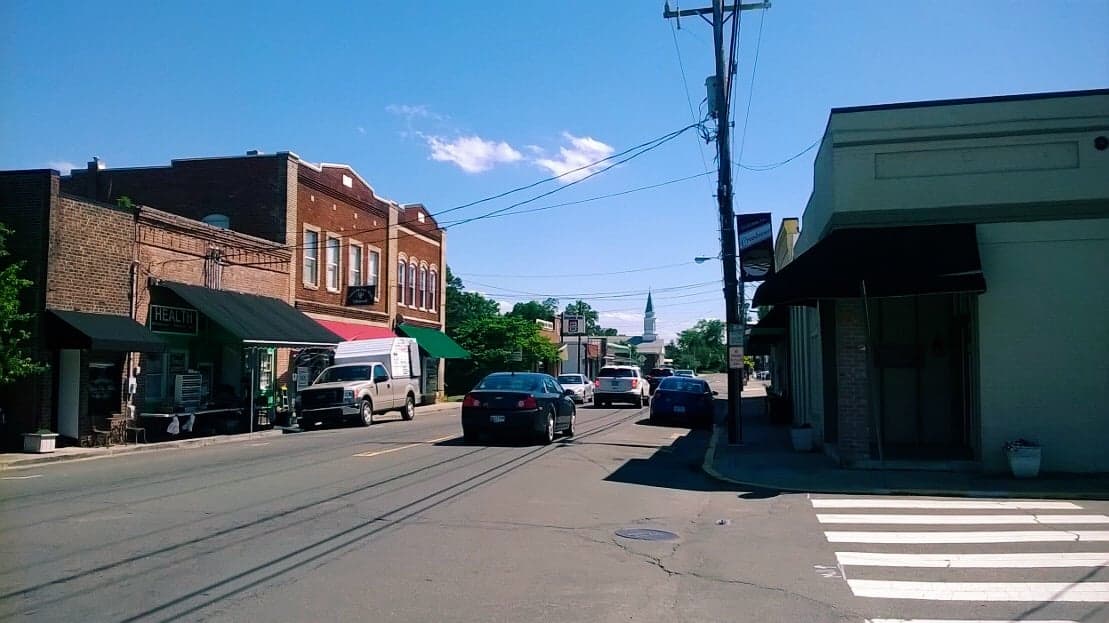
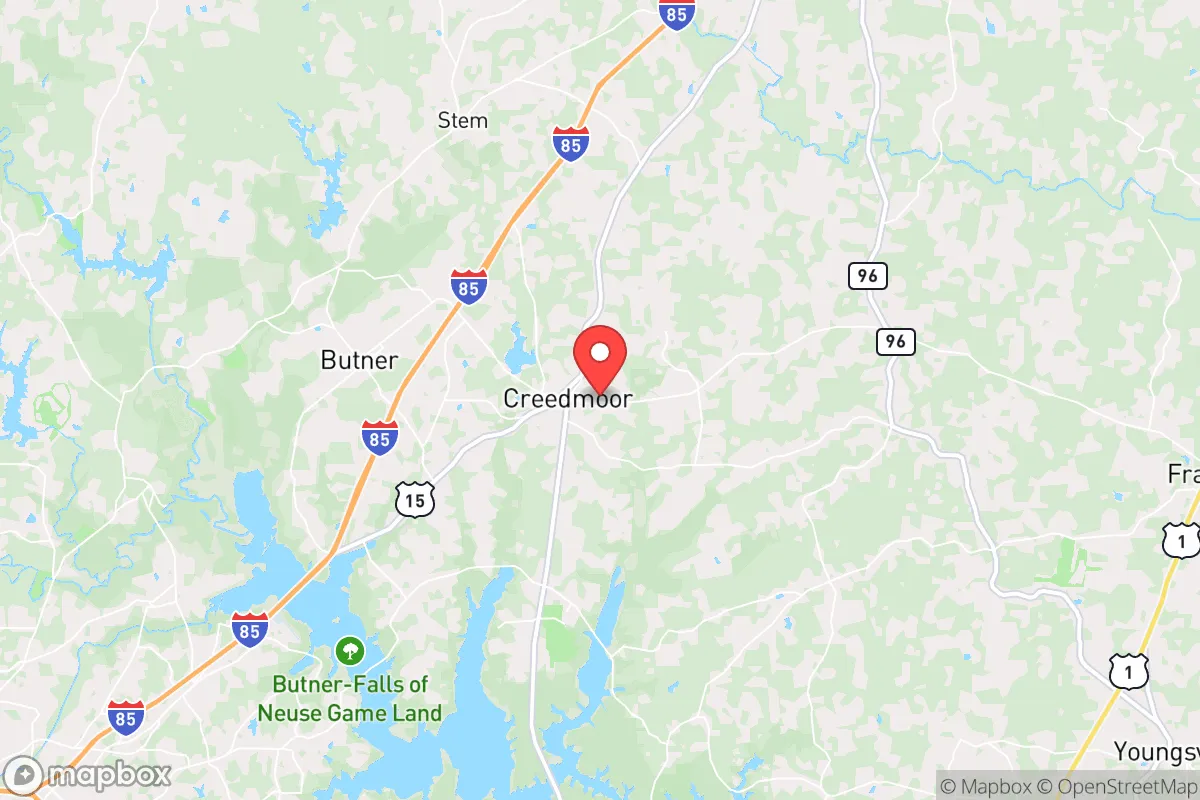
Photo: Wikipedia
Political ClimatePolitical Climate in Creedmoor, NC
District shown is the primary district for this city’s centroid. Cities may span multiple districts.
Local Political AnalysisPolitical Analysis of Creedmoor, NC
Creedmoor leans solidly Republican, with a Cook PVI of R+8 that places it well to the right of North Carolina as a whole, which sits at R+1. This isn't a recent shift; the area has been reliably red for decades, anchored by a mix of rural traditions, a strong military and veteran presence from nearby Fort Liberty (formerly Fort Bragg), and a population that values limited government. But if you've been around since the 1990s, you've seen the change. Back then, Creedmoor was a quiet crossroads town where everyone knew everyone, and politics rarely came up at the diner. Now, with Raleigh's suburban sprawl creeping north along Highway 56, you're getting more transplants from Wake County—some bring their blue-leaning views, but most are still conservative-leaning families who moved here for lower taxes and bigger lots. The result is a place that's still deeply Republican, but with a growing moderate streak that wasn't there twenty years ago.
How it compares
Compared to the state average, Creedmoor is a political outlier. North Carolina's R+1 rating reflects a true battleground—think of the razor-thin margins in presidential races since 2008. Creedmoor's R+8 is more like the rural counties to the east and north, such as Granville County (where it sits) or neighboring Vance County. But drive 15 minutes south to Wake Forest, and you'll hit a different world: that town has trended purple-to-blue as it's been absorbed into the Raleigh metro, with a Cook PVI closer to D+2. Or head 20 minutes west to Durham—a deep blue D+20 stronghold. That contrast is stark. In Creedmoor, you'll see Trump signs on lawns year-round; in Durham, you'll see Harris-Walz bumper stickers on Teslas. The local school board and town council races here rarely see a Democrat on the ballot, while just over the county line in Wake, those same races are hotly contested. For a sense of trajectory: Granville County voted +24 for Trump in 2020, but that was down from +30 in 2016, hinting at a slow drift leftward as the exurbs fill up.
What this means for residents
For conservative residents, Creedmoor is comfortable. You can expect your values reflected in local ordinances—low property taxes, minimal zoning fuss, and a sheriff's office that emphasizes Second Amendment rights. The local GOP is active but not overbearing; you'll see them at the annual Fourth of July parade, not knocking on your door every weekend. For liberal residents, it's more of a mixed bag. You won't face hostility, but you'll be in a clear minority. The local Democratic Party chapter is small and often struggles to field candidates. That said, no one's going to hassle you for a Biden sticker on your car—it's more of a "live and let live" vibe, especially among the newer arrivals. The real friction point isn't politics per se, but growth: conservatives worry about losing the rural character, while liberals often push for more public transit and affordable housing. Both sides agree on one thing: they don't want Creedmoor to become another soulless suburb.
Culturally, Creedmoor still feels like a small town where the high school football game on Friday night is the main event. There's no local paper, but the Granville County Sun covers town council meetings. The biggest policy distinction from the state at large is the tax rate: Granville County's property tax is about $0.85 per $100 of assessed value, notably lower than Wake County's $0.63 (which sounds lower but is offset by higher home values). That's a deliberate choice—the county board has resisted raising taxes for schools or infrastructure, a stance that pleases fiscal conservatives but frustrates those who want better roads and parks. Looking ahead, if the Raleigh exurban wave keeps pushing north, Creedmoor's R+8 could slip to R+5 or R+6 within a decade. But for now, it remains a reliably red pocket in a purple state, where the biggest political argument might be over whether to allow a new Dollar General or a craft brewery.

State Political ClimatePolitical Climate in North Carolina
State Political AnalysisPolitical Environment in the State
North Carolina is a classic swing state with a slight Republican lean, carrying a Cook PVI of R+1, but its political reality is far more nuanced than that number suggests. Over the past 20 years, the state has shifted from a reliably red stronghold—where George W. Bush won twice comfortably—to a fiercely competitive battleground where margins are razor-thin. The dominant coalition is a rural, conservative base in the Piedmont and coastal plains, increasingly challenged by explosive growth in the Research Triangle (Raleigh-Durham-Chapel Hill), Charlotte, and the Asheville corridor. This tension between a booming, diverse urban core and a shrinking but politically potent rural electorate defines every election and policy debate.
Urban vs. rural divide
The political map of North Carolina is a study in stark contrasts. The state's three major metro areas—Charlotte (Mecklenburg County), the Raleigh-Durham-Chapel Hill triangle (Wake, Durham, Orange counties), and Asheville (Buncombe County)—are Democratic strongholds that together deliver roughly 40% of the state's vote. These areas are driven by a mix of tech and finance transplants, university communities, and a growing minority population. In 2020, Joe Biden won Wake County by 26 points and Mecklenburg by 30, while Donald Trump carried the rest of the state by a combined 8 points. Meanwhile, the rural east—places like Robeson County (historically Democratic but shifting right) and the northeastern coastal counties—and the exurban west, including Gaston County and Catawba County, are deeply Republican. The suburbs are the real battleground: Union County, just southeast of Charlotte, voted for Trump by 28 points in 2020, while Wake Forest and Cary (Wake County suburbs) are trending blue as professionals move in. The result is a state where statewide races are decided by less than 2 points, but the legislature remains firmly Republican due to gerrymandering.
Policy environment
North Carolina’s policy environment reflects its divided government. The state has a flat income tax rate of 4.5% (down from 5.25% in 2021), with a scheduled phase-down to 3.99% by 2027, making it competitive for businesses and high-earners. The corporate income tax is 2.5%, one of the lowest in the South. Sales tax is 4.75% statewide, but local options push it to 7-7.5% in most counties. There is no state property tax; property taxes are set locally, averaging about 0.8% of assessed value. On education, the state funds a voucher program (Opportunity Scholarships) that now serves over 30,000 students, and charter schools are plentiful. Healthcare policy is a mixed bag: the state expanded Medicaid in 2023 under a bipartisan deal, adding 600,000 low-income adults, but the state also has some of the strictest abortion laws in the Southeast—a 12-week ban with limited exceptions, passed in 2023. Election laws are a flashpoint: the state requires photo ID to vote, has strict absentee ballot rules, and the legislature has repeatedly drawn maps that courts have struck down as partisan gerrymanders. Gun laws are permissive: permitless carry for handguns became law in 2023, and the state has a "stand your ground" statute.
Recent policy direction
The last five years have seen a clear conservative shift in state policy, driven by a Republican supermajority in the legislature (after 2022) that can override Democratic Governor Roy Cooper’s vetoes. Key legislation includes the 2023 abortion ban (12 weeks, with exceptions for rape, incest, and fetal anomalies), the 2023 permitless carry law (allowing concealed carry without a permit), and the 2023 Parents’ Bill of Rights (requiring schools to notify parents about curriculum changes and medical services, and banning instruction on gender identity and sexuality in K-4). On property rights, the state has strong eminent domain protections and no statewide rent control. On privacy, the state passed a consumer data privacy law in 2023 (effective 2025) but has no broad surveillance restrictions. Voting access has tightened: the 2023 law shortened the absentee ballot return window and banned private funding of election administration. On medical freedom, the state did not impose COVID-19 vaccine mandates for state employees and banned vaccine passports in 2021. The overall direction is toward lower taxes, expanded gun rights, parental control in schools, and restrictions on abortion—a package that appeals to conservative relocators but alarms liberal ones.
Civil unrest & political movements
North Carolina has a history of visible political activism on both sides. The Moral Monday protests (2013 onward) brought thousands to the state capitol against Republican policies on voting rights, education, and healthcare. In 2020, the Wrightsville Beach area saw large Black Lives Matter protests, while rural counties like Harnett and Johnston hosted pro-Trump caravans. Immigration politics are heated but not as explosive as in border states: the state has no sanctuary city policies, and sheriffs in counties like Alamance and Cabarrus cooperate with ICE, while Durham and Orange counties have more lenient stances. Election integrity remains a live issue: the 2020 election saw Trump challenge the results in court (unsuccessfully), and the 2024 cycle featured intense scrutiny of voter rolls. There is no serious secession or nullification movement, but the "Free the NC GOP" faction pushes for more aggressive conservative action. A new resident will notice the political divide in everyday life—yard signs, bumper stickers, and local news coverage are heavily polarized, especially in the run-up to elections.
Projection
Over the next 5-10 years, North Carolina is likely to become more competitive, not less. In-migration is the key driver: the state adds about 100,000 new residents annually, mostly from blue states like New York, California, and New Jersey. These newcomers tend to settle in the urban and suburban metros—Charlotte, Raleigh, Durham, and Wilmington—and lean Democratic. If current trends hold, the state could flip to a lean-Democratic PVI by 2030, though the legislature’s gerrymandered maps will likely keep the GOP in power in Raleigh for another decade. The rural population is aging and shrinking, while the urban and suburban population is growing and diversifying. However, the state’s conservative policy direction (low taxes, gun rights, school choice) may actually accelerate in-migration from conservatives fleeing high-tax states, creating a self-reinforcing cycle. The wildcard is national politics: if the GOP nominates a candidate who alienates suburban women or moderates, North Carolina could swing blue in presidential races. For someone moving in now, expect a state that remains purple but with a conservative policy tilt for the next decade, followed by a possible shift toward the center or left as demographics change.
For a new resident, the bottom line is this: North Carolina offers a low-tax, business-friendly environment with strong gun rights and school choice, but also a vibrant, growing urban culture and a competitive political landscape. Conservatives will find a welcoming policy environment and a like-minded rural and exurban community. Liberals will find safe havens in the cities and suburbs, but will face a legislature that consistently passes laws they oppose. The state is not a political monoculture—it’s a place where you can live in a deep-blue city like Durham and drive 30 minutes to a deep-red county like Granville. The key is choosing your location wisely: if you want a conservative community, look at Union County or Johnston County; if you want a liberal bubble, Orange County or Buncombe County are your best bets. Either way, you’ll be paying low taxes and enjoying a state that is politically engaged, growing fast, and unlikely to settle into a comfortable partisan corner anytime soon.
* Values derived from national, state, county, city and local statistics and may differ in a specific area. Last updated: 2026-09-02T22:29:34.000Z
Narrative content on this page is AI-generated and may contain mistakes. Verify any details that matter before acting on them.
ReloMaps may earn a commission from affiliate links at no extra cost to you.

