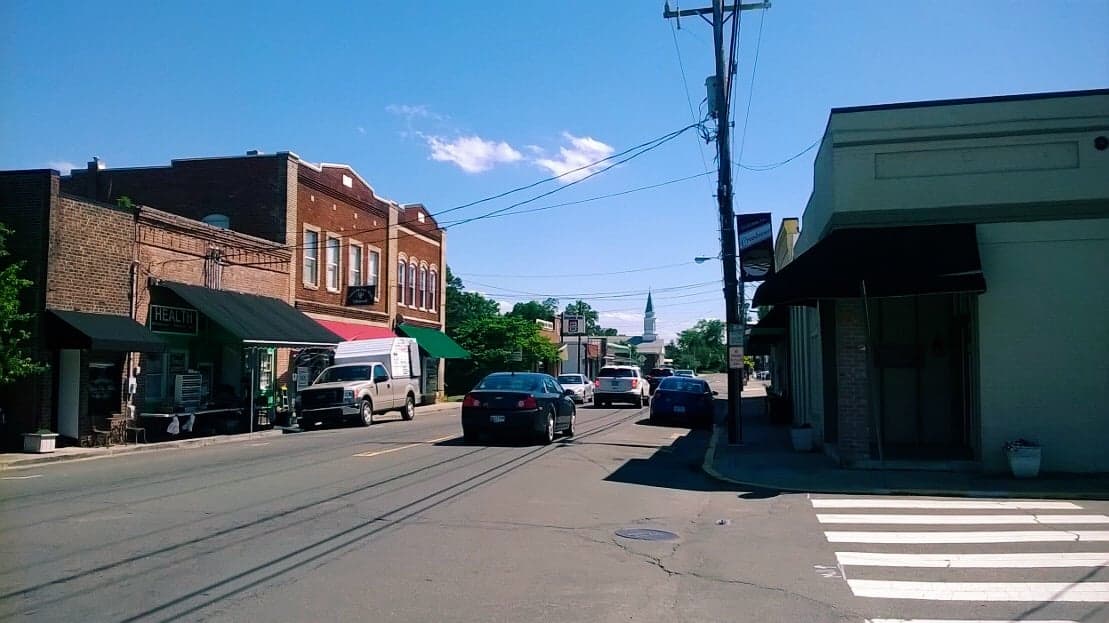
Photo: Wikipedia
Personal Sovereignty in Creedmoor, NC
Viable for self-reliance. Generally workable, though some barriers may limit total independence.
What does Personal Sovereignty tell us?
Personal Sovereignty measures your capacity for self-reliance and independence with minimal government friction. Higher scores mean fewer barriers between you and the way you want to live... but it assumes you have the space you need and good neighbors.
What does this tell us?
Personal Sovereignty measures your capacity for self-reliance and independence with minimal government friction. Higher scores mean fewer barriers between you and the way you want to live... but it assumes you have the space you need and good neighbors.
State Policy
Energy independence: Importer (15% of energy produced in-state)
Personal Liberty
Homesteading

Personal Liberty Analysis
Creedmoor, North Carolina, offers a personal sovereignty environment shaped by its location in a state with a strong tradition of local control and individual rights, while still operating within the framework of county and municipal regulations. For those prioritizing autonomy, the town provides a balance of rural character and suburban accessibility, with a regulatory posture that is generally light-touch compared to more urbanized areas of the Triangle. The key factors for self-reliance here—tax burden, gun laws, homesteading feasibility, and personal liberties—are largely defined by North Carolina state law, which leans toward individual freedom, but with specific local nuances in Granville County that a relocation-minded person should understand.
Tax burden and regulatory posture in Granville County
North Carolina’s flat state income tax rate of 4.5% (as of 2025, with scheduled reductions) and a state sales tax of 4.75% (plus local add-ons totaling 7.25% in Granville County) create a moderate tax environment. Property taxes in Creedmoor are set by Granville County at a rate of approximately $0.89 per $100 of assessed value, which is notably lower than neighboring Wake County (around $0.72–$0.80 in some areas, but with higher home values) and significantly below Durham County (over $1.00). This means a $300,000 home in Creedmoor carries an annual property tax bill of roughly $2,670—a tangible savings for a family seeking to keep more of their income. The regulatory posture in Creedmoor is business-friendly: the town has a streamlined permitting process for residential construction and small-scale commercial projects, with no county-level zoning overlay that would impose additional hurdles. However, the town does enforce a unified development ordinance covering setbacks, lot coverage, and stormwater management, so off-grid or unconventional building plans require a variance. For a reader comparing to states like California or New York, the overall burden here is light, but not libertarian—permits are required for most structural changes, and the county health department inspects septic systems and wells.
Self-defense and gun law specifics in North Carolina
North Carolina is a shall-issue state for concealed carry permits, meaning the sheriff of Granville County must issue a permit to any qualified applicant who passes a background check and completes an approved firearms safety course. The state does not require a permit to openly carry a handgun or long gun, though local ordinances in Creedmoor do not restrict open carry in public spaces (except for posted government buildings). Stand-your-ground laws are fully in effect: there is no duty to retreat before using deadly force in self-defense if you are lawfully present and reasonably believe it is necessary to prevent death or great bodily harm. Castle doctrine protections extend to vehicles and occupied structures. Magazine capacity is not restricted, and there is no state-level assault weapons ban. For a family moving from a restrictive state like New Jersey or California, the shift is dramatic—you can purchase a handgun with a permit from the sheriff (typically issued within 14 days) and carry it concealed after a short course. The Granville County Sheriff’s Office is known for efficient processing of pistol purchase permits, which are required for private transfers, though the state is moving toward permitless carry for those 21 and older (effective 2024). For a reader prioritizing self-defense autonomy, Creedmoor sits in a jurisdiction that respects the right to keep and bear arms with minimal bureaucratic friction.
Self-reliance and homesteading viability: lot sizes, zoning, and off-grid feasibility
Creedmoor’s zoning allows for residential lots as small as 0.25 acres in subdivisions, but the town’s extraterritorial jurisdiction (ETJ) and unincorporated Granville County offer larger parcels—often 1 to 10 acres—where homesteading becomes practical. The county’s zoning code permits accessory dwelling units, backyard chickens, and small-scale livestock (goats, sheep, up to two horses) on parcels of 2 acres or more, with no requirement for a special use permit. For a family wanting to raise a significant portion of their own food, this is a green light. Off-grid feasibility is mixed: the town requires connection to municipal water and sewer within its limits, but in the county, private wells and septic systems are standard. Solar panels are allowed without restriction, though the county follows the state building code for structural attachments. Rainwater collection is legal and encouraged for non-potable uses, but the state does not permit rainwater as a primary drinking water source without treatment. Composting toilets are allowed only with a county-approved septic system for graywater. The regulatory environment here is pragmatic—it does not prohibit self-reliance, but it does require compliance with health and safety codes. For a reader seeking true off-grid independence, the county’s rural areas are viable, but the town’s ordinances on setbacks and utility connections mean that a fully autonomous homestead within Creedmoor’s limits would require a variance. The Granville County Soil and Water Conservation District offers free technical assistance for permaculture and erosion control, a resource that signals local support for self-reliant land use.
Personal liberties: parental rights, medical autonomy, speech, and property
North Carolina has strong parental rights protections under state law, including the Parents’ Bill of Rights (enacted 2023), which requires school districts to notify parents of curriculum changes, medical services offered on campus, and any changes to a student’s mental or physical health. Granville County Schools generally comply with these provisions, and the district has a conservative-leaning board that has resisted controversial instructional materials. Medical autonomy is more constrained: the state has not expanded Medicaid under the ACA (as of 2025, though a waiver is pending), and vaccine mandates are left to employers and schools, with no state-level requirement for adults. For a family seeking to make independent healthcare decisions, the environment is permissive—no state income tax on health savings accounts, and direct primary care (DPC) memberships are legal and growing in the Raleigh-Durham area. Free speech protections are robust, with no state-level hate speech laws that chill expression, and the town has no ordinances restricting political signage or public assembly. Property rights are strong: North Carolina is a “measure of damages” state for eminent domain, meaning landowners are entitled to fair market value plus severance damages, and the state’s right-to-farm act protects agricultural operations from nuisance lawsuits. For a reader who values the ability to speak, parent, and use their property without government overreach, Creedmoor’s legal framework is among the more favorable in the Southeast.
Overall, Creedmoor’s personal sovereignty profile is best described as “pragmatic freedom”—the state and county provide a light regulatory touch on taxes, guns, and property, while maintaining basic health and safety codes that do not significantly impede self-reliance. Compared to rural areas in the Mountain West (where federal land ownership limits private control) or the Northeast (where zoning and taxation are heavier), Creedmoor offers a middle ground: you can own firearms without a permit, raise livestock on a few acres, and keep more of your income, but you will still need a permit for a deck addition and a septic inspection for a new well. For a family or individual moving from a high-regulation state, the autonomy gain is substantial; for someone coming from a truly libertarian enclave like rural Idaho or Alaska, the trade-off is access to Triangle jobs and amenities. The key takeaway: Creedmoor respects individual choice but expects compliance with basic community standards—a balance that suits most relocation-minded conservatives seeking both freedom and stability.

* Values derived from national, state, county, city and local statistics and may differ in a specific area. Last updated: 2026-09-02T22:29:34.000Z
Narrative content on this page is AI-generated and may contain mistakes. Verify any details that matter before acting on them.
ReloMaps may earn a commission from affiliate links at no extra cost to you.

