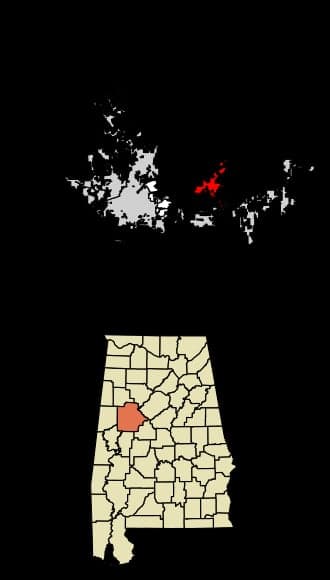
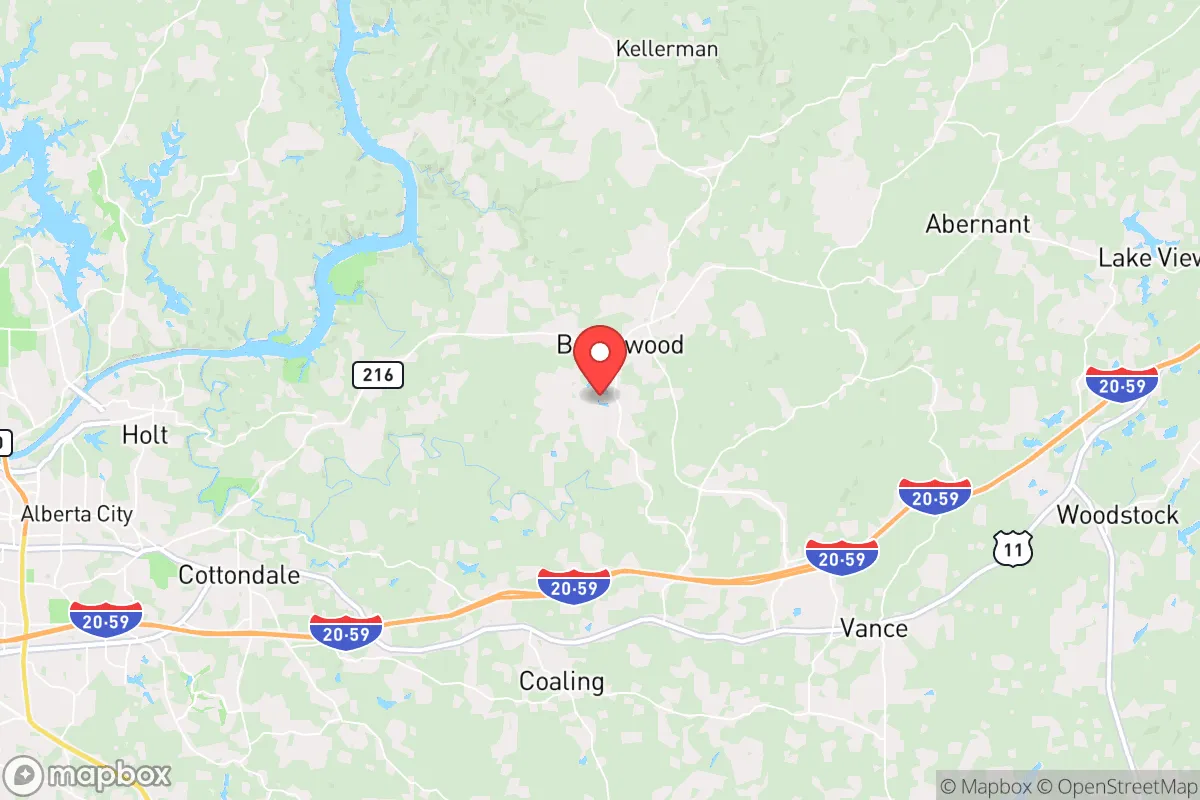
Photo: Wikipedia
Political ClimatePolitical Climate in Brookwood, AL
District shown is the primary district for this city’s centroid. Cities may span multiple districts.
Local Political AnalysisPolitical Analysis of Brookwood, AL
Brookwood, Alabama, is a bit of a political outlier in the Deep South. While the surrounding state of Alabama is reliably Republican at the statewide level—with a Cook PVI that leans heavily red, though an exact figure isn't publicly available—Brookwood itself carries a Cook PVI of D+13, meaning it votes about 13 points more Democratic than the national average. That's a stark contrast to the vast majority of towns in west-central Alabama. If you've lived here a while, you've seen this shift accelerate over the past decade, driven largely by the growth of the University of Alabama in nearby Tuscaloosa and an influx of younger, more diverse families moving into the area for jobs in education, healthcare, and the growing logistics sector along I-20/59.
How it compares
To understand Brookwood's politics, you have to look at its neighbors. Drive 15 minutes west into Tuscaloosa, and you'll find a city that's also Democratic-leaning, but more polarized between the university crowd and the older industrial base. Head east toward Birmingham, and you hit places like Bessemer and McCalla, which are more mixed but still lean blue in parts. But go just 10 miles north to places like Northport or Coker, or south to Moundville, and the political landscape flips hard to the right—those areas are solidly Republican, often voting 60-70% for GOP candidates. Brookwood sits right on that dividing line. It's a small, unincorporated community that has historically been rural and conservative, but the last two presidential cycles saw a noticeable uptick in Democratic votes, especially in the precincts closest to the Tuscaloosa city limits. The D+13 rating reflects that it's not just a blue dot—it's a genuine Democratic stronghold in a sea of red, which is rare for a town of its size in Alabama.
What this means for residents
For conservative residents, living in a D+13 area means you're in the minority locally, but you're still very much in the majority statewide. You'll find plenty of like-minded neighbors in the surrounding rural areas, and your vote carries weight in state and national elections because Alabama's overall lean is so red. For liberal residents, Brookwood offers a more comfortable local environment than most Alabama towns—you're less likely to feel isolated, and local civic groups and school events tend to be more politically mixed. That said, the practical impact is modest: Brookwood is unincorporated, so it doesn't have its own city council or mayor. County-level politics in Tuscaloosa County are still dominated by Republicans, though the county commission has become more competitive in recent years. What you'll notice most is in the local schools and community events—there's less overt political signaling than in deep-red towns, and more of a live-and-let-live vibe.
Culturally, Brookwood's D+13 lean translates into a few distinct policy realities. The area is more likely to support local funding for public schools and infrastructure projects, and you'll see more yard signs for Democratic candidates during election season than in neighboring communities. But it's not a progressive enclave—gun rights are widely supported, and the local economy still relies heavily on logging, mining, and manufacturing, which tend to lean conservative. The real distinction is that Brookwood feels less polarized than the national narrative suggests. People here tend to judge neighbors by their character, not their bumper stickers. If you're moving from a deep-blue city, you'll find the politics more moderate than you might expect; if you're coming from a deep-red town, you'll find the community welcoming and not as "woke" as the PVI might imply. It's a genuinely mixed bag, and that's what makes it a surprisingly comfortable place for just about anyone.

State Political ClimatePolitical Climate in Alabama
State Political AnalysisPolitical Environment in the State
Alabama is a deeply conservative state, with Republicans holding every statewide elected office and supermajorities in both legislative chambers. The state has not voted for a Democratic presidential candidate since 1976, and Donald Trump carried it by over 25 points in both 2020 and 2024. Over the past two decades, the shift has been a steady march rightward, driven by the realignment of white working-class voters and the near-total collapse of the old "Yellow Dog" Democratic tradition in rural areas. While the state remains overwhelmingly Republican, the political landscape is not monolithic — the urban crescent from Huntsville down through Birmingham to Montgomery provides the only real Democratic footholds, and even those are shrinking in relative influence.
Urban vs. rural divide
The political map of Alabama is a study in contrasts. The state's few reliably blue areas are concentrated in the urban cores of Jefferson County (Birmingham), Montgomery County, and parts of Madison County (Huntsville). Birmingham's city limits and inner-ring suburbs like Homewood and Mountain Brook lean Democratic, though the latter is more moderate than progressive. Huntsville, a fast-growing tech and aerospace hub, is more politically mixed — its high-education workforce produces a libertarian-leaning Republicanism that sometimes breaks for moderate Democrats in local races. The Black Belt, a crescent of majority-Black counties stretching from the Mississippi border to the Georgia line, votes overwhelmingly Democratic, but turnout there is often suppressed by restrictive voting laws and lower population density. Everywhere else — the Wiregrass, the Tennessee Valley outside Huntsville, the Gulf Coast, and the sprawling exurbs of Birmingham — is deep red. Auburn and Opelika in Lee County are reliably Republican, while Mobile and Baldwin County (Fairhope, Daphne) are among the most conservative metro areas in the country. The rural-to-urban split is stark: in 2024, Trump won 80%+ of the vote in counties like Blount, DeKalb, and Cullman, while losing Jefferson County by 15 points.
Policy environment
Alabama's policy environment is a textbook example of a low-tax, low-regulation, culturally conservative state. There is no state income tax on Social Security benefits, and the state's top marginal income tax rate is 5%, one of the lowest in the Southeast. Property taxes are among the lowest in the nation, with an effective rate around 0.4% of home value. The state has a right-to-work law, no state minimum wage above the federal floor, and a regulatory climate that actively courts heavy industry and manufacturing. Education policy is a flashpoint: the state has a robust school choice program, including the Alabama Accountability Act (tax-credit scholarships) and the new CHOOSE Act (Education Savings Accounts for low- and middle-income families). Public schools are chronically underfunded, ranking near the bottom nationally in per-pupil spending and outcomes. Healthcare is a major concern — Alabama has not expanded Medicaid under the Affordable Care Act, leaving roughly 300,000 residents in the coverage gap. The state has some of the strictest abortion laws in the country, with a near-total ban in effect since the Dobbs decision. Election laws are restrictive: voter ID is required, absentee voting requires a notarized application or two witnesses, and there is no early voting period (though in-person absentee voting is available for a limited window).
Recent policy direction
The last five years have seen Alabama accelerate its conservative agenda across multiple fronts. In 2022, the legislature passed the Alabama School Choice and Opportunity Act, creating Education Savings Accounts for families below 300% of the federal poverty line. In 2023, the state enacted a near-total abortion ban with no exceptions for rape or incest, only for the life of the mother. On gun rights, Alabama is a constitutional carry state (permitless carry for handguns, passed in 2022), and it has a "stand your ground" law with no duty to retreat. The legislature also passed the Alabama Critical Race Theory Act in 2022, restricting how race and gender can be taught in K-12 classrooms. On property rights, the state has strong eminent domain protections and a homestead exemption that shields up to $15,000 of assessed home value from property tax. Privacy and surveillance are less protected — the state has no comprehensive data privacy law, and law enforcement can access cell-site location data without a warrant in some circumstances. Voting access has tightened: in 2021, the legislature passed a law banning curbside voting and restricting absentee ballot drop boxes. The overall direction is toward more school choice, more gun rights, less abortion access, and more cultural regulation in education.
Civil unrest & political movements
Alabama has a long history of civil rights activism, and that legacy continues in muted form today. The most visible political movements are on the right: the Alabama Republican Party has been pulled further right by grassroots groups like the Alabama Citizens for Life and the Alabama Policy Institute, which push for school choice and tax cuts. On the left, the Alabama Poor People's Campaign and the Alabama Arise coalition organize around Medicaid expansion and criminal justice reform. Immigration politics are less heated than in border states, but there have been flashpoints: in 2011, the state passed HB 56, one of the strictest anti-immigration laws in the country, which led to boycotts and legal challenges. That law has been largely gutted by courts, but the political sentiment remains. Election integrity controversies flared after 2020, with some Republican county officials questioning the security of mail-in voting, though no major fraud was ever proven. The most visible protest movements in recent years have been around abortion rights — after the Dobbs decision, protests erupted in Birmingham and Montgomery, but they were small and quickly faded. A new resident would notice the ubiquity of pro-life messaging on billboards and church signs, and the near-total absence of visible left-wing organizing outside of college towns like Tuscaloosa and Auburn.
Projection
Over the next 5-10 years, Alabama's political trajectory is likely to remain solidly conservative, but with some interesting wrinkles. The biggest demographic shift is the growth of Huntsville, which is attracting a younger, more educated, and slightly more moderate population from out of state. This could make Madison County a swing county in state-level races within a decade, though it will remain Republican for now. The Black Belt is losing population, which further dilutes Democratic voting power. In-migration from California and the Northeast is happening, but it's mostly to the Gulf Coast and Huntsville, and those newcomers tend to be conservative-leaning or libertarian. The biggest wildcard is the state's education system — if school choice continues to expand and public schools continue to struggle, it could accelerate a two-tier system that deepens the urban-rural divide. On social issues, expect more legislation targeting LGBTQ+ rights (bathroom bills, sports bans) and further restrictions on abortion access, including potential efforts to limit travel for out-of-state procedures. The state's tax structure is unlikely to change dramatically, though there is growing pressure to eliminate the state income tax entirely, which would make Alabama even more attractive to retirees and remote workers.
For a new resident, the bottom line is this: Alabama is a state where conservative values are baked into the law and culture, and that is unlikely to change in your lifetime. If you are a conservative, you will find a welcoming environment with low taxes, strong gun rights, and a government that actively supports traditional family structures. If you are a liberal, you will find a small but resilient community in Birmingham, Huntsville, and Montgomery, but you will be swimming against a powerful current. The practical takeaway is that your vote will have little impact on statewide elections, but local races — especially school board and county commission — are where the real action is. The state is not changing its political stripes anytime soon, but the growing diversity of Huntsville and the continued decline of the Black Belt mean the map is slowly redrawing itself. Plan accordingly.
* Values derived from national, state, county, city and local statistics and may differ in a specific area. Last updated: 2026-10-30T15:08:45.000Z
Narrative content on this page is AI-generated and may contain mistakes. Verify any details that matter before acting on them.
ReloMaps may earn a commission from affiliate links at no extra cost to you.

