
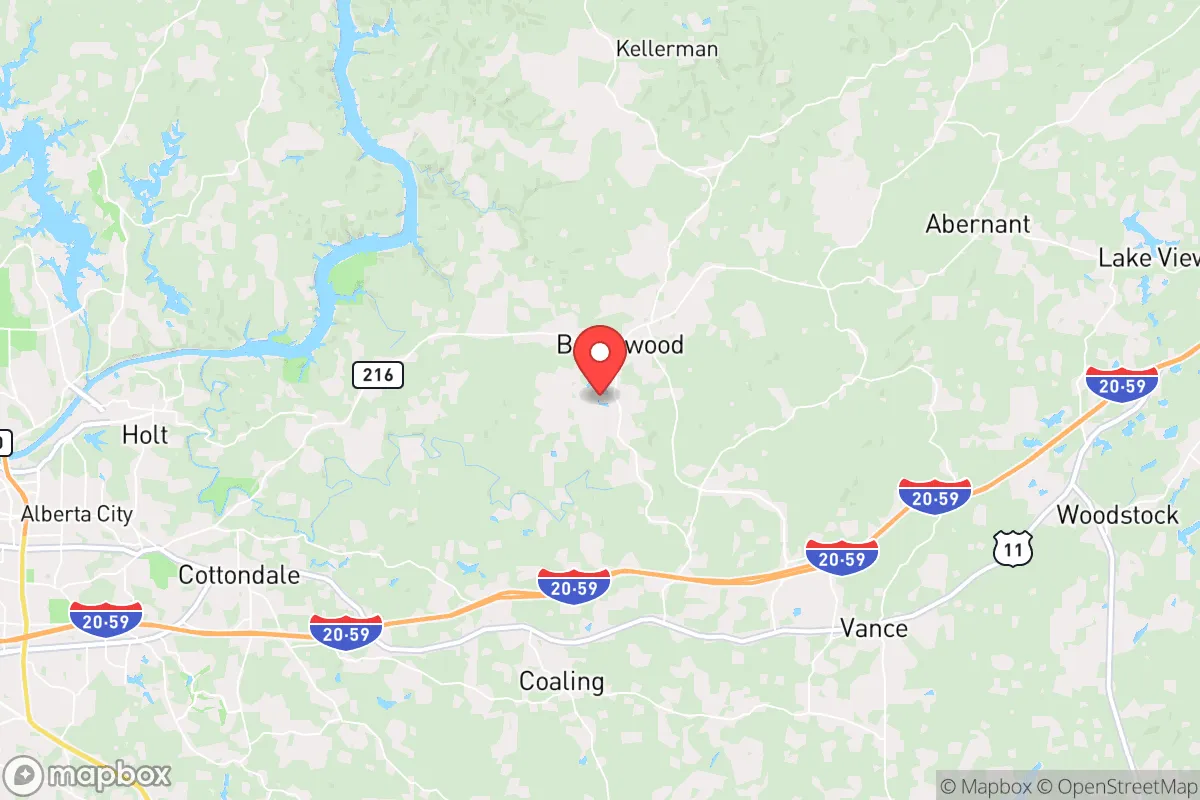
Photo: Wikipedia
Demographics of Brookwood, AL
Affluence Level in Brookwood, AL
An upper-middle-class area. Household wealth, education levels, and homeownership run ahead of national benchmarks.
People of Brookwood, AL
Brookwood, Alabama, is a small, predominantly white community of 2,489 residents where a strong sense of local identity is rooted in its railroad and coal-mining heritage. The city remains notably homogeneous, with 86.2% of the population identifying as white and a very small foreign-born share of just 2.1%. Its character is that of a quiet, working-class bedroom community, offering a slower pace of life within commuting distance of Tuscaloosa, while retaining a distinct, insular cultural identity shaped by generations of families who have lived and worked in the area.
How the city was settled and grew
Brookwood’s human history begins not with colonial settlement but with the arrival of the railroad and the discovery of coal in the late 19th century. The town was officially established in the 1880s as a stop on the Alabama Great Southern Railroad, which connected the region’s rich coalfields to industrial markets. The earliest population was drawn by mining jobs, with the first wave consisting largely of white laborers from rural Alabama and Appalachia. These families settled in what is now known as Old Town Brookwood, the historic core clustered near the railroad tracks and the original company stores. A second, smaller wave of European immigrants—primarily Irish and Italian miners—arrived in the early 1900s, forming a distinct enclave in the Coal Valley neighborhood, where many of their descendants still reside. The town’s growth remained modest through the mid-20th century, tied almost entirely to the boom-and-bust cycles of the coal industry, with the population hovering around 1,000 until the 1970s.
Modern era (post-1965)
After the 1965 Hart-Cellar Act, Brookwood saw virtually no new immigration, a pattern that continues today with a foreign-born population of just 2.1%. The modern era instead brought domestic in-migration, driven by the expansion of the University of Alabama and industrial employers in Tuscaloosa. From the 1980s onward, new subdivisions began to appear, attracting white families seeking affordable housing and a rural feel within a short commute. The Lake View Estates neighborhood, developed in the 1990s, became the primary destination for these newcomers, many of whom work in Tuscaloosa’s manufacturing and healthcare sectors. The city’s Black population, at 2.7%, is small and largely concentrated in the older Mine Hill area, a historically Black settlement dating to the early 1900s when African American miners and their families lived in segregated company housing. The Hispanic population, now 8.9%, began to grow in the 2000s, with families settling in the Riverbend area, drawn by construction and service jobs in the broader Tuscaloosa region. This growth has been the most significant demographic shift in decades, though Brookwood remains overwhelmingly white compared to the state average.
The future
Brookwood’s population is projected to grow slowly, driven primarily by continued suburban spillover from Tuscaloosa County. The Hispanic share is likely to increase gradually, as families already in the area attract relatives and as new service-sector jobs emerge. However, the city’s overall diversity is expected to remain low, with the white population holding steady above 80% and the Black and Asian shares staying in the low single digits. New residential development is concentrating in the North Brookwood corridor along Highway 216, where larger lots and newer homes appeal to families seeking a rural lifestyle with city access. The cultural identity is evolving slowly, with the old mining-town character giving way to a more generic suburban feel, though the annual Brookwood Coal Festival still anchors the community in its heritage. For the next 10 to 20 years, the city will likely remain a predominantly white, family-oriented bedroom community, with modest diversification driven by Hispanic in-movement.
For someone moving in now, Brookwood offers a stable, low-crime environment with a strong sense of place, but little racial or ethnic diversity. The community is becoming slightly more suburban and slightly more Hispanic, but its core identity remains rooted in the white, working-class families who have called it home for generations. It is a place where newcomers are welcomed if they respect the local traditions, and where the pace of change is slow enough to preserve the character that drew people here in the first place.

* Values derived from national, state, county, city and local statistics and may differ in a specific area. Last updated: 2026-10-30T15:08:45.000Z
Narrative content on this page is AI-generated and may contain mistakes. Verify any details that matter before acting on them.
ReloMaps may earn a commission from affiliate links at no extra cost to you.

