Photo: Wikipedia
Political ClimatePolitical Climate in Biltmore Forest, NC
District shown is the primary district for this city’s centroid. Cities may span multiple districts.
Local Political AnalysisPolitical Analysis of Biltmore Forest, NC
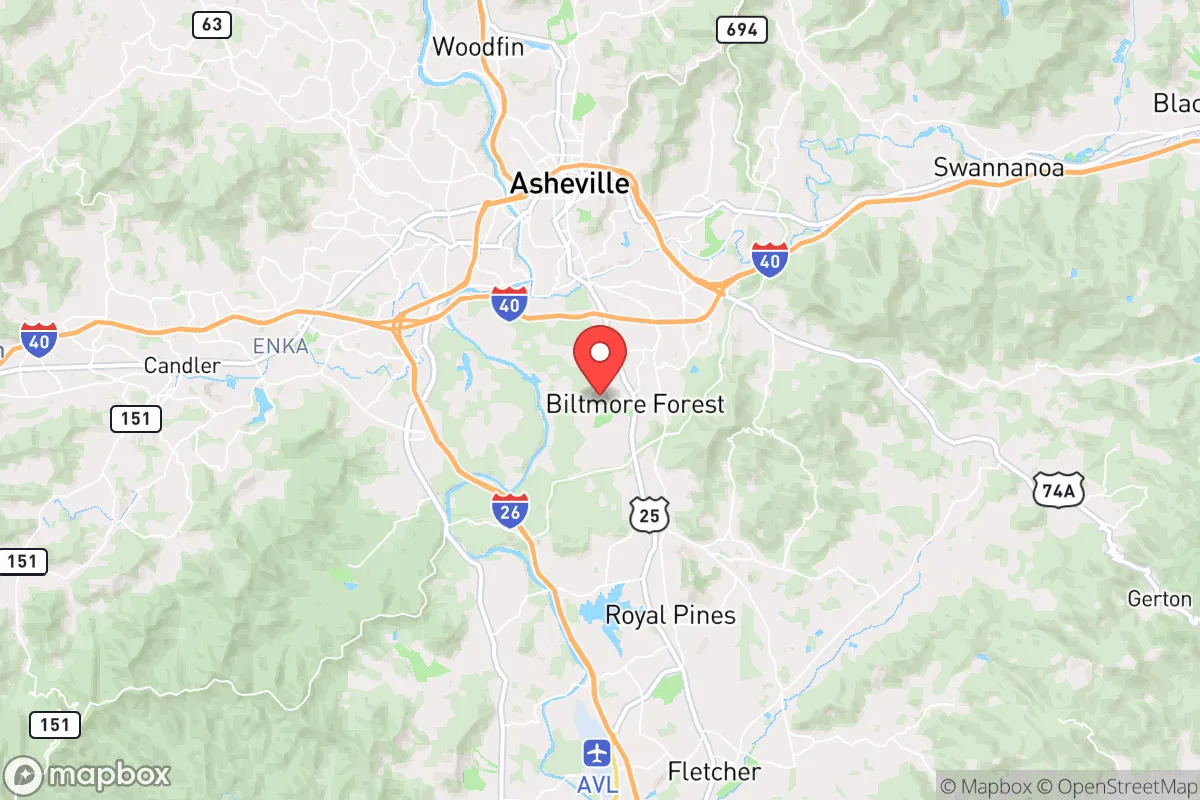
Biltmore Forest leans reliably Republican, with a Cook PVI of R+5 that places it noticeably to the right of North Carolina as a whole, which sits at R+1. This isn't a recent shift—this small, affluent enclave just south of Asheville has long been a conservative stronghold in an otherwise increasingly competitive state. While Buncombe County as a whole has trended blue in recent cycles, driven by Asheville’s progressive growth, Biltmore Forest has held steady, voting Republican by comfortable margins in both state and federal races. The area’s political identity is rooted in its character as a quiet, wealthy residential community where property values, tax policy, and local governance tend to dominate conversation over the culture-war issues that animate politics elsewhere.
How it compares
North Carolina’s R+1 PVI reflects a true swing state, where both parties invest heavily and outcomes are often decided by razor-thin margins—think the 2024 governor’s race or the 2020 presidential contest. Biltmore Forest’s R+5 is a more comfortable Republican lean, but it’s not extreme. For context, nearby conservative strongholds like Hendersonville (Henderson County) lean R+10 or more, while Asheville proper is a deep blue island with a PVI around D+15. So Biltmore Forest sits in a kind of political buffer zone: Republican-leaning, but surrounded by a county that’s purple trending blue. This creates an interesting dynamic—residents here vote red, but they live within a few miles of one of the South’s most liberal cities. That proximity means you’ll see Asheville’s progressive policies (like local minimum wage ordinances or sanctuary city resolutions) debated in local news, even if they don’t directly apply within Biltmore Forest’s town limits.
What this means for residents
For conservative residents, Biltmore Forest offers a comfortable political environment where their views are the norm, not the exception. Local elections tend to be low-key and focused on zoning, road maintenance, and police funding—issues where a small-government philosophy aligns well with the community’s priorities. You won’t see the same kind of partisan gridlock that plagues larger municipalities. For liberal residents, living here means being in the minority, but it’s a polite minority. The town’s small size (under 2,000 people) and high property values mean that most interactions are neighborly, and political disagreements rarely turn hostile. That said, liberal residents may feel out of step on national issues, and they’ll likely drive to Asheville for more like-minded social circles or cultural events. In practice, the political climate here is less about heated debate and more about a shared commitment to maintaining the area’s quiet, exclusive character—something both sides can agree on.
One cultural distinction worth noting: Biltmore Forest’s politics are shaped by its identity as a planned community built around the Biltmore Estate. There’s a strong tradition of civic engagement that prioritizes property rights, low taxes, and minimal government intrusion. You won’t find the same evangelical or populist conservative energy you might in rural parts of the state—this is more of a country-club Republicanism, where fiscal conservatism and environmental stewardship (the town has strict tree-protection ordinances) coexist. Looking ahead, the area’s political trajectory seems stable. While Buncombe County may continue to drift left, Biltmore Forest’s demographics—wealthy, older, and homeowner-heavy—suggest it will remain a Republican-leaning outlier for the foreseeable future. For anyone moving here, the takeaway is simple: if you value quiet, low-tax living and don’t mind being in a conservative bubble near a liberal city, you’ll fit right in.

State Political ClimatePolitical Climate in North Carolina
State Political AnalysisPolitical Environment in the State
North Carolina is the quintessential swing state, with a Cook PVI of R+1 that barely hints at the internal tension pulling it in opposite directions. Over the last 10-20 years, the state has shifted from reliably red to a purple battleground where Republicans hold the legislature and governorship (as of 2026), but Democrats win statewide races for Council of State positions and occasionally the presidency. The dominant coalition is a rural, small-town conservative base in the east and west, squared off against a rapidly growing, diverse, and college-educated urban crescent stretching from Charlotte through the Triad to the Research Triangle. This isn't a state that's "turning blue" or "staying red" — it's a state where both sides have dug in, and the fight over who gets to define its future is the defining political fact of life here.
Urban vs. rural divide
The political map of North Carolina is a story of two worlds. The urban crescent — Charlotte (Mecklenburg County), the Raleigh-Durham-Chapel Hill metro (Wake, Durham, Orange counties), Greensboro-Winston-Salem (Guilford and Forsyth counties), and Asheville (Buncombe County) — votes overwhelmingly Democratic. Mecklenburg and Wake alone account for roughly 20% of the state's vote, and they've been trending bluer with each cycle. Meanwhile, the rural east (counties like Robeson, Columbus, Duplin) and the mountain west outside Asheville (like Watauga, Henderson, and Haywood counties) are deeply Republican, often voting 65-75% for GOP candidates. The suburbs are the real battleground: Union County (southeast of Charlotte) and Johnston County (southeast of Raleigh) are growing fast and remain reliably red, while Cabarrus County and Wake Forest are shifting purple. The 2024 presidential race saw Trump win the state by roughly 1.5 points, but down-ballot races were tighter — a pattern that's held since 2012.
Policy environment
North Carolina's policy environment reflects its divided government. The state has a flat income tax rate of 4.5% (down from 5.25% in 2020, with a scheduled phase-down to 3.99% by 2027), and no state tax on Social Security benefits. Sales tax is 4.75% state-level, with local add-ons that push it to 7-7.5% in most counties. Property taxes are low by national standards, averaging about 0.75% of assessed value, but vary widely — Orange County (Chapel Hill) is around 1.0%, while Brunswick County is closer to 0.5%. Education policy is a flashpoint: the state funds a private school voucher program (the Opportunity Scholarship Program) that has expanded significantly since 2023, now available to all families regardless of income. Charter schools are plentiful, and homeschooling is lightly regulated. Healthcare is a mixed bag: the state expanded Medicaid in 2023 under a bipartisan deal, adding roughly 600,000 low-income adults to coverage, but the state still has one of the highest uninsured rates in the country. Election laws are moderately restrictive: voter ID is required (photo ID, with exceptions), early voting is generous (17 days, including two Saturdays), and same-day registration is available during early voting but not on Election Day. The state's 14 electoral votes and competitive nature mean it's a perennial target for national campaign spending and legal fights over redistricting and voting access.
Recent policy direction
The last five years have seen North Carolina lurch rightward on several fronts, even as the state's demographics shift left. In 2023, the Republican supermajority (since reduced to a simple majority after 2024 elections) passed a 12-week abortion ban, overriding Governor Roy Cooper's veto. The law includes exceptions for rape, incest, and fetal anomalies, but effectively ended most abortion access after the first trimester. On gun policy, the state enacted permitless concealed carry in 2023 (House Bill 189), allowing any adult who can legally possess a firearm to carry a concealed handgun without a permit. The same year, the legislature passed a Parents' Bill of Rights (House Bill 755), requiring schools to notify parents of any changes to a student's health or well-being and restricting instruction on gender identity and sexuality in K-4 classrooms. On property rights, the state has strong protections against eminent domain abuse, and the 2023 regulatory reform bill (Senate Bill 582) limited local governments' ability to impose zoning restrictions that reduce housing supply. On voting, the 2023 omnibus election law (Senate Bill 747) shortened the mail-in ballot return window, banned private funding of election administration, and added new signature verification requirements. The state has no broad privacy law comparable to California or Virginia, but a 2024 law (House Bill 348) created a limited data privacy framework for consumer health data. Medical marijuana remains illegal, though a 2024 bill to legalize it for severe conditions passed the Senate but stalled in the House. Recreational marijuana is not on the near-term horizon.
Civil unrest & political movements
North Carolina has a history of visible political activism on both sides. The 2020 protests in Charlotte and Raleigh over George Floyd's death were large but largely peaceful, though there were isolated incidents of property damage. The state has a robust organized left, anchored by groups like the NC NAACP and the progressive advocacy network Down Home NC, which focuses on rural organizing. On the right, the state is home to a strong grassroots conservative movement, with groups like the NC Values Coalition (social conservative) and Americans for Prosperity-NC (fiscal conservative) wielding significant influence in the legislature. Immigration politics are relatively muted compared to border states, but Charlotte and Durham have "welcoming city" ordinances that limit local cooperation with ICE, while rural counties like Cabarrus and Gaston have passed resolutions declaring themselves "Second Amendment sanctuaries." Election integrity remains a live issue: the 2020 and 2024 elections saw no evidence of widespread fraud, but the state's tight margins keep the issue front and center. The 2024 gubernatorial race between Republican Mark Robinson (who lost) and Democrat Josh Stein was one of the most expensive in state history, with heavy focus on abortion, education, and transgender rights. There is no serious secession or nullification movement, but the state's rural-urban divide means that some western counties have floated the idea of joining a "State of Jefferson" movement, though it's mostly rhetorical.
Projection
Over the next 5-10 years, North Carolina will likely remain a competitive swing state, but the trajectory favors Democrats in presidential races and Republicans in state-level races — a pattern seen in other purple states like Georgia and Arizona. In-migration is a key driver: the state added roughly 400,000 new residents between 2020 and 2024, with most settling in the urban crescent and the coastal counties (Wilmington, New Hanover County). These newcomers tend to be younger, more educated, and more Democratic-leaning than the existing population, but they also include retirees from the Northeast and Midwest who often vote Republican. The rural population is shrinking and aging, which will slowly erode the GOP's base advantage. However, the Republican legislature has shown a willingness to gerrymander congressional and state legislative maps aggressively, and the state's Supreme Court flipped to a 5-2 Republican majority in 2024, which will shape redistricting for the rest of the decade. The most likely scenario: North Carolina becomes a lean-Democratic presidential state by 2032, but Republicans maintain control of the legislature through 2030 via map-drawing and incumbency advantage. A new resident moving in now should expect a state where the political temperature stays high, where local elections matter as much as national ones, and where the policy landscape can shift dramatically depending on which party holds the governorship and the legislature in any given cycle.
For a new resident, the bottom line is that North Carolina offers a genuinely competitive political environment where your vote matters more than in almost any other state. If you're conservative, you'll find a state that has moved right on guns, abortion, education, and taxes over the last five years, with a legislature that is likely to stay Republican for the foreseeable future. If you're liberal, you'll find growing urban centers where Democratic policies dominate locally, and a statewide political scene where your vote can tip the balance in close races. The practical takeaway: pay attention to local elections — school board, county commission, city council — because those are where the real policy battles over growth, zoning, and education are being fought. And be prepared for a state that is changing fast, where the political identity you encounter today may not be the one you find in a decade.
* Values derived from national, state, county, city and local statistics and may differ in a specific area. Last updated: 2026-10-15T16:38:07.000Z
Narrative content on this page is AI-generated and may contain mistakes. Verify any details that matter before acting on them.
ReloMaps may earn a commission from affiliate links at no extra cost to you.

