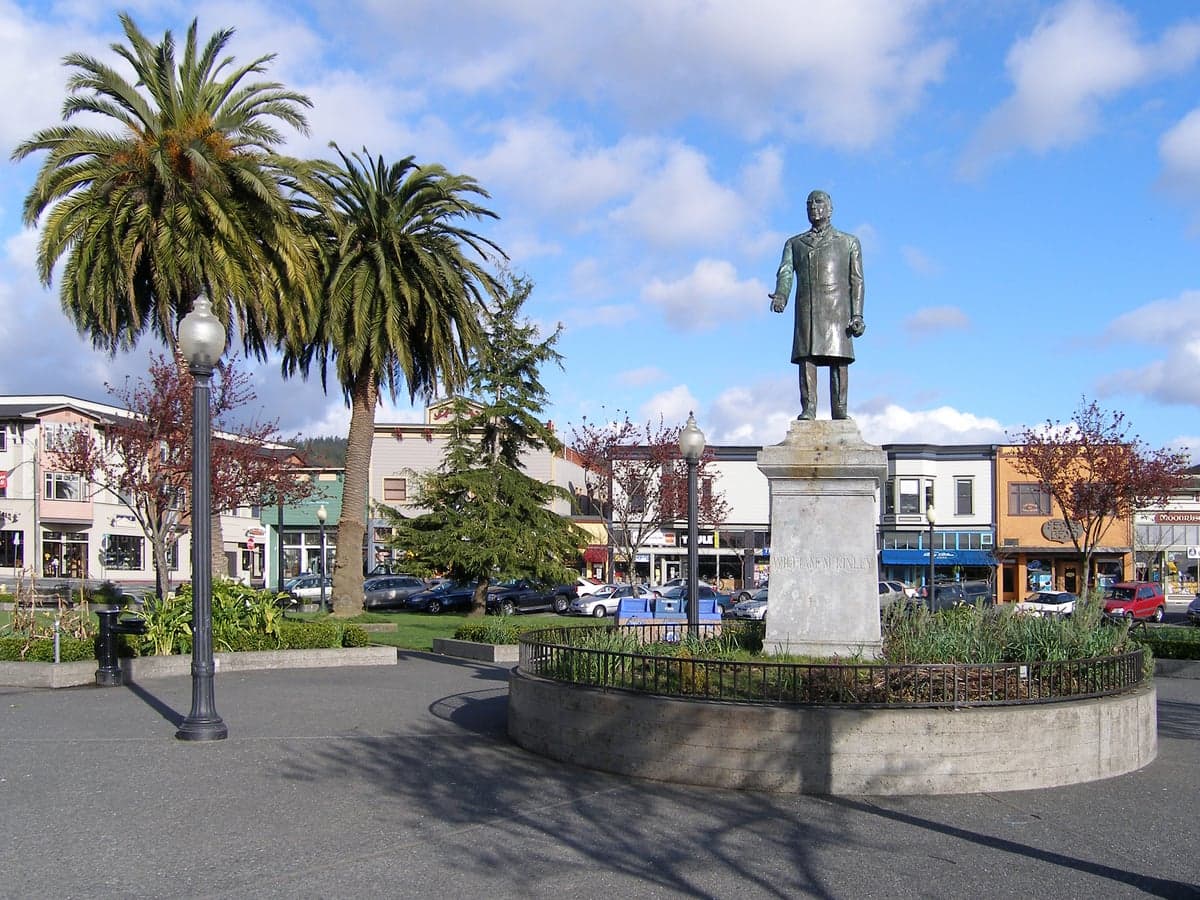
Photo: Wikipedia
Political ClimatePolitical Climate in Arcata, CA
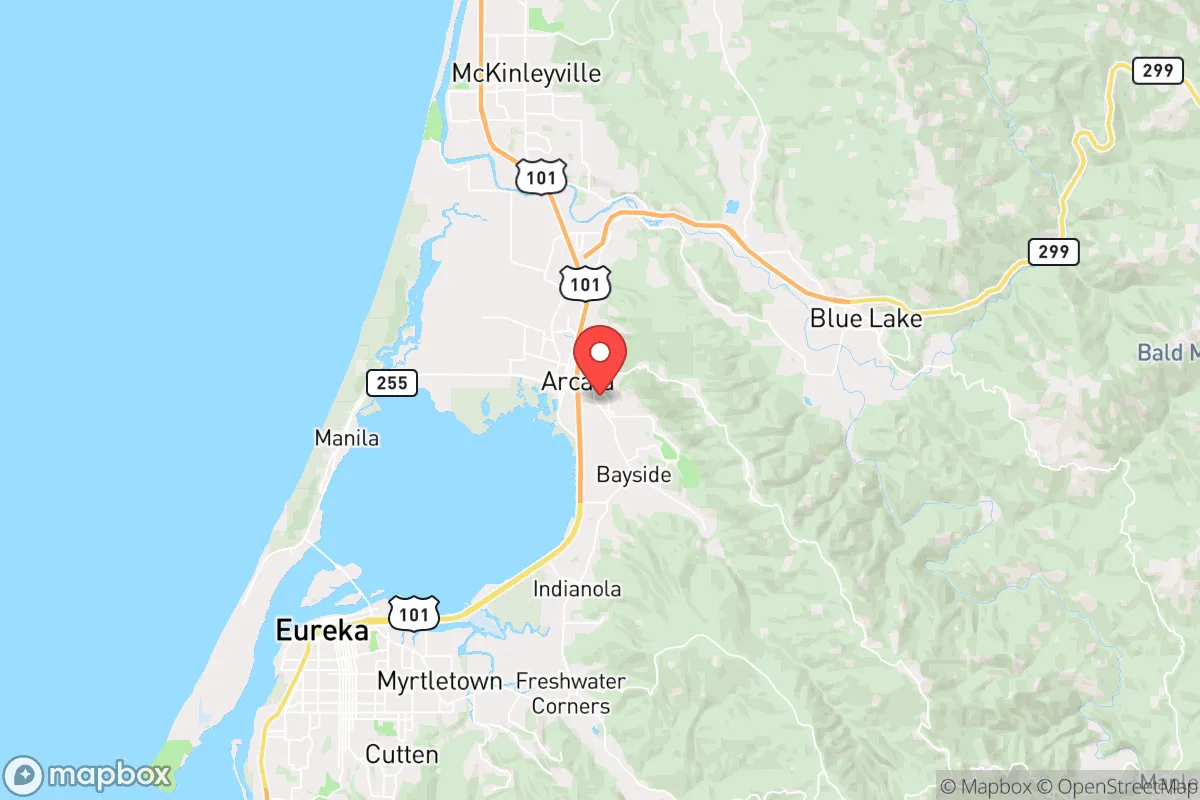
District shown is the primary district for this city’s centroid. Cities may span multiple districts.
Local Political AnalysisPolitical Analysis of Arcata, CA
Arcata is one of the most reliably progressive cities in California, with a Cook Partisan Voting Index of D+24, meaning it votes about 24 points more Democratic than the national average. That’s not just a number—it’s a lived reality. In the 2024 presidential election, Humboldt County as a whole went for the Democratic candidate by about 30 points, and Arcata itself likely pushed that margin even higher. The city has been trending left for decades, driven by the presence of Humboldt State University (now Cal Poly Humboldt) and a strong environmentalist culture. If you’re looking for a swing district, this isn’t it; Arcata is about as blue as blue gets in California.
How it compares
Compared to the rest of California, Arcata is notably more liberal than the state average. California’s overall Cook PVI is D+13, so Arcata’s D+24 puts it in the top tier of Democratic strongholds, alongside places like Berkeley (D+26) and San Francisco (D+23). The real contrast, though, is with nearby towns. Just a 15-minute drive south, Eureka leans more moderate—still Democratic, but with a noticeable conservative minority, especially in its outlying neighborhoods. Head 30 minutes east to Blue Lake or McKinleyville, and you’ll find a mix of working-class voters who often split tickets. Go further inland to Fortuna or Rio Dell, and the political landscape shifts sharply: those areas regularly vote Republican by double digits. So while Arcata is a bubble of intense progressivism, it’s surrounded by a region that’s far more politically diverse than the city itself.
What this means for residents
For liberal residents, Arcata feels like home. You’ll find strong support for climate action, public transit, and local food systems—the city even banned new gas stations in 2021. Political activism is woven into daily life, from protests on the Plaza to city council meetings where housing and homelessness are constant flashpoints. For conservative residents, life here can be isolating. You’re unlikely to find a Republican club or a conservative church with a large congregation in town. That said, the practical impact is manageable: property taxes are relatively low (around 0.7% of assessed value), and the city’s small size means most people interact across political lines at work or school. The biggest friction point is often local policy—like the city’s strict rent control measures or its push for a “sanctuary city” status—which can feel alienating if you don’t share the majority view.
One cultural distinction that sets Arcata apart is its deep-rooted environmentalism. The city was an early adopter of plastic bag bans and single-use foodware restrictions, and it’s home to the Arcata Marsh & Wildlife Sanctuary, a constructed wetland that treats the city’s wastewater. That ethos extends to land use: development is often slow and contentious, with a strong “slow growth” movement that resists new housing projects. This can frustrate both liberals who want more affordable housing and conservatives who see it as overregulation. Looking ahead, the trajectory is likely more of the same—Arcata will probably stay D+24 or even shift left as Cal Poly Humboldt expands its student body. But the surrounding county will remain a patchwork, meaning the real political drama isn’t inside Arcata, but in the tension between it and its more moderate neighbors.

State Political ClimatePolitical Climate in California
State Political AnalysisPolitical Environment in the State
California is a deeply blue state, with Democrats holding every statewide office and supermajorities in both legislative chambers, but its reputation as a monolithic liberal monolith oversimplifies a far more complex reality. The state’s overall partisan lean is roughly D+20 in presidential elections, a margin that has widened from D+10 in the 1990s as the GOP’s base has contracted to a few inland strongholds. Over the last 20 years, the Democratic share of the vote has grown steadily, driven by demographic shifts and suburban flight from the Republican Party, though the 2024 election saw a slight rightward tick in some coastal suburbs that hints at a potential ceiling.
Urban vs. rural divide
The political map of California is a study in extremes. The massive urban centers of Los Angeles, San Francisco, and Oakland are among the most liberal jurisdictions in the country, routinely delivering 80-90% of the vote to Democrats. The Bay Area’s tech-driven economy and the Los Angeles basin’s diverse, union-heavy workforce create a deep blue foundation that alone accounts for roughly half the state’s total vote. In contrast, the Central Valley and inland interior are reliably red: Bakersfield and Fresno anchor a conservative agricultural belt where Republicans often win by double digits. The most dramatic shift has been in Orange County, once a national GOP bastion, which flipped from red to purple to light blue over the past decade — Irvine and Santa Ana now elect Democrats to Congress, while inland Yorba Linda remains a conservative holdout. The rural north, from Redding to the Oregon border, is deeply Republican but too sparsely populated to offset the coastal metros.
Policy environment
California’s policy environment is defined by high taxes, heavy regulation, and expansive state services. The state has a progressive income tax with a top marginal rate of 13.3%, the highest in the nation, and a 7.25% sales tax that local jurisdictions can push above 10%. Property taxes are capped at 1% of assessed value under Proposition 13, a 1978 measure that remains popular across party lines. The regulatory posture is aggressive: California sets its own vehicle emissions standards, mandates renewable energy targets (60% by 2030), and enforces strict labor laws including a $16.50 minimum wage. Education policy is centralized, with the state funding K-12 through a complex formula that favors low-income districts, while healthcare is heavily regulated through a state-run insurance exchange (Covered California) and a recent law allowing undocumented residents to qualify for Medi-Cal. Election laws are among the most accessible in the country: same-day registration, universal vote-by-mail, and automatic voter registration at the DMV are standard.
Recent policy direction
The last five years have seen California accelerate its progressive agenda across nearly every dimension a relocator might weigh. On gun and self-defense law, the state passed a 2023 law banning the carrying of firearms in most public places, including parks and hospitals, and requires a “good cause” permit for concealed carry — effectively eliminating constitutional carry. Parental and education rights have been contentious: a 2024 law prohibits school districts from notifying parents if a child changes their gender identity or pronouns, sparking fierce backlash and a pending lawsuit. Speech is broadly protected under the state constitution, but a 2022 law targeting “hateful” online speech by requiring platforms to disclose moderation policies has raised free-speech concerns. Privacy and surveillance are mixed: the California Consumer Privacy Act (CCPA) gives residents strong data rights, but the state also operates one of the nation’s most extensive automated license plate reader networks. Medical and bodily autonomy are fully protected, with abortion and gender-affirming care enshrined as constitutional rights via a 2022 ballot measure. Property rights are constrained by rent control expansion (AB 1482 caps annual rent increases at 5% plus inflation) and a 2024 law that makes it easier for local governments to impose inclusionary zoning. Taxation remains high, with no signs of reduction, and ballot access is wide open — ranked-choice voting is used in several cities, and the top-two primary system often locks out third parties.
Civil unrest & political movements
California has a long history of visible political activism, and recent years have been no exception. The 2020 George Floyd protests in Los Angeles and Oakland were among the largest and most destructive in the nation, with looting and arson causing billions in damage. The state’s sanctuary law (SB 54) prohibits local law enforcement from cooperating with federal immigration authorities, making California a flashpoint in national immigration politics — San Diego and El Centro see regular border-related protests. The secessionist “Calexit” movement, which pushed for independence after Trump’s 2016 win, has faded but still has a small organized base. On the right, the “Recall Newsom” effort in 2021 gathered 1.7 million signatures and forced a special election, though the governor survived easily. Election integrity controversies are less intense than in swing states, but rural counties like Shasta have seen activists challenge voting machines and demand hand-count audits. A new resident would notice the ubiquity of political signage — from “Defund the Police” to “Parental Rights” — and the frequency of street protests in downtown areas, particularly around the state capitol in Sacramento.
Projection
Over the next 5-10 years, California’s political trajectory points toward a continued but potentially softening Democratic dominance. Demographic trends — an aging white population, declining birth rates among native-born residents, and steady immigration from Asia and Latin America — favor the left, but the state is also losing net domestic migrants to Texas, Arizona, and Nevada, many of whom are moderate or conservative-leaning. The 2024 election showed a slight rightward shift in coastal suburbs like Orange County and San Diego, suggesting that the Democratic ceiling may be near. The GOP’s best hope is to consolidate the Central Valley and inland empire while picking off disaffected moderates in the suburbs, but without a major national realignment, the state will remain solidly blue. A new resident moving in now should expect to find a state where progressive policies continue to expand — likely a single-payer healthcare system and further rent control — but where the practical impact is tempered by a growing affordability crisis that may force moderation on housing and business regulation.
For a conservative-leaning relocator, the bottom line is that California offers a vibrant economy and unmatched natural beauty, but you will be living under a government that is actively hostile to many of your political values. You will pay high taxes, navigate heavy regulation, and encounter a culture that assumes liberal consensus. For a liberal relocator, the state delivers on its promises of progressive governance, but the cost of living and bureaucratic friction can be frustrating. Either way, the key is to choose your community carefully — Bakersfield and Redding feel like a different country from San Francisco and Los Angeles, and the political climate you experience day-to-day will depend almost entirely on which California you pick.
* Values derived from national, state, county, city and local statistics and may differ in a specific area. Last updated: 2026-10-05T17:08:23.000Z
Narrative content on this page is AI-generated and may contain mistakes. Verify any details that matter before acting on them.
ReloMaps may earn a commission from affiliate links at no extra cost to you.

