Photo: Wikipedia
Demographics of Arcata, CA
Affluence Level in Arcata, CA
A middle-class area roughly in line with national averages across income, home values, education, and employment.
People of Arcata, CA
Arcata, California, is a small, politically progressive college town of 18,578 residents, anchored by Humboldt State University (now Cal Poly Humboldt). The city is notably white (70.9%) and highly educated (45.1% hold a bachelor’s degree or higher), with a distinctive countercultural and environmentalist identity that sets it apart from much of conservative-leaning rural Humboldt County. Its population is dense for a town its size, with a young median age driven by the student body, and a foreign-born share of just 3.2% that is well below the national average.
How the city was settled and grew
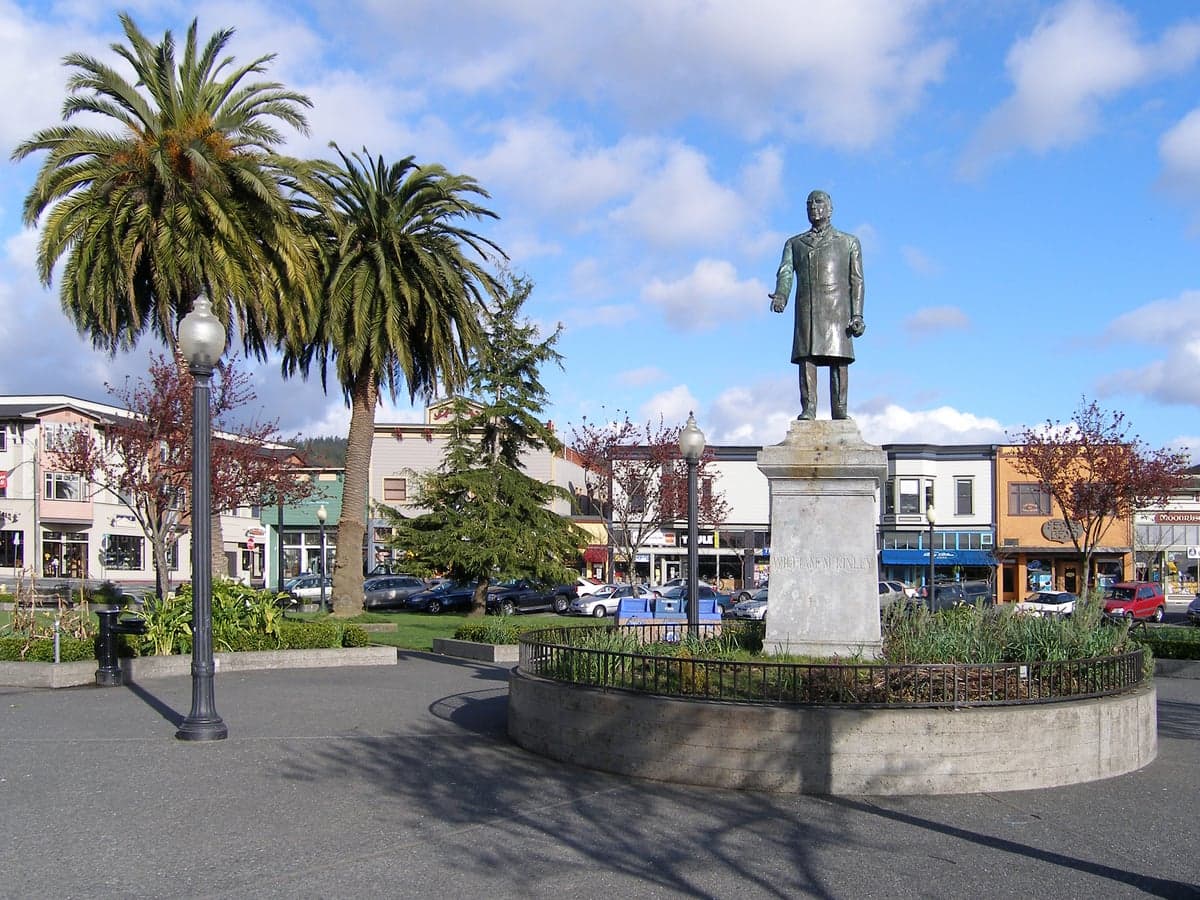
Arcata’s modern population history begins with the 1850 California Gold Rush, which drew white American and European settlers to the region. The city was founded in 1850 as Union (renamed Arcata in 1860) and quickly became a supply hub for inland mining camps. The original settlers were predominantly of Anglo-American and Irish descent, with a smaller number of German and Italian immigrants. These early residents built the historic Plaza area—the central square and surrounding blocks—which remains the city’s commercial and civic heart. The Wiyot people, the original inhabitants of the area, were displaced and decimated by violence and disease during this period; today, the Wiyot Tribe maintains a presence in the region, including the Table Bluff Reservation south of Arcata.
Through the late 19th and early 20th centuries, Arcata’s economy shifted from mining supply to timber and dairy farming. The Sunny Brae neighborhood, developed in the 1920s and 1930s, housed many of the mill workers and their families, largely of Northern European ancestry. The arrival of Humboldt State College in 1913 (later Humboldt State University) began drawing a different kind of resident: faculty, staff, and students from across California and the U.S., who settled in the Campus District and the Fickle Hill area. By 1950, the population was nearly entirely white, with a small number of Native American and Asian residents.
Modern era (post-1965)
The 1965 Hart-Cellar Act opened immigration from Asia and Latin America, but Arcata’s remote location and small economy limited the impact. The city’s foreign-born population remains low at 3.2%, and the Asian share is just 2.2% (primarily East and Southeast Asian communities, including Filipino and Chinese residents). The Hispanic population, at 15.4%, is the largest minority group, concentrated in the Valley West neighborhood—a more affordable, working-class area near the southern edge of town—and in the Bayside area just outside city limits. Many Hispanic families arrived in the 1980s and 1990s for work in the timber industry, agriculture, and service sectors.
The most transformative demographic shift in the modern era has been domestic in-migration: the countercultural back-to-the-land movement of the 1970s brought a wave of young, white, college-educated idealists to Arcata. They settled in the Westwood neighborhood and the rural Jacoby Creek area, establishing the town’s reputation for environmental activism, organic farming, and alternative lifestyles. This group, combined with the university’s continued growth, solidified Arcata’s identity as a liberal enclave within a conservative county. The Black population remains small at 2.1%, with no significant concentration in any single neighborhood.
The future
Arcata’s population is projected to grow slowly, constrained by housing shortages and high costs relative to local wages. The university’s 2022 transition to Cal Poly Humboldt, with a planned expansion to 10,000 students, is the single largest driver of future demographic change. This will likely bring more domestic students from outside the region, many of whom are white and middle-class, reinforcing the city’s educated, progressive character. The Hispanic share is expected to rise modestly as families in the Valley West and Bayside areas grow, but the foreign-born population will likely remain low due to limited economic opportunity and housing stock. The city’s cultural identity—environmentalist, activist, and university-centric—is unlikely to shift dramatically, though tensions between long-term residents and new student arrivals may increase.
For a conservative-leaning individual or family considering a move to Arcata, the bottom line is clear: this is a place where the population is overwhelmingly white, highly educated, and politically progressive, with a small but growing Hispanic minority and very little racial or ethnic diversity beyond that. The city’s future is tied to the university’s expansion, which will reinforce its existing character rather than transform it. If you value a tight-knit, environmentally conscious community with a strong academic presence, Arcata may fit; if you seek a more diverse or politically moderate environment, you may find it a challenging fit.

* Values derived from national, state, county, city and local statistics and may differ in a specific area. Last updated: 2026-10-05T17:08:23.000Z
Narrative content on this page is AI-generated and may contain mistakes. Verify any details that matter before acting on them.
ReloMaps may earn a commission from affiliate links at no extra cost to you.

