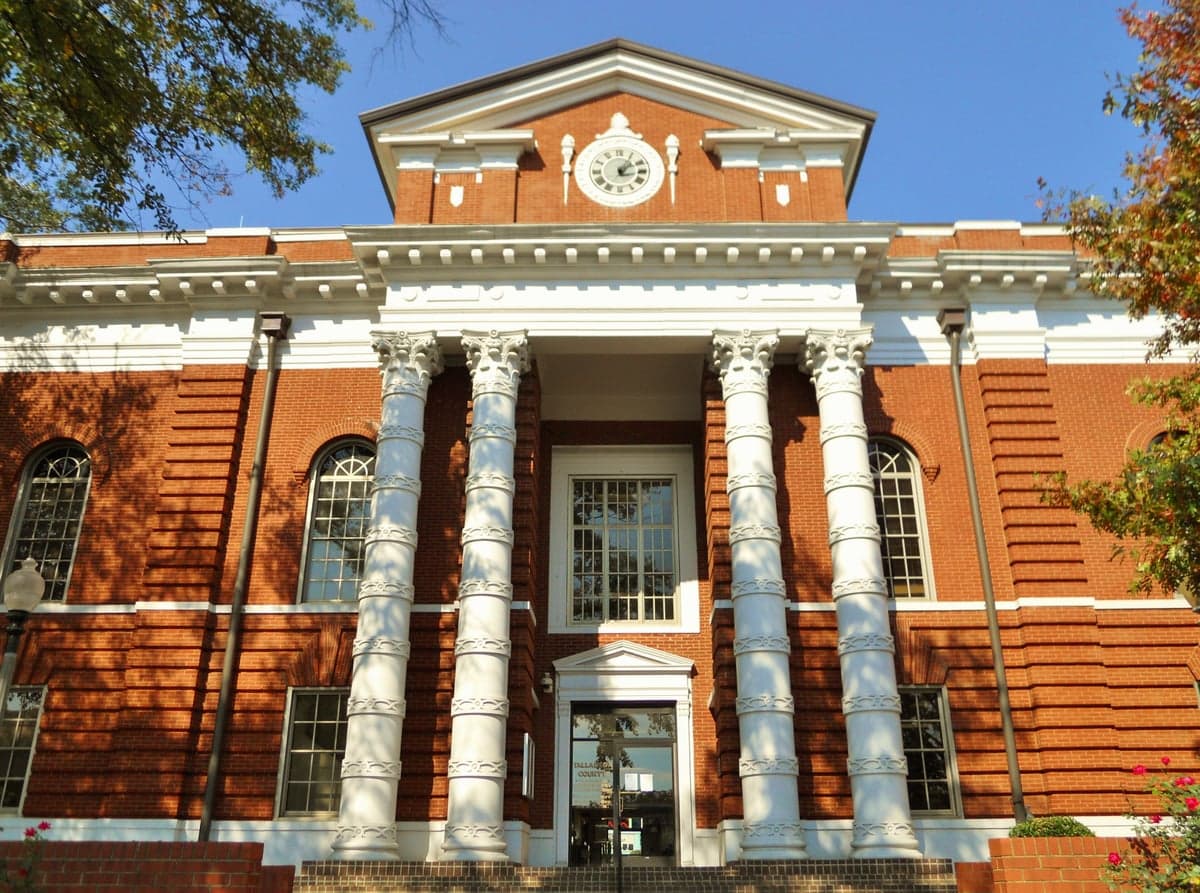
Photo: Wikipedia
Political ClimatePolitical Climate in Talladega County
Showing district-level results — no local-only data available.
Local Political AnalysisPolitical Analysis of Talladega County
Talladega County is a deeply Republican stronghold, carrying a Cook Partisan Voting Index of R+23, which is a full nine points more conservative than the state of Alabama's already solid R+14 rating. This isn't a recent shift, either; the county has been reliably red for decades, with the margins only widening in the last three presidential cycles. While the state as a whole has trended rightward since the 1990s, Talladega County has moved even faster, driven by a combination of rural cultural conservatism and a shrinking, older Democratic base that once held sway in the industrial mill towns.
How it compares
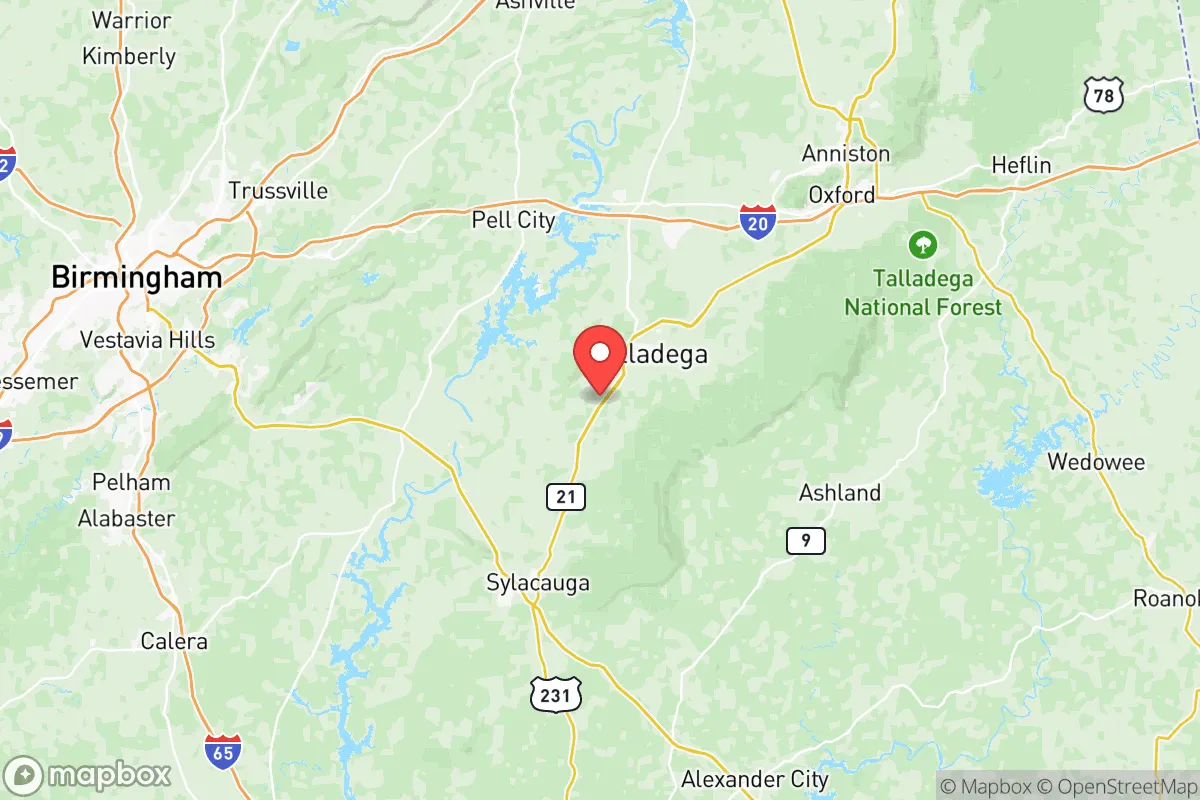
The gap between the county and the state is significant. Alabama's R+14 rating reflects a state that is reliably Republican but still contains competitive pockets, like Jefferson County (Birmingham) and Montgomery County. Talladega County's R+23, however, places it in the top tier of Alabama's most conservative counties, alongside places like Blount and St. Clair. The difference is stark when you look at the local geography. The city of Talladega itself, home to the county seat and the Talladega Superspeedway, is a solid red town, but it has a few precincts near the college (Talladega College, a historically Black institution) that can swing toward Democrats in local races. In contrast, the smaller towns tell a different story. Lincoln and Munford are overwhelmingly Republican, with precincts routinely delivering 80% or more of the vote to GOP candidates. The real outlier is the city of Sylacauga, which is still reliably red but has a slightly more moderate streak, especially in its southern precincts near the Coosa River, where a mix of retirees and younger families sometimes produce closer margins. The rural precincts in the county's northern and eastern reaches—places like Alpine and Waldo—are among the most conservative in the entire state, often voting 85-90% Republican.
What this means for residents
For conservative residents, this political climate means their values are reflected in nearly every level of local government. County commission meetings, school board decisions, and law enforcement priorities align closely with a traditional, small-government worldview. There is little to no political friction in daily life for a Republican voter; the local culture, church life, and civic organizations all reinforce that perspective. For liberal or moderate residents, the reality is more isolating. While they are not actively targeted, they often feel like a silent minority. There are no visible Democratic Party offices in the county, and progressive candidates rarely bother to campaign here. A liberal resident in Talladega or Sylacauga might find their views are a non-starter in casual conversation at a local diner or a PTA meeting. The practical effect is that many non-Republican residents either keep their politics private or simply don't participate in local elections, which further entrenches the one-party dominance.
Culturally, this political uniformity reinforces a few distinct policy distinctions. The county is a strong "Second Amendment sanctuary" area, with local sheriffs publicly stating they will not enforce any future state or federal gun restrictions they deem unconstitutional. There is also a notable resistance to any form of public transit or regional planning that might be seen as "big government" overreach. The local economy, heavily tied to automotive manufacturing (Honda has a major plant in Lincoln) and the Talladega Superspeedway, is pro-business and anti-union, which aligns with the county's political DNA. For anyone moving here, the takeaway is simple: if you are a conservative, you will find a welcoming, like-minded community. If you are not, you will need to be comfortable being in the political minority, with all the social and practical implications that carries in a deeply red corner of a deeply red state.

State Political ClimatePolitical Climate in Alabama
State Political AnalysisPolitical Environment in the State
Alabama is a deeply conservative state with a Cook PVI of R+14, meaning it votes about 14 points more Republican than the national average in presidential elections. The dominant coalition is a blend of traditional Southern Democrats-turned-Republicans, evangelical Christians, and rural voters who have shifted hard right over the past two decades. While Democrats once held a lock on state government through the 1990s, the realignment accelerated after 2010, and today Republicans hold supermajorities in both legislative chambers and every statewide office. The trajectory is clear: Alabama has moved from a competitive purple state to a solid red one, with no signs of reversing.
Urban vs. rural divide
The political map breaks down along familiar lines: the state’s few urban centers are blue islands in a sea of red. Jefferson County, home to Birmingham, and Montgomery County (the capital) reliably vote Democratic, driven by large Black populations and younger, more educated voters. Huntsville, in Madison County, is a fascinating exception — it’s a growing tech and aerospace hub that leans Republican but is more moderate than the rest of the state, thanks to a high concentration of defense contractors and engineers. The rural Black Belt, stretching from the Mississippi border to the Georgia line, is heavily Democratic but low-turnout, while the rest of the state — from the Wiregrass in the southeast to the Tennessee Valley in the north — is overwhelmingly Republican. The suburbs of Birmingham, like Hoover and Vestavia Hills, are reliably red, while Auburn and Tuscaloosa (college towns) lean conservative but with a libertarian streak on issues like alcohol and marijuana. The divide isn’t just urban vs. rural; it’s also racial, with white voters breaking about 80-20 Republican and Black voters about 90-10 Democratic.
Policy environment
Alabama’s policy environment is among the most conservative in the nation. The state has no state income tax on wages (though it does tax retirement income and Social Security, a quirk that’s been debated for years). Sales tax is high, averaging around 9-10% in most cities, and property taxes are among the lowest in the country — a boon for homeowners but a strain on local schools. The regulatory posture is light-touch: no state-level minimum wage above the federal $7.25, no universal background checks for gun purchases, and a right-to-work law that keeps unions weak. Education policy is a mixed bag: the state has a robust school choice program (the Alabama Accountability Act provides tax credits for private school tuition), but public schools rank near the bottom nationally in funding and outcomes. Healthcare is a sore spot: Alabama did not expand Medicaid under the ACA, leaving roughly 300,000 low-income adults in a coverage gap. Election laws are restrictive by national standards: voter ID is required, early voting is limited to absentee ballots with an excuse, and same-day registration is not allowed. The state also has a near-total abortion ban (the Human Life Protection Act of 2019) with no exceptions for rape or incest, though enforcement has been tied up in court challenges.
Recent policy direction
The last five years have seen Alabama double down on conservative priorities. In 2022, the legislature passed a constitutional carry law (permitless carry of handguns), making it one of about two dozen states to do so. Parental rights in education were strengthened with the Alabama Parental Rights Act (2022), which requires schools to notify parents of any curriculum changes involving sexuality or gender identity. On speech and privacy, the state passed a law in 2023 banning TikTok on government devices and restricting certain data collection by tech companies. Medical and bodily autonomy is sharply limited: gender-affirming care for minors was banned in 2022 (the Vulnerable Child Compassion and Protection Act), and the state has resisted any expansion of medical marijuana (a limited program was finally signed in 2021 but implementation has been slow). Property rights are strong — Alabama is a “stand your ground” state with no duty to retreat — but the state also has a history of aggressive eminent domain for industrial projects, like the Mazda Toyota Manufacturing plant in Huntsville. Taxation remains a flashpoint: in 2023, the legislature passed a modest income tax cut (reducing the top rate from 5% to 4.99%), but the state still taxes groceries at the full sales tax rate, a regressive policy that disproportionately hurts low-income families. Voting access has tightened: in 2024, the state passed a law banning curbside voting and restricting absentee ballot drop boxes, moves that were challenged in court but largely upheld.
Civil unrest & political movements
Alabama has a long history of civil rights activism, and that legacy continues in quieter forms today. The Selma to Montgomery March is still commemorated annually, and groups like the Alabama Poor People’s Campaign organize around poverty and healthcare. On the right, the Alabama Citizens for Life and Eagle Forum of Alabama are active in pushing anti-abortion and parental rights legislation. Immigration politics are less heated than in border states — Alabama’s foreign-born population is only about 4% — but the state passed a strict anti-immigration law (HB 56) in 2011 that was largely gutted by courts. There’s no sanctuary city movement to speak of; law enforcement generally cooperates with ICE. Secession or nullification rhetoric is mostly historical, though some local GOP groups have floated “constitutional carry” as a form of nullification of federal gun laws. Election integrity controversies flared after 2020, with the state GOP pushing for stricter voter ID rules and purging voter rolls, but there’s been no widespread fraud found. The most visible flashpoint for a new resident would be the ongoing debate over Confederate monuments — Montgomery removed its Confederate statue in 2021, while Birmingham’s monument was taken down in 2020, sparking protests from both sides. Overall, political activism is less visible than in swing states; most Alabamians are polite about their differences, though the divide between urban and rural can feel stark.
Projection
Over the next 5-10 years, Alabama will likely stay solidly red, but the nature of that conservatism may shift. In-migration is concentrated in Huntsville, which is growing fast thanks to defense and tech jobs — this could pull the state slightly toward a more moderate, business-friendly Republicanism, similar to what’s happened in Nashville or Charlotte. The Black Belt will continue to lose population, reducing the Democratic base, while the suburbs of Birmingham and Mobile are aging and becoming more conservative. The biggest wildcard is the state’s education and healthcare outcomes: if the coverage gap persists and schools continue to underperform, younger families may leave for states with better services, even if those states are more expensive. On the policy front, expect further tax cuts (especially on retirement income), continued resistance to Medicaid expansion, and possibly a push for school vouchers. The abortion ban will remain in legal limbo, but the legislature may add exceptions if public opinion shifts. For a new resident, the bottom line is this: Alabama will remain a low-tax, low-regulation, culturally conservative state where your personal freedoms (gun rights, property rights, speech) are broad, but your access to public services (healthcare, education, transit) is limited. If you’re moving here, you’re betting on a state that values liberty over equity, and that’s unlikely to change anytime soon.
For a relocator, the practical takeaway is straightforward: Alabama offers a low cost of living, strong property rights, and a government that stays out of your business on most issues — but you’ll need to be self-reliant when it comes to healthcare, education, and infrastructure. The political climate is stable and predictable, which is a plus for many conservatives, but liberals should expect to be in the minority and may find the policy environment frustrating. If you’re looking for a place where your vote counts in a national sense, this isn’t it — Alabama is safely red. But if you want a state where your local school board and county commission have more impact on your daily life than Washington, you’ll find plenty of company here.
* Values derived from national, state, county, city and local statistics and may differ in a specific area. Last updated: 2026-06-28T19:12:03.000Z
Narrative content on this page is AI-generated and may contain mistakes. Verify any details that matter before acting on them.
ReloMaps may earn a commission from affiliate links at no extra cost to you.

