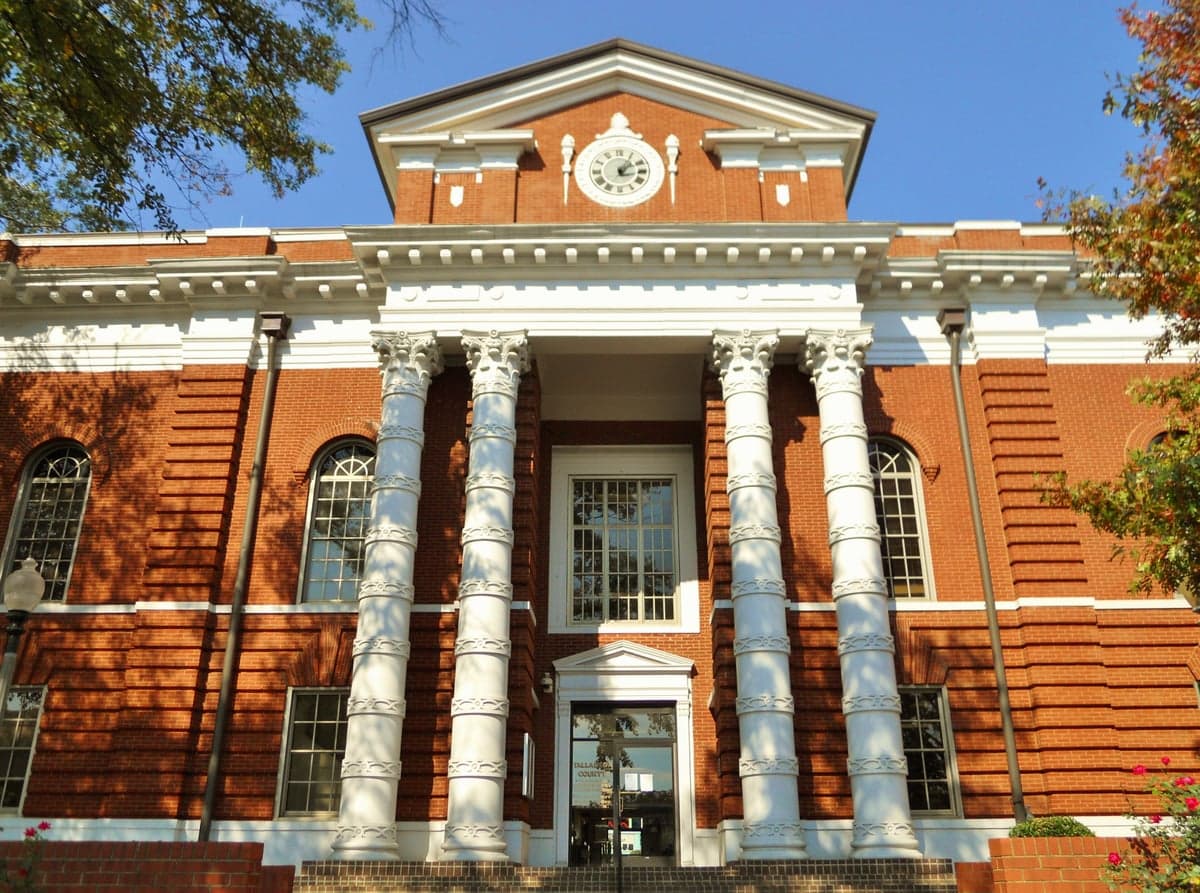
Photo: Wikipedia
Demographics of Talladega County
Affluence Level in Talladega County
A below-average socioeconomic profile. Incomes, home values, and educational attainment trail the U.S., with higher poverty and unemployment.
People of Talladega County
Today, Talladega County’s 81,170 residents form a community shaped by deep Southern roots, a significant Black population, and a small but growing Hispanic presence. The county is predominantly rural and small-town, with a population density of about 55 people per square mile, and its identity is marked by a strong manufacturing and automotive heritage, anchored by the Talladega Superspeedway and the Honda Manufacturing of Alabama plant in Lincoln. The population is notably less diverse than the national average, with a foreign-born share of just 1.2% and a college attainment rate of 16.8%, reflecting a working-class character that appeals to families and individuals seeking affordable, slower-paced living.
Settlement & growth (pre-1960)
Before American settlement, the area now known as Talladega County was the heartland of the Creek Confederacy, particularly the Abihka and Talladega tribes. The name "Talladega" itself is derived from the Creek words "talwa" (town) and "diga" (border), meaning "border town." The Creek people lived in established villages along the Coosa River and its tributaries, farming corn, beans, and squash, until the Creek War of 1813–1814 and the subsequent forced removal via the Trail of Tears in the 1830s emptied the land for white settlement.
The first major wave of American settlers arrived in the 1820s and 1830s, primarily Scots-Irish and English yeoman farmers from Virginia, North Carolina, and Georgia. They were drawn by the promise of fertile cotton land in the Coosa Valley. These early settlers established the county seat of Talladega (chartered 1835) and the nearby communities of Sylacauga and Childersburg. By the 1840s, the county was a thriving cotton plantation economy, with enslaved Black people making up a substantial portion of the population. The 1860 census recorded over 12,000 enslaved individuals in Talladega County, a number that would shape the county’s demographics for generations.
After the Civil War and Emancipation, many freed Black families remained in the county as sharecroppers and tenant farmers, concentrating in rural settlements and the southern parts of towns like Talladega and Sylacauga. The founding of Talladega College in 1867 by the American Missionary Association provided a crucial educational anchor for the Black community, attracting Black educators and professionals. The post-Reconstruction era saw the establishment of a rigid Jim Crow system, but the Black population remained a large and resilient presence, forming the backbone of the county’s agricultural and later industrial labor force.
The late 19th and early 20th centuries brought a second wave of economic transformation. The discovery of high-quality marble in the Sylacauga area led to the rise of the Sylacauga Marble industry, attracting skilled Italian stonecutters and quarrymen in the 1890s and early 1900s. These Italian immigrants settled primarily in Sylacauga and the nearby community of Bon Air, leaving a lasting cultural and architectural mark. Meanwhile, the expansion of the railroad and the timber industry drew a smaller number of German and Irish laborers to towns like Lincoln and Munford. By 1920, the county’s population had grown to over 40,000, with a roughly 60-40 white-to-Black ratio.
The Great Depression and the mechanization of cotton farming in the 1930s and 1940s triggered a significant out-migration of both Black and white residents to industrial cities in the North and Midwest. This "Great Migration" reduced the county’s population from a peak of 47,000 in 1940 to around 41,000 by 1960. The post-World War II era saw the slow decline of agriculture and the rise of light manufacturing, with textile mills and garment factories opening in Talladega and Sylacauga, providing jobs that kept some families from leaving.
Modern era (post-1965)
The 1965 Hart-Cellar Act had a minimal direct impact on Talladega County, as the region did not attract significant international immigration. The foreign-born population remains extremely low at 1.2%, and the county’s demographic story since 1965 is primarily one of domestic migration and internal shifts. The most transformative event was the 1965 opening of the Talladega Superspeedway, which brought seasonal tourism and a modest influx of service-industry workers, but did not fundamentally alter the county’s population structure.
The real demographic pivot came in the 1990s and 2000s with the arrival of major automotive manufacturing. The 1999 opening of the Honda Manufacturing of Alabama plant in Lincoln (just east of Talladega County) and the subsequent expansion of supplier industries created thousands of well-paying jobs. This drew a wave of domestic migrants from the Rust Belt—particularly Ohio, Michigan, and Indiana—who relocated for stable employment. These new residents, predominantly white and middle-class, settled in Lincoln and the northern part of the county, contributing to a slight whitening of the population in those areas.
Simultaneously, the county’s Black population, which had been declining due to out-migration for decades, stabilized. The Black share of the population today stands at 31.6%, concentrated in Talladega (where it is a majority), Sylacauga, and the rural communities of Alpine and Fayetteville. The Hispanic population, while still small at 2.3%, has grown steadily since 2000, driven by construction and agricultural labor. These Hispanic residents are primarily of Mexican origin and are dispersed across the county, with small clusters in Childersburg and Sylacauga. The East/Southeast Asian population (0.4%) is almost entirely tied to the Honda plant and its suppliers, with a small number of Japanese and Korean engineers and managers living in Lincoln and Talladega. The Indian-subcontinent population is effectively zero.
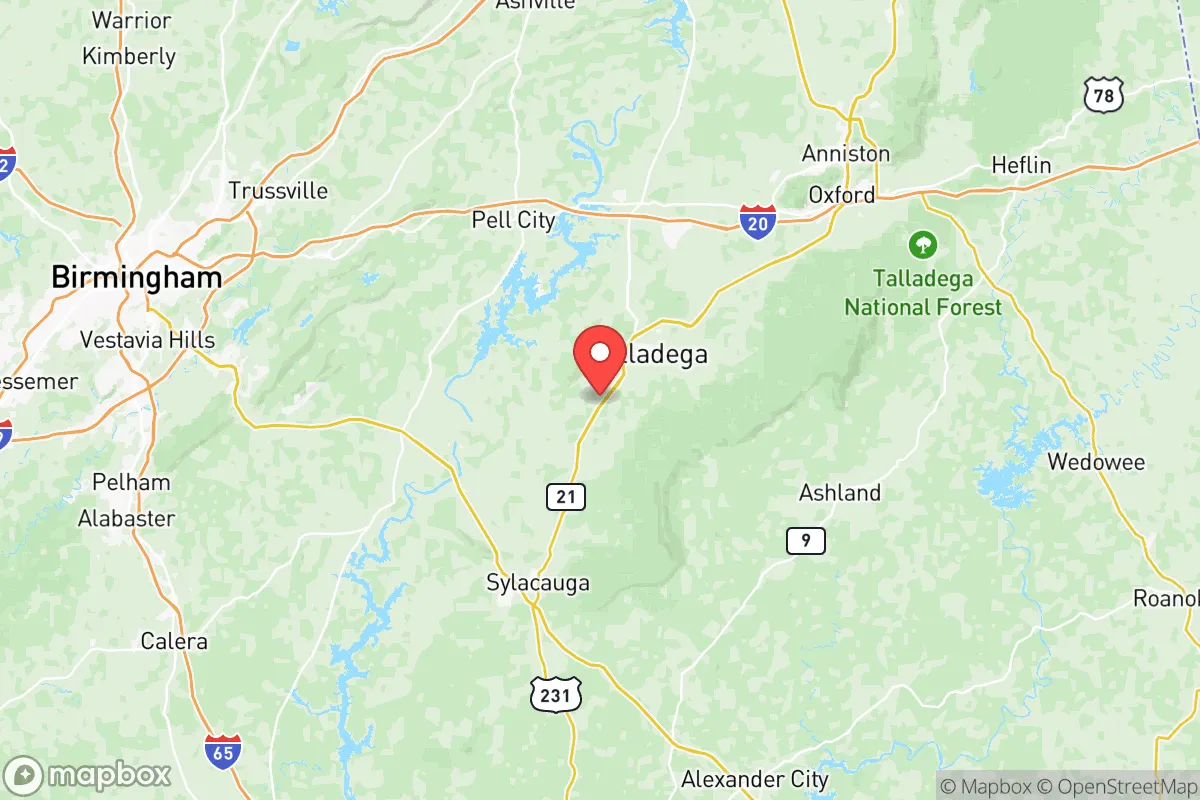
Suburbanization has been limited. The county lacks a major urban core, and growth has been concentrated in the Lincoln area (due to Honda) and the southern edge of Sylacauga, which serves as a bedroom community for workers commuting to Birmingham (about 45 miles west). The county’s population has remained remarkably stable, hovering between 80,000 and 82,000 since 2010, as natural increase has been offset by continued out-migration of young adults seeking college and career opportunities elsewhere.
The future
Talladega County’s population is projected to remain flat or decline slightly over the next 10–20 years, as the county’s low birth rate and aging population (median age 41) are not offset by significant in-migration. The county is becoming slightly more diverse, but very slowly. The Hispanic share is expected to rise to 4–5% by 2040, driven by continued demand for labor in construction, poultry processing, and landscaping. The Black population share is likely to remain stable at around 30–32%, as the county’s Black community is aging and younger Black residents continue to leave for larger cities.
The white population, currently 62.2%, is projected to decline in absolute numbers, as the county’s white residents are older and have lower fertility rates than the Hispanic population. The East/Southeast Asian population will remain a tiny, specialized enclave tied to the automotive industry. The county’s cultural identity will likely remain rooted in its Southern, working-class character, with a growing but still small Hispanic influence in food and festivals. The biggest demographic wildcard is the potential for new industrial development along the I-20 corridor, which could attract a new wave of domestic migrants, but no major projects are currently announced.
For someone moving in now, Talladega County offers a stable, affordable, and deeply traditional community. The population is not growing, but it is not shrinking rapidly either. The county’s future is one of slow, incremental change, where the automotive industry and the Superspeedway will continue to provide economic anchors, and where the racial and ethnic makeup will become slightly more diverse without undergoing a dramatic transformation. It remains a place where family roots run deep, and where newcomers are welcomed if they respect the established rhythms of small-town Southern life.

* Values derived from national, state, county, city and local statistics and may differ in a specific area. Last updated: 2026-06-28T19:12:03.000Z
Narrative content on this page is AI-generated and may contain mistakes. Verify any details that matter before acting on them.
ReloMaps may earn a commission from affiliate links at no extra cost to you.

