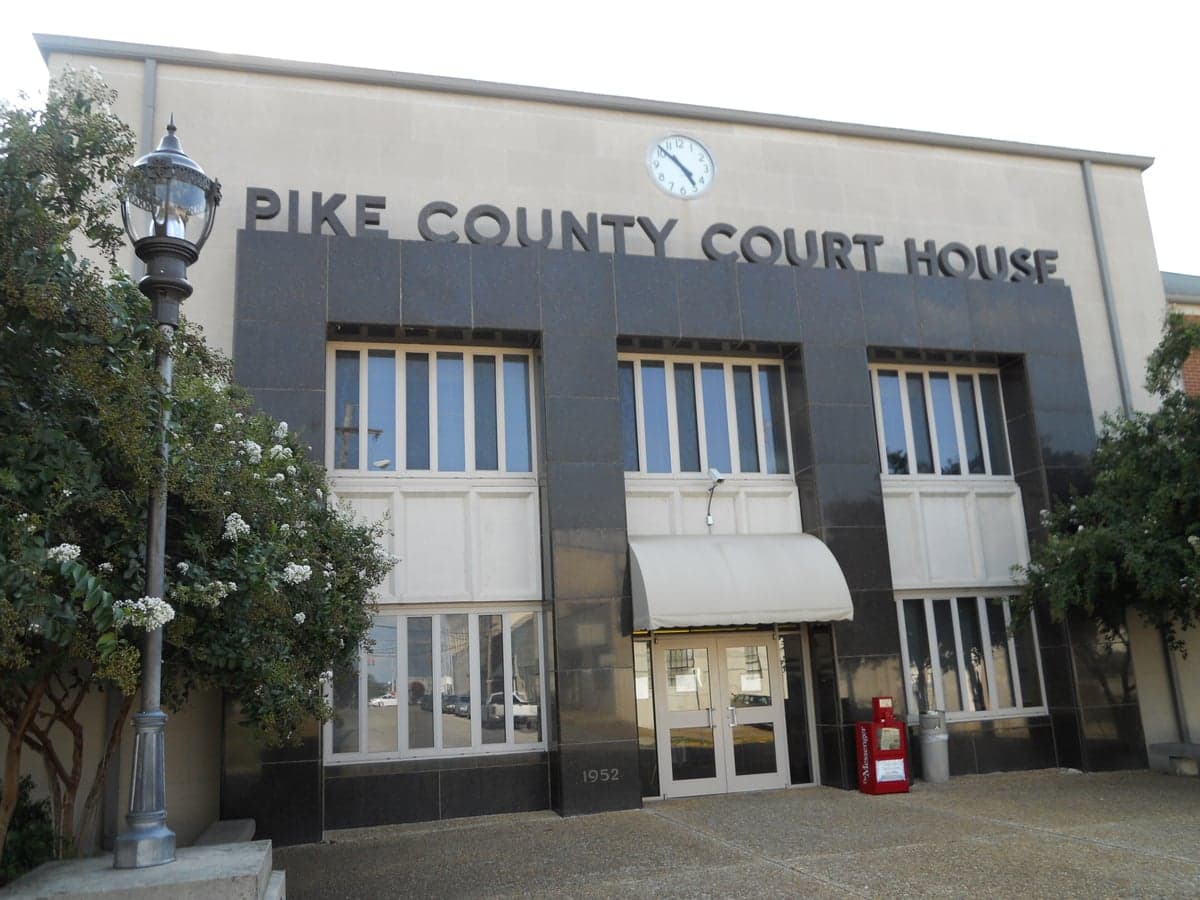
Photo: Wikipedia
Political ClimatePolitical Climate in Pike County
Showing district-level results — no local-only data available.
Local Political AnalysisPolitical Analysis of Pike County
Pike County, Alabama, is a classic Deep Blue outlier in a deeply Red state, with a Cook Partisan Voting Index of D+5 that reflects the enduring Democratic lean of the county seat, Troy, and its surrounding areas. This has been the case for generations—Troy’s large African American population and the presence of Troy University have historically kept the county Democratic in local and federal races, even as the rest of Alabama has shifted sharply Republican since the 1990s. But don’t let that D+5 sticker fool you: the county is a patchwork of near-even splits and deep-red pockets, and the trajectory is subtle rightward drift, especially in the smaller towns and rural precincts.
How it compares to the rest of Alabama
Alabama as a whole is one of the most reliably Republican states in the nation, with a Cook PVI of R+15 in 2024—so Pike County’s D+5 is a stark, almost political inversion. Think of it as a 20-point spread between county and state leans. Compare Troy’s Democratic machine (where precincts like Troy Ward 1 and Ward 4 routinely deliver 70-80% Democratic margins) to the rural precincts in the county’s eastern and southern ends—places like Banks and Goshen, which vote closer to 60-70% Republican. The swing precincts are the suburban-rural fringe around Troy, like the Pike Road area (no relation to the city of Pike Road in Montgomery County) and the US 231 corridor toward the state line. Those precincts can flip between 51-49 either way depending on the cycle. In a typical statewide race, Pike County as a whole votes about 5-8 points more Democratic than the state average—so while the rest of Alabama is crushing for the GOP, Pike County is a blue foothold.
What this means for residents
For a liberal resident, living in Pike County means being in the political minority at the state level but having genuine local representation that aligns with your views. You can reliably elect Democratic county commissioners (the commission is majority-Democratic as of 2025) and a Democratic sheriff—that’s not something you get in most of Alabama. But state policies—like the near-total abortion ban, permitless carry of firearms, and a strict anti-immigration law—still govern your daily life, and there’s no shielding from them. For a conservative resident, the local reality is more frustrating: you can win your precinct in Banks or near the county line, but you’re overshadowed in countywide elections by the Troy base. That said, the rightward drift is real—younger white voters in the university area are increasingly voting Republican, and the 2024 election saw a narrower Democratic margin in the county than in 2020. If you’re a conservative, you can expect the county to become more winnable over the next decade, but you’re still fighting uphill.
Cultural and policy distinctions worth knowing
The biggest cultural-policy split is over education and local spending. Troy City Schools and the Pike County school system are both majority-minority and heavily reliant on state funding, which is a perennial point of tension in a conservative state legislature that tends to favor suburban and rural white districts. Locally, though, the school board and city council in Troy have long supported progressive initiatives like universal pre-K and teacher pay supplements—policies that would be politically toxic in many other Alabama counties. Another distinction is alcohol sales: Troy is a “wet” city (the county went wet in 2018), but some rural precincts remain dry, meaning you can still find pockets where you can’t buy a beer on Sunday. That’s a classic Alabama micro-clash, and in Pike County it tracks closely with the redder precincts. If you’re moving here, understand that the political climate is a two-tier system: your local government feels one way, your state government feels another, and the cultural war is fought at the ballot box every two years over school boards, tax referendums, and the sheriff’s office. It’s not a sleepy county politically—it’s one of the most interesting battlegrounds in the state.

State Political ClimatePolitical Climate in Alabama
State Political AnalysisPolitical Environment in the State
Alabama is a deep red state where Republican candidates reliably win by double-digit margins in presidential and statewide elections—Donald Trump took 62% of the vote in 2020 and 64% in 2024, a margin that has actually widened over the past decade. The dominant coalition is a blend of rural white evangelicals, suburban conservatives, and a growing number of aligned independents, while Democrats hold sway almost exclusively in the Black Belt counties running from the Mississippi line to the Georgia border, plus parts of Jefferson County around Birmingham. Over the last 20 years, the state has shifted about 10 points to the right in presidential races, driven by the collapse of Democratic strongholds in rural north Alabama and the consolidation of conservative white voters in metro areas like Huntsville and Mobile.
Urban vs. rural divide
The political map of Alabama is starkly split between its few urban centers and the vast rural countryside. The metro areas of Birmingham (Jefferson County), Montgomery, and Mobile (Mobile County) all vote reliably Democratic in local and national elections—Jefferson County gave Biden 57% in 2020 and Harris 55% in 2024. But the real political weight lies in the rural and exurban counties: Baldwin County (Gulf Shores and Fairhope) votes 75% Republican, while Madison County (Huntsville) has become a fascinating battleground, voting 55-60% Republican but with a growing libertarian-leaning tech workforce that sometimes splits tickets. The Black Belt—counties like Dallas (Selma), Lowndes, and Macon (Tuskegee)—votes 80%+ Democratic, but these areas have lost population for decades, diminishing their electoral footprint. Meanwhile, the Wiregrass region around Dothan and the northeast corner near Fort Payne are among the most reliably Republican areas in the country, often voting 80%+ for GOP candidates.
Policy environment
Alabama has one of the most conservative policy environments in the nation. The state income tax is a flat 5%, with no local income taxes, and the state sales tax averages 9.2% (including local add-ons), one of the highest in the country on groceries. There is no inheritance tax and no estate tax. Property taxes are among the lowest in the U.S., typically around 0.4% of assessed value, which makes homeownership cheap but starves local school funding. The state has a right-to-work law, no minimum wage above the federal $7.25, and very weak unions outside of the auto industry in Tuscaloosa and Huntsville. Public education is decentralized: the state Department of Education has limited authority over local districts, and there is no statewide pre-K program outside of a small pilot. Healthcare policy is notably hands-off: Alabama refused Medicaid expansion under the ACA, leaving over 150,000 low-income adults in a coverage gap. Election law is administered locally by partisan probate judges, with same-day registration unavailable and a voter ID law that requires a photo ID with a signature.
Recent policy direction
Recent Alabama legislation has pushed the state sharply to the right across multiple fronts. In 2022, the Alabama Legislature passed Act 2022-319, which bans abortions at any stage of pregnancy with no exceptions for rape or incest—only to preserve the life of the mother. In 2023, the state enacted Act 2023-431, which restricts public library content and allows local officials to defund libraries that do not remove books deemed sexually explicit, with library staff sometimes facing criminal liability for "obscene" materials. On gun law, Alabama became a permitless carry state under Act 2022-272, allowing anyone 18 or older to carry a concealed firearm without a background check or training—though federal firearm dealer background checks still apply at the point of sale. The state also passed Act 2023-213, which prohibits gender-affirming medical care for minors and authorizes civil lawsuits against healthcare providers who perform such procedures. On education, the 2024 CHOOSE Act created education savings accounts (ESAs) worth up to $7,000 per child for private school tuition and related expenses, funded by a new state tax credit program. Property rights were strengthened by Act 2023-207, which caps annual property tax increases at 3% for owner-occupied homes—a measure that prevents assessments from rising with market values, keeping existing homeowners' taxes low but creating a two-tier system for new buyers. Voting access expanded slightly: in 2024, the state began allowing absentee voting without an excuse for the first time, though in-person early voting remains unavailable.
Civil unrest & political movements
Political protest in Alabama is localized and often focused on racial justice, given the state's deep history. The Peaceful Assembly Act of 2021 made it a felony to block highways during protests, a direct response to the 2020 George Floyd protests in Montgomery and Birmingham that saw interstate closures. Black Lives Matter actions in Birmingham and Mobile have been met with heavy police presence and some arrests, but large-scale sustained unrest is rare. On the right, the Alabama Freedom Caucus, formed in 2023, has pushed aggressively against public health mandates and library content, staging protests at county commission meetings in places like Auburn and Madison. Immigration politics remain hot: in 2023, the state passed HB 114, which makes it a crime for local governments to adopt sanctuary policies and requires law enforcement to verify the immigration status of people arrested. No county has tried to defy this law, though immigrant-rights groups have filed lawsuits. There is a visible anti-abortion movement: large "Choose Life" rallies are held annually at the state capitol, and pro-choice activists have countered with smaller but persistent protests outside the Montgomery Women's Center. Election integrity concerns have simmered since 2020; the Alabama Secretary of State's office has produced no evidence of widespread fraud, but in 2021 the legislature passed SB 1, which prohibits curbside voting and outlaws the mailing of unsolicited absentee ballot applications—measures that election integrity groups say reduce turnout in Black Belt counties.
Projection
Over the next 5-10 years, Alabama's political complexion is likely to harden further, albeit with new friction points. The dominant demographic trend is a slow but steady influx of out-of-state retirees and remote workers to the Gulf Coast (Baldwin County) and the Huntsville metro, many of whom are conservative-leaning but not necessarily aligned with the alt-right factions of the state GOP. This in-migration will likely push the state's Republican primary electorate further right on cultural issues while possibly creating space for a more pragmatic, business-oriented wing around Huntsville's defense and tech sector. The Black Belt will continue to lose population, weakening the Democratic base in rural areas, but the increasing suburbanization of Birmingham (Shelby County now votes 70%+ Republican, up from 65% a decade ago) and growth in Auburn and Opelika will deepen the GOP's structural advantage. The biggest wildcard is legal medical cannabis: Alabama's medical cannabis program, approved in 2021 but still not operational in 2025, has become a litmus test for how the legislature balances Christian conservative opposition with economic and medical demand. Any expansion would signal a slight moderation; continued blockage signals a continued hardline. Expect more education savings accounts, continued restrictions on abortion and trans care, and a stable low-tax, low-service model that appeals to conservatives but frustrates those wanting better roads and schools.
For a new resident, the practical takeaway is this: if you lean conservative, you'll find a state where your values are reflected in law at every level, where taxes are low and gun rights are expansive, and where communal life revolves around church and family. If you lean liberal, you'll find a smaller but resilient community in Birmingham, Montgomery, or the Black Belt, but you'll need to accept that state policy will often run counter to your preferences on healthcare, education, and civil rights. Either way, the politics here are real and visible but not daily oppressive—most people just live their lives, go to work, and don't obsess over the capitol. The biggest adjustment for anyone moving in is the sheer local control: what your town or county does is often more important than what Montgomery does, so pay closer attention to your city council and school board races than to the presidential election. That's where Alabama's real political decisions are made.
* Values derived from national, state, county, city and local statistics and may differ in a specific area. Last updated: 2026-07-03T08:00:46.000Z
Narrative content on this page is AI-generated and may contain mistakes. Verify any details that matter before acting on them.
ReloMaps may earn a commission from affiliate links at no extra cost to you.

