
Photo: Wikipedia
Demographics of Pike County
Affluence Level in Pike County
A below-average socioeconomic profile. Incomes, home values, and educational attainment trail the U.S., with higher poverty and unemployment.
People of Pike County
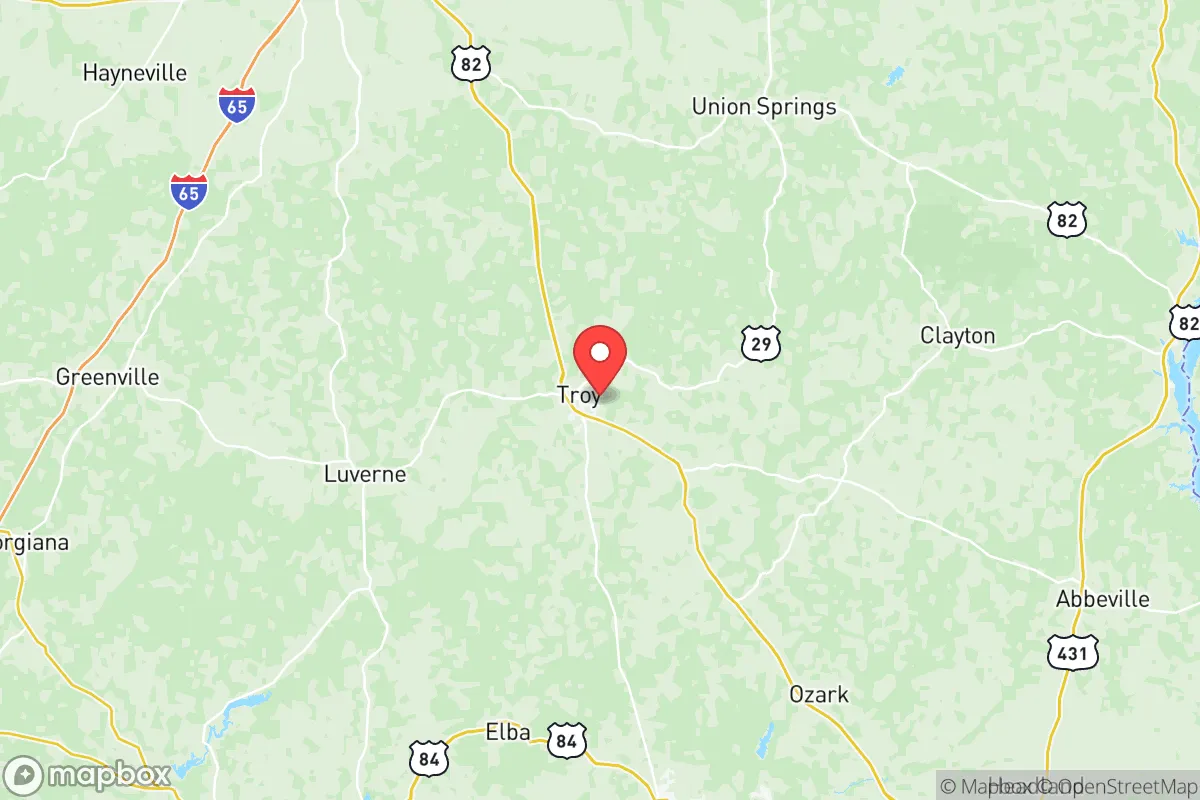
The people of Pike County, Alabama, today number 32,953, a community shaped by a deep-rooted Black and White binary, with 54.7% White and 37.3% Black residents and a small but growing Hispanic (2.7%) and Asian (1.0%, East/Southeast Asian) and Indian (1.0%, subcontinent) presence. The county is overwhelmingly native-born, with only 2.2% foreign-born, and its character is distinctly rural and small-town, anchored by the county seat of Troy and the smaller towns of Brundidge and Goshen. A strong sense of place, conservative social values, and a proudly Southern identity define the area, with a lower-than-average college attainment rate of 27.3% reflecting the region's historical reliance on agriculture and manufacturing rather than white-collar industries.
Settlement & growth (pre-1960)
Before American settlement, the region that is now Pike County was part of the vast domain of the Creek Confederacy, specifically the Alabamu and Coushatta tribes, who controlled the fertile bottomlands along the Conecuh River and its tributaries. The Creek War of 1813-1814 ended with the Treaty of Fort Jackson, which forced the Creeks to cede over 20 million acres, opening the area to white settlement. By the 1820s, the first wave of Scots-Irish and English pioneers from Georgia and the Carolinas pushed into the region, drawn by cheap, fertile land for cotton cultivation.
Pike County was formally established in 1821, and the town of Monticello served as the first county seat, though it was a small, rough-hewn frontier settlement. The real population hub emerged when the county seat was moved to Troy in 1838, a location chosen for its proximity to the Three Notch Road, a major stagecoach route connecting Montgomery to the Gulf Coast. By 1850, the county's population had swelled to over 10,000, almost entirely White and enslaved Black individuals, with the cotton economy driving the forced migration of enslaved African Americans into the area. The towns of Brundidge (founded 1850s) and Goshen (settled 1830s) grew as plantation-era service centers.
The Civil War and emancipation reshaped the population dramatically. By 1870, the county's Black population, now freed, comprised roughly 45% of the total, a share that would remain largely stable for the next century. In the post-Reconstruction era, the economy shifted from large plantations to a mix of tenant farming and sharecropping. The arrival of the Central of Georgia Railroad through Troy in the 1880s spurred a modest boom, bringing small numbers of European immigrants—mostly Irish and German laborers—who worked on the rails and in the emerging timber industry. These immigrants never formed large enclaves, but their descendants are still present in Troy and Banks (unincorporated Pike County).
The 20th century saw the county remain overwhelmingly agricultural until the 1940s, with cotton still king. The Great Migration of Black residents to Northern industrial cities began in earnest after World War I, reducing Pike County's Black population share from a peak of roughly 50% in 1900 to about 37% by 1950. White farmers also left for factory jobs, but at a lower rate. The establishment of Troy University (then Troy State Teachers College) in 1887 became a growing anchor, drawing faculty and students from across the South. By 1960, the county's population had fallen to roughly 25,000, a decline from its 1910 peak, as rural depopulation hit hard.
Modern era (post-1965)
The post-1965 era in Pike County was not shaped by the Hart-Cellar Act's immigration wave—the area is 97.8% native-born—but by domestic migration and civil-rights-era shifts. The 1950s and 1960s desegregation of schools and public facilities in Troy and Brundidge was gradual and often tense, but it did not trigger White flight on the scale seen in larger Southern cities. Instead, the county's racial balance has remained remarkably stable, with the Black share hovering around 37% for decades.
The major demographic change since 1965 has been the slow urbanization and suburbanization of the county around Troy. Troy University's growth, especially after joining the Alabama state university system in 1967, became a powerful draw. The university now enrolls over 14,000 students, many from outside the county, and has brought a modest influx of Asian and Indian faculty and students since the 1990s, accounting for the 1.0% East/Southeast Asian and 1.0% Indian shares. These groups are highly concentrated in the Troy University neighborhood and adjacent parts of the city.
Hispanic population growth, now at 2.7%, began in the 1990s and accelerated after 2000, driven by Mexican and Central American immigrants recruited for poultry processing and agricultural labor. The towns of Brundidge and Goshen have seen the most visible Hispanic presence, with a small but growing number of tiendas and Spanish-language church services. However, this community is still dispersed across the county rather than forming a single dense enclave.
Domestic migration has been modest but noticeable. Retirees from the Rust Belt and Florida have moved to the Troy area, drawn by low property taxes and the slow pace of life, while some Black professionals have returned from Northern cities to family roots, a small but meaningful reverse migration. Suburbanization has played out as the gradual spread of new subdivisions on the edges of Troy, particularly along U.S. Highway 231 toward Montgomery, but the county remains overwhelmingly rural, with a population density of just 38 people per square mile.
The future
Demographic projections suggest Pike County will become modestly more diverse but not dramatically so. The Hispanic share is likely to grow to 5-7% by 2040 as agricultural and processing industries continue to draw immigrant labor and as second-generation families establish deeper roots. The Asian and Indian populations, tied to Troy University, will likely remain small (1-2%) but could grow if the university expands its international programs. The Black population share appears stable, with slow growth possible through the return of native sons and daughters from urban areas.
The aging White population—many rural areas are seeing outmigration of young adults—could reduce the White share from 54.7% to just over 50% by 2040, though this is a gradual, decades-long trend. The county's cultural identity will remain strongly Southern and conservative, with Troy and Brundidge likely seeing the most visible changes in food options, church services, and retail as diversity increases. New residential development is concentrating in Troy's southern and eastern fringes, near the university and the new bypass, and in the rural corridors connecting Troy to Brundidge and Goshen.
For someone moving to Pike County now, the area is becoming a slightly more diverse, modestly more educated place than it was a generation ago, but its core character—rooted in agricultural heritage, conservative politics, and close-knit communities—remains intact. The county is not experiencing rapid change; rather, it is evolving slowly, preserving its traditions while gradually accommodating newcomers.

* Values derived from national, state, county, city and local statistics and may differ in a specific area. Last updated: 2026-07-03T08:00:46.000Z
Narrative content on this page is AI-generated and may contain mistakes. Verify any details that matter before acting on them.
ReloMaps may earn a commission from affiliate links at no extra cost to you.

